Homemade Pickled Ginger (Gari ガリ)
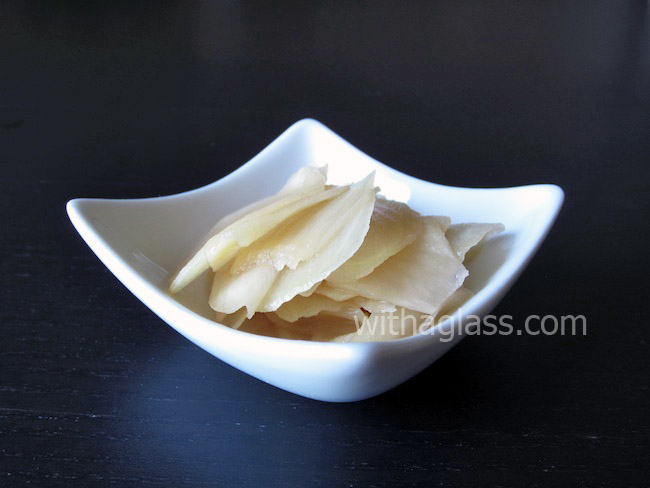
A very funny thing happened to me about a week ago (my Asian friends will laugh their socks off now!). I went to my Asian grocery shop, took some shiso, some lemongrass, sweet thai basil and – at least that is what I thought I took – a package of galangal. When I came back home I looked closely at my galangal and it seemed a bit different… Then I read on the label it was actually young ginger. You might think I was angry, disappointed or both, but not at all! Not only was I happy to have young ginger, but actually instantly knew what to do with it.
As a notorious preserver and pickler I repeat my favourite recipes year by year, but also constantly look for new ideas, so when I saw Pickled Ginger in Street Café. Japan by Emi Kazuko, I made it straight away. The recipe called for fresh ginger and I didn’t understand at first that “fresh” meant young, cream-coloured bulbs without the hard brown skin. Needless to say, my experiment with “standard” ginger was a bit disappointing and when I finally realised after some web research what the problem was, I assumed I will never be able to make this delicious pickle at home because I had never seen young ginger anywhere in my city. Imagine my joy when only after a couple of weeks I realised I was actually able to buy it in my favourite Asian grocery shop!
I have slightly modified the original recipe . Moreover, apart from the short-term, “fridge” pickled ginger (will keep up to three months apparently), I have also prepared a second batch of long-term, Western-style processed pickles (the only difference is that I processed the jars in boiling water). I will be updating this post to report about the changes (if there are any) throughout the year. The pickling liquid in both jars has taken on a slightly pink hue (alas the ginger colour hasn’t almost changed at all, maybe because I used cider vinegar) and the fridge version turned up exactly as I wanted it to be: refreshing, slightly crunchy, but still soft, not too sweet and without the “soapy” aftertaste I sometimes find in store-bought pickled ginger. It wasn’t as soft as the store bought pickled ginger, but it didn’t really bother me. Apparently young ginger is in season until the end of summer, so I hope I can prepare more of these pickles.
UPDATE: After several months the long-term pickled ginger (processed in boiling water and stored in my pantry) tastes even better!
TIP: If you plan long-term pickles, change slightly the amounts and do not add water (see the ingredients’ list below)
Special equipment: a mandolin to slice the ginger
Preparation: 40 – 50 minutes + at least 24 hours before tasting
Ingredients (yields at least 1 x 300 ml/ 10 oz jar; if you prepare long-term pickles, prepare 1 more small jar just in case):
150 g fresh, young ginger, peeled
2 tablespoons sea salt
125 ml (1/2 cup) rice vinegar (I have used 4,5 % cider vinegar, simply because I have several bottles in stock; use 250 ml/1 cup vinegar if you prepare long-term pickles)
60 ml (about 1/4 cup) water (for long-term pickles I have skipped water)
60 ml (about 1/4 cup) white sugar (for long-term pickles I used 90 ml/ about 0,4 cup sugar)
1 teaspoon salt
Cut up the ginger into knobs and then, using a mandolin, cut each knob lengthwise into paper-thin slices (lengthwise direction is very important!).
Rub the ginger with salt and put aside for 3 hours (the ginger will soften).
Rinse the ginger, pat dry and put into a jar.
Bring to boil the vinegar, the sugar, the salt and the water, if you prepare short-term pickles.
Pour the hot (not boiling) mixture over the ginger, close the jar.
Leave it to cool down and then refrigerate for at least 24 hours.
It can stay in the fridge for three months.
If you prepare long-term pickles, place the cooled jars into a big pan, bottom lined with an old kitchen towel folded in two (this will prevent the jars from breaking), cover up with hot – but not boiling- water to the level just below the lid. Bring to boil and keep on a very low heat, in simmering water, for around 15 minutes.
Stick on self-adhesive labels, write the name of the pickle and don’t forget to mark the date.
These will keep for at least a year in your pantry. I will update this post saying if the ginger taste changes.
NOTE (concerns only the long-term pickles): For the readers who live in the USA, the USDA-approved canning method is different. You can find it described here: http://www.uga.edu/nchfp/publications/uga/using_bw_canners.html

My grandma would go crazy over this, thank you 😀
Cheers
Choc Chip Uru
Thank you, Choc Chip Uru.
I’m glad you were able to put that young ginger to good use. Also…I had no idea you had been leaving comments on my blog because I always get back to everyone who leaves a comment. But I have a new commenting system and it seems to have a few issues and last night I found your comments and a lot of other bloggers comments in the spam box yet it didn’t indicate that there was any spam in there! I felt really terrible for everyone who hasn’t heard from me for a while. I don’t know how to fix the problem but I’ll try to sort it out over the weekend xx
Thank you, Charlie. I have noticed some commenting systems don’t like me 😉 I have had this issue on some other blogs too and I sometimes find real comments in my spam folder too, so don’t worry. Thank you for letting me know my comment are not lost!
I always wanted to make Japanese pickled Ginger that look pink, did you mean the colour will change to pink after sometime in the fridge ?
I have no idea what makes the bright pink, but ginger will never turn bright pink on its own. My ginger was supposed to change into very light “powder” pink but it didn’t (only the pickling liquid changed into pink). On the other hand, if you go to a Japanese shop there are two kinds (at least) of pickled ginger: one has a cream colour and the other is bright pink.
Wow, I’ve never thought of making gari at home!
How are you going to use your gari besides as a garnish for sushi?
Hiroyuki, it was so easy that now I will be making this ginger every year! I have just bought some more young ginger and will be making some more jars this weekend.
I like it so much I have it with many different Japanese or Asian dishes such as donburi, fried rice, fried noodles… (and even as a snack with sandwiches). It was fantastic with ebi fry a couple of days ago. It makes everything taste lighter and cleanses the palate, just like with sushi. This is the same way I have my Western-style pickles. I pickle sweet peppers, chili peppers, small cucumbers etc. in vinegar every year and the procedure is the same (I only process the jars in boiling water to make sure they stay closed for a long time without fridge). Every year they tasted better; this year I have finished the last jar which was the best of all!). This is the side of long-term pickling I love… One never knows how it changes, but it usually gets better and better.
I love pickled ginger. I often wondered how the ginger was so soft and without the usual fibres…I know see it’s a young ginger. I will have to look for it at my Asian market. I always eat the ginger that is left on the plate after my hubby is done with his sushi. Love the recipe Sissi!
Thank you so much, Nazneen. I think there are two reasons for its softness (or maybe even three). First it’s of course the young ginger, second it’s the slicing way against the grain and third it’s the salting process before it is pickled (it softens the ginger a bit too). On the other side it’s not as soft as the store bought ginger, but not hard or fibrous either, just a bit crunchy.
I’m also very excited by this. I love pickled ginger, it’s a must with sushi, and is just a nice palate cleanser to meals. It’s so much cheaper to be able to make it yourself. So the colour naturally turns pink as it pickles? What happened when you used old ginger, I might only be able to get that unless I make a trip down to Chinatown.
Thank you so much, Shuhan. When I made it with old ginger, it was a bit fibrous and a bit harder and also the taste was stronger. Otherwise, it was not that bad… I didn’t throw it away, but the young was is definitely better.
In theory my ginger was supposed to turn very light “powder” pink, but as you see it’s still creamy and only the pickling liquid I don’t show here turned pinkish (when I made it with old ginger the liquid turned pinkish too). The bright pink ginger is especially coloured with something (I don’t know what).
I adore pickled ginger and like you, I have thought about making a home-made version many times. And like you, I had no idea you needed to use young ginger. Norma, over at Garden to Wok is experimenting with growing her own ginger from your standard organic grocery variety and I think it’s working out well. I suspect you can do it in a pot too. Norma’s zone is similar to mine, so I am able to take a lot of her suggestions and apply them to my little city garden.
I noticed a string of comments regarding the colour of store bought ginger as pink. I think that’s food colouring; I also noticed that restaurants are now using natural coloured ginger (like your version) instead of pink, which is likely healthier.
Hi Eva. I have just read that sometimes it’s chemical colouring, sometimes beetroot juice, but I suppose the colouring is still the most widespread… I have seen Norma’s ginger experiment. I might try it next year maybe…
I had no idea about the young ginger either… I’m so delighted to have a recipe for pickled ginger – would you believe I just devoured a tray of sushi getting back from the gym and I ran out of ginger – that’s just not right… no one should run out of ginger when eating sushi! ;-). This is so neat to be able to make at home… can’t wait to try. Thanks Sissi!
Hi, Kelly. I hope I will have enough jars in my pantry and never run out of pickled ginger. It’s really easy and quick to prepare.
Sissi …. you’re such a whiz at coming up with things to inspire me!!
When I first started eating sushi I ran across a recipe for pickling your own ginger but I didn’t think I’d ever eat enough to make it worth while. But if I can figure other things to do with it, it might make just sense. 🙂
Got a late start today (my mom just got transferred to a long term care facility today so I had to get her organized and settled, back there tomorrow as well) but I will be making the post you inspired as soon as I can with many thanks.
Thank you for such kind words… Sometimes seeing how some bloggers keep on posting very complicated, time-consuming, fancy recipes, I wonder if mine do not seem very simple and basic. On the other hand I really post what I eat and if I make experiments and discoveries, they are posted because I liked the result and intend to repeat them.
I have pickled the second batch in small jars (you know the size of small capers jars). This way they will not take much space in the fridge while waiting to be finished 😉 I’m looking forward to see your post! Good luck with your mum’s transfer!
My mom’s transfer went well. Thank you for the kind wish.
It’s a smart idea, pickling the gari in the smaller jars. You could put dates, six months apart on the jars, and see how the gari stands up to the longer pickling times. I imagine the young ginger is nice and tender compared to the fibrous older stuff we get in jars.
Like you, I post what I eat and sometimes by the time I get to eat my food it’s cold so I have to reheat it. Oh well, it makes me cut back on the numbers of pictures that I take.
I always put exact dates on the jars and often also mark the modifications (for example less/more sugar etc.). Otherwise I would be lost with my full pantry.
Yes, the cooling side is the worst for the photos… I often heat the plates in the oven so that the meal doesn’t cool down too quickly while I take photos. On the other hand the plate cannot be too hot, otherwise it leaves marks on the table… A food blogger’s life isn’t easy 🙂
I recently ruined a pretty blue plastic tablecloth (luckily it was very inexpensive) when I put a baking sheet on a small trivet on the tablecloth to take a picture, and the baking sheet slipped off the edge of the trivet and melted and then stuck to the tablecloth. 🙂
It’s amazing what we go through to take a nice picture, isn’t it? 🙂
It sounds like something that might happen to me too! You are right. I often spend more time taking a picture than cooking the dish and still am not happy with it enough to post it (many of my dishes are not posted because they are not photogenic and it makes me furious to see how appetising they are in real life and how awful they look on the photo).
I’ve never gone the pickling ginger rout before, bt now I have a reason to. Thx Sissi and have a great weekend!
Thank you, Jed. Have a nice weekend too.
Dear Sissi,
I love pickled ginger as an appetizer and I love eating it at certain japanese restaurants where you can have unlimited refills of their pickled ginger. It has good health benefits too.
Hi, Chopinand. Now that I have made it and it’s so cheap I keep on serving it with almost every meal. I am glad it’s healthy too.
Woo, I can’t believe you made you own pickled ginger – that’s really cool. I don’t know why, but to me it seems so much more exotic than other pickled and preserved items so I’m really impressed!
Did I ever tell you the story about the guy in a restaurant who grabbed a big handful of pickled ginger and ate it thinking it was smoked salmon… I mean seriously… why would a restaurant have a big pot of self-serve smoked salmon sitting in the middle of the table?
Thank you, Charles. It’s really easy. Just like most pickled stuff I prepare. I’m very impatient to see how it will behave after a couple of months in the pantry. Some pickles improve greatly and some don’t change.
I have never heard this story! He wasn’t a big food connoisseur then… or maybe he had forgotten his glasses?
Sissi, this photo is simply amazing! it makes me want to bite into the ginger. beautiful, absolutely beautiful…
Thank you so much, Zsuzsa.
Ah, finally someone found young ginger over yonder. When I posted my candied ginger, so many told me it’s difficult to find (or dearly expensive) young ginger.
Pickled ginger is really popular here, not just with Japanese cuisine but we have it with century eggs that some europeans might gag at. Lovely! One condiment that’s a permanent in my fridge.
Thank you, Ping. You know I would keep on repeating it for many years maybe if it wasn’t for this mistake. They have such an array of different vegetables, herbs and fruits in such a tiny space and stock the young ginger next to galangal, so I would always think it’s galangal.
I also see in my shop pickled ginger produced in other countries (not Japan).
Now it will be permanent in my pantry! I hope to be able to report how a 1 year old (or older) home-pickled ginger tastes.
What a happy mistake! I hadn’t heard of “young ginger” so once again I thank you for sharing your knowledge Sissi. Good luck with your long-term version. Have a great weekend. (Tomorrow is the party for ponytail #2…between getting ready for that and jury duty selection I don’t know if I’m coming or going!)
Thank you so much, Barb. Good luck with the party!
This is so nice, I love gari. The only recipe for gari I’ve got during all these years came from a friend, an german chef de cuisine, and it calls for lots of coarse salt and whole parts of ginger – you have to pickle gari in a salty brine until it turns pink.. Needless to say I did not try it at all. But your method seems to be much more convenient. Thanks a lot.
Thank you, Kiki. The ginger recipe you talk about gives me some ideas! It sounds like fermented ginger (like cucumbers or cabbage). I will try it very soon! I am very curious how it will taste. Thank you for the idea!
I did not know that fresh ginger meant young ginger. Thanks for that information! Now I need to check that out at the Asian market and see if they carry it. I’ve always wanted to try making my own pickled ginger so I thank you for the recipe! So glad you mistakenly bought the wrong thing! 🙂
Thank you, MJ. I hope you can find it.
I’ve never thought about how pickled ginger was made before (I love the stuff)! How neat that you made your own!
Hi, Liz. It was very easy.
You know what I will say… You are more Japanese than I am! Seriously, I never thought of making gari at home. When the post came in, you made me smile. Sorry to be here late again. I’m totally swamped with kids… Miss chatting with you!
Nami, you are so sweet… I have made another batch this weekend (the long-term jars for the pantry). I have made it first out of curiosity but now I’m so happy to have my own pickled ginger and it’s so easy that I think I will carry on 🙂 I feel a bit guilty I think it’s me who is late in answering 🙁 Sorry.
Sissy, I’m just so behind in commenting and noticed that I have not commented to this post. I think the biggest problem is that I post every 4 days, and a lot of bloggers post every-other, and even every day. The ones that skip for a week to post, or even less…wonder how they’re doing with their comments, because it’s hard enough to keep up with doing my own post and maintaining my blog, especially with family situations…makes it a lot harder!
Now that I’m done whining, I just want to let you know that homemade pickled ginger is so much better than the store bought kind, and your recipe is so much better, (which I will use) than mine!
Thanks for the great recipe!
Elisabeth, I post three times a week. When I started to blog I realised most bloggers posted every second day and some even everyday, so I opted for three times a week because I couldn’t imagine more often. Then I noticed some bloggers, after a certain time, start blogging less frequently (twice a week for example) and sometimes when I’m busy I’m thinking of slowing the pace too… (Actually sometimes I blog only twice a week, but for now it’s still rare).
I also have sometimes problems with keeping up with some more frequent bloggers than me.
I am glad you like this recipe. I am very curious to learn about yours (I’m not sure if mine is better!). I put a lot of hope in the long-term ones.
Brilliant! Your mistake has helped me understand what is meant by fresh/ young ginger, and with your description I’ll know what to look out for. I love pickled ginger, but have often been put off by the additives in the bought packets, so I’ll bookmark this and then when I see th eginger I’ll be back 🙂 thank you!
Thank you, Claire. I hope you can make it one day. It’s really easy.