Category Archives: Sauces, Spreads, Chutneys, etc.

Goat Yogurt, Cucumber, Radish and Dill Salad

goatyogurtsaladp

Have you ever bought a food product which tasted good but you had no idea what to do with it? It happens to me regularly, but usually involves exotic, foreign food. Strangely, I have recently had similar experience with goat yogurt. I like goat cheese a lot, so I did like goat yogurt too, but somehow couldn’t place it in any food category (and definitely not in the same as cow milk yogurt), not to mention a dish where I could use it.

The other day I felt like making a Cucumber and Radish Salad but unfortunately – or rather luckily – I ran out of standard yogurt and sour cream I usually add. Substituting it with goat yogurt, I actually discovered a much more interesting version of this refreshing salad. I have also added some chopped dill harvested from my balcony and couldn’t believe my taste buds! I have no words to describe how terrific proved the mixture of refreshing cucumber, subtle dill scent, slight radish spiciness and subtle goat yogurt flavour.

UPDATE: I have just discovered that goat yogurt is amazingly good served with Hungarian Chicken with Paprika (Paprikàs Csirke), instead of the usual sour cream.

Here are some other cucumber salad ideas you might like (I have just realised there is the same bowl in all the photos… I guess I liked it a lot last year!):

Cucumber and Seaweed Salad

Cucumber and Seaweed Salad

Cucumber and Chervil Salad

Cucumber and Chervil Salad

Radish Cucumber and Sour Cream/Yogurt Salad

Radish Cucumber and Sour Cream/Yogurt Salad

TIPS: This salad should be made just before serving, otherwise the vegetables will render liquid and the “sauce” will get watery.

Just like my older yogurt/sour cream version, this salad a perfect side-dish or starter in both Western and Asian meals. I can very well see it served with hot and spicy Indian food.

Dill is one of the herbs which freeze very well and taste much better preserved this way rather than dried. You just have to chop it finely before freezing and make sure it is thoroughly dried.

Preparation: 10 minutes

Ingredients (serves one):

6-7 big red radishes

1/3 long cucumber

3 heaped tablespoons goat yogurt

2 tablespoons chopped fresh dill

(salt)

Cut the cucumber in four pieces lengthwise, and then into thin slices.

Cut the radishes in two pieces lengthwise, then into thin slices.

Combine all the ingredients in a bowl (taste if you need salt; I didn’t need any) and serve.

Miso Vinaigrette

misovinp

I never get bored with dressed green salads. After years of having it regularly, both as a side-dish and a starter, I am always excited at the discovery of a new dressing, especially when warm spring days arrive and salad leaves are bought with higher frequency. This miso vinaigrette is simple, but original in its creamy consistency and quite complex taste it owes to miso. I have written below a short recipe, but to put it simply, it’s a traditional mustard vinaigrette with miso used instead of mustard. Accidentally this salad was a perfect company for the recently posted Chicken with Soy Sauce, Garlic and Molasses.

Miso has been frequently appearing on my table (see below) for several years now, but I have never thought of putting it into a vinaigrette. I have found this excellent and obvious idea in Japanese Farm Food by Nancy Singleton Hachisu, an American married to a Japanese farmer and living in rural area for several decades. The book contains both classic recipes and Nancy Singleton’s own inventions based on local ingredients. It is also full of stories about family, neighbours, local producers and, in general, describes life in the Japanese countryside. The book is a particularly compelling read, a beautiful object, a good source of recipes and I strongly advise it to all the Japanese cuisine fans, even novices because the majority of the recipes are easy and clearly explained.

For those who haven’t tasted miso (味噌), it’s a thick paste made by fermenting soybeans and/or barley or rice and one of the most important ingredients of the Japanese cuisine (Korean and Chinese cuisines use very similar pastes too). Miso is packed with protein, vitamins and minerals and some people claim it even helps to fight the radiation sickness. In Japan miso has three main colour types: white (shiromiso), red (akamiso), black (kuromiso), and there is also mixed miso (awasemiso). The only downside of miso is that is can be very high in sodium, so look for special “low sodium” misos (some high quality misos don’t even have this mention, but are less salty). Whatever the salt content, white miso has always a milder taste, so it’s a good idea to start one’s adventure with light-coloured miso. Apart from the three basic colours, there are myriads of different misos, depending on the brand or producer, the ingredients, the region…

If you have bought a tub of miso and wonder what to do with it, you might like:

aspchickmisop

Asparagus and Chicken Stir-Fried with Miso Sauce

-chmisogarlicpp

Garlic Miso Chicken Breast

misoshrimp3p

Miso Soup with Shrimp and Tofu

redmisomack1pp

Mackerel Simmered in Miso

chickenaubmisop

Chicken and Aubergine in Garlic Miso Sauce

And if you look for other salad dressing ideas, you might be interested in my recent delicious and very unusual discovery:

sesamesaladp

Sesame Paste (Tahini) Dressing

Apparently I am not the only one who eats more salads at the arrival of spring. This week Nami (Just One Cookbook) has posted a gorgeous seaweed salad and a miso (!) dressing, while Gourmantine (Gourmantine’s Blog) has presented no more no less but eight salad dressings. Visit their blogs for more inspiration!

TIPS: The below amounts should only be treated as approximate and adjusted to your taste, the miso kind or brand. (I have slightly modified the original amounts too). I have added some agave syrup to mellow the flavours (not present in the original recipe), but it’s not necessary.

I don’t like my salads drown in sauce, so double the below amounts if you prefer a very moist, rich salad.

Preparation: 10 minutes

Ingredients (serves two – three):

1/3 lettuce head, washed and torn into smaller pieces

(cucumber, tomatoes or any other raw vegetables cut into pieces)

Dressing:

3 heaped teaspoons miso of your choice (I wouldn’t advise the very dark, strong miso)

2 teaspoons oil

4 teaspoons rice vinegar

(1 teaspoon syrup or honey in case you need to adjust the taste; I have used agave syrup)

In a glass combine well the vinaigrette ingredients.

Place the salad leaves and other vegetables in a bowl and pour the miso vinaigrette over them just before serving.

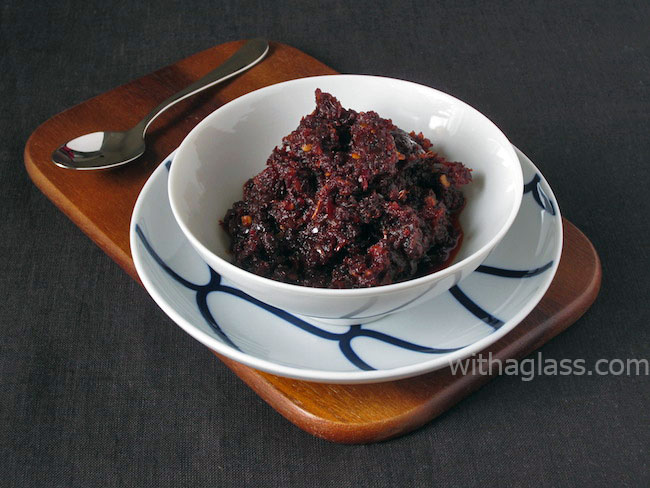
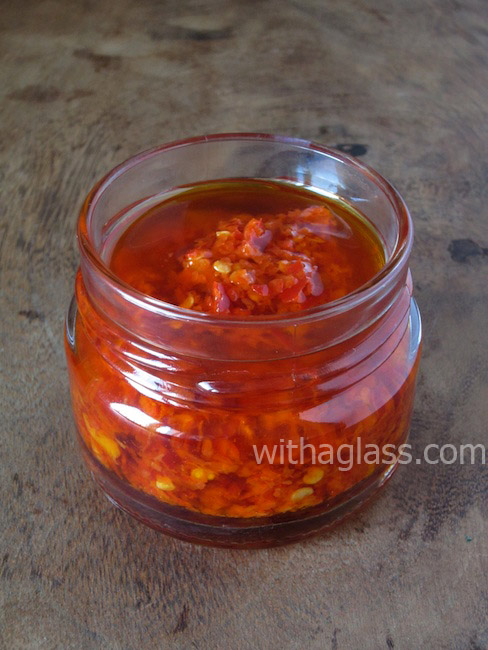
Thai Roasted Chili Paste (Nham Prik Pao)

roastedpastep

For those addicted to fiery flavours, experimenting with a new chili variety or a new hot seasoning is always an exciting adventure. This simple chili paste, completely different from anything I have ever tasted, has proven an extraordinary discovery. Obligatory ingredient of the famous Thai hot and sour shrimp soup (Tom Yum Goong), roasted chili paste (Nham Prik Pao/Nam Prik Pao) is widely available in Asian grocery shops, but it’s so easy and quick to prepare, I strongly discourage you from the shopping trip.

All you need are shallots, garlic, dried chilies, oil and, after about twenty minutes, you obtain a surprisingly complex, aromatic, smoky seasoning that can enrich many – not only Thai – dishes. Even a tiny amount of this paste will transform any boring stir-fried meat, seafood or soup into a fragrant, well-seasoned meal.

I have found this recipe in “Real Thai. The Best of Thailand’s Regional Cooking” by Nancie Mc Dermott, the book I mentioned last week when I presented you the fantastic Pork Curry without coconut milk. Apparently, this paste is traditionally roasted over charcoals, but the author’s dry-frying method can be made in every kitchen. I have followed the author’s instructions, but using a food processor instead of a mortar and slightly changing the ingredients’ amounts.

Obviously, the dish I prepared shortly after I made this paste was the above-mentioned Hot and Sour Shrimp soup (I will write about it soon) and it was just perfect. Then, the following day I simply added this paste to stir-fried shrimp and obtained once more a delicious result. According to the author, the paste will keep at room temperature for at least a month, so I hope to experiment with it in many more meals.

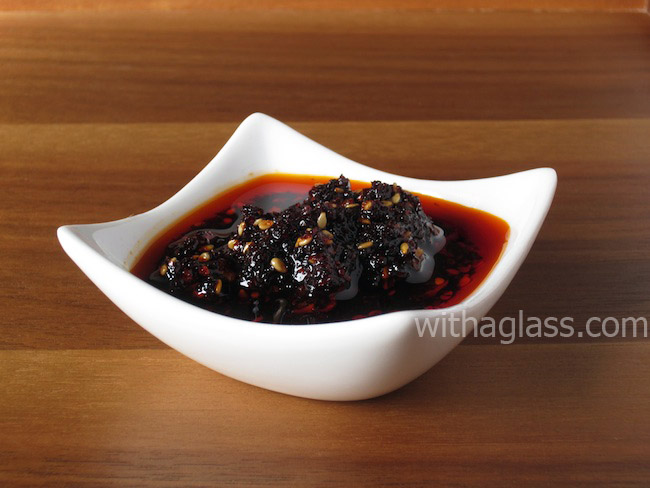
If you like the idea of making your own oily chili seasoning, you might be interested in the moderately hot and completely different Japanese thick sesame and chili oil condiment called Taberu Rayu:

tabrayu3p

TIP: Unless you are a crazy hot food addict, make sure you remove all the chili seeds. As you see above, I didn’t and I think me and my husband are the only people I know who can enjoy food seasoned with this explosive paste.

Preparation: about 20 minutes

Ingredients (yields about 125 – 150 ml/ 1/2 cup or a bit more):

6 big garlic cloves, unpeeled and halved lengthwise

8 small shallots, unpeeled and halved lengthwise

15 small dried chilies 

250 ml / 1/2 cup oil (I have used peanut oil) (+ a small amount for dry-frying, if necessary)

Warm a pan or a wok, pour a tiny amount of oil (or not, if you have a pan which allows the absence of fat). Dry-fry the chilies at low heat, constantly stirring for about 5 minutes until they become darker but make sure they are not burnt.

Remove the chilies.

Dry-fry the garlic and shallots (you can fry them together or separately depending on the size of your pan or wok) until they have charred black spots, but, once more, do not let them burn completely.

Put the garlic and shallots aside and when they are cool enough to be handled, remove the peel.

Remove the seeds from the chilies (or, if you are very bold, leave them) and the stems.

Put the three ingredients in a food processor and mix until a thick, relatively smooth paste is formed (mine was slightly chunky).

Heat the 250 ml oil in a pan and, constantly stirring, fry the paste for about 5 minutes until it darkens.

The oil will be almost totally absorbed by the paste, so you will end up with a rather small batch.

Put the paste into a jar, wait until it cools down, close well the jar and keep at room temperature for at least one month.

Salad with Sesame Paste Dressing

sesamesaladpp

If, every time you open a jar of sesame paste, you have to close your eyes to fully enjoy the inebriating, nutty fragrance and never resist stealing a teaspoonful, then this recipe is for you. I know it looks like a bowl of ordinary lettuce, but it’s much more than that. The leaves are delicately seasoned with the creamiest, richest salad dressing I have ever made. If used in moderation (this is why it is barely visible on the photo), this dressing is so addictive, I found myself preparing it three days in a row. I discovered it accidentally, a couple of days ago, while leafing through Sichuan Cookery by Fuchsia Dunlop, one of the best written cookery books I know. As someone, who prepares either the classical French vinaigrette with mustard (sometimes garlic) or its vaguely Asian version, with soy sauce and sesame seeds, I was thrilled to discover this completely new way to dress the humble lettuce.

This salad has proved for me an ideal choice for the this time of the year, when a bright green, crisp, raw side-dish cheers me up and announces the imminent spring. Its creamy, intense dressing keeps it still in the rich, comforting food category. The addition of sesame oil might at first seem superfluous, but it has wonderfully increased the nutty fragrance, so I wouldn’t advise skipping it. The only big change I have allowed myself here was the addition of vinegar. The original recipe didn’t contain any acid ingredient and I desperately need some tanginess in my salads. In my defence I would like to emphasize I have used black Chinkiang vinegar, regularly appearing in Sichuanese recipes, such as Bang Bang Chicken, also found in the same book and also containing sesame paste.

TIP: If you don’t have dark Chinese sesame paste, try finding wholegrain sesame paste (I buy it in organic shops). Otherwise, any good light sesame paste will do. Black sesame paste might be too strong, but of course it depends on your preferences.

Soy sauce is not mentioned in the original recipe, only salt. I have used low-sodium soy sauce here because the dressing was too thick and I didn’t want to use more oil.

Preparation: 10 minutes

Ingredients (serves two):

crisp salad leaves (tear the bigger ones into several pieces)

1 heaped tablespoon sesame paste

1 flat tablespoon Chinkiang vinegar (I think that malt vinegar would be the closest substitute here but do try finding Chinkiang vinegar which is unique)

pinch of sugar or syrup

1/6 teaspoon salt (or/and light soy sauce)

1/2 teaspoon sesame oil

(toasted sesame seeds)

Place the dressing ingredients in a big bowl.

Mix them with a spoon until the sauce is homogenous.

Adjust the taste and add more oil/soy sauce/vinegar/sugar if the consistency is too thick.

Spread the dressing inside the bowl, place the salad leaves and delicately “wipe” the bowl’s interior with them.

Transfer the seasoned salad to a serving dish or bowl.

You can sprinkle it with toasted sesame seeds.


Pineapple and Chili Jelly

pineapplechjp

January is maybe not the most exciting month to fill one’s pantry with jams, pickles and other preserves, but there is certainly still some work to be done. Pineapple, like certain other exotic fruits, is in full season here in winter and, given its low price and ubiquity, this is probably the best moment to put it into jars. This golden yellow jelly is until now the best pineapple preserve I have tested. The method, as well as my beloved hot and sweet flavours’ combination, make this jelly similar to Hot Pepper JellyApricot and Chili Jelly or Green Tomato and Chili Jelly. A unique pineapple aroma is what makes all the difference.

This jelly goes well with both Asian and Western dishes. I often have it with grilled or stir-fried meat, vegetables, on steamed rice or as a sandwich spread and it’s fabulous with fish and seafood in general. You can also serve it as a dip with crackers, nachos or… why not with Baked Wonton Chips from my previous post?

TIPS:

-Some of you might have probably heard that pineapple (as well as kiwi and some other fruits) stop jelly from… jelling. This is absolutely true, but only when it comes to raw fruit. Cooked for some time, pineapple loses this troublesome characteristic.

-Since every pepper variety is different and everyone has different preferences (or chili resistance level), it is difficult to say exactly how many chilies should be used. Adjusting is not easy since the jelly tastes stronger when it’s still hot (and it should be put still hot into the jars). The best idea is to stick to the same chili variety, make a small first batch, put aside a couple of tablespoons and taste the mixture when it has cooled down. It might be too late for this batch, but it will give you an idea of how the following ones should be modified. Needless to say, the below amounts should be treated rather as approximate (this jelly was very hot).

-The sugar and vinegar amounts depend of course on your preferences, but also on the pineapple’s sweetness. Try with the minimal amounts (see below) and increase them if needed.

-It’s a good idea to prepare different hotness levels of this jelly and label jars as “slightly hot”, “medium hot”, “very hot” etc..

-Do not forget to write down the exact amount of chili, sugar, vinegar, etc. you have used, so that you can improve the recipe next season or simply make sure you stick to the good one.

Preparation: about 1 hour

Ingredients:

1 kg pineapple (weighed after being peeled), i.e. approximately one big pineapple

160 g – 200 g (5,5 oz – 7 oz) caster sugar

10 bird’s eye chilies or 10 bigger medium hot chilies

160 ml – 200 ml (5,5 – 6,8 fl oz) cider vinegar (4,5%)

25 g powdered pectin

1 flat tablespoon salt

Core the peppers, discard the stems and wash thoroughly removing the seeds (or not, if you want a very hot jelly).

Peel the pineapple, cut into chunks and mix with chilies in a food processor.

Combine the mixed fruit with the remaining ingredients in a big pan.

Bring to the boil on high heat and, stirring, keep boiling for about 20 minutes.

Lower the heat and simmer for 10 more minutes.

Taste it and adjust the taste adding the vinegar, the sugar or the chili if needed (bearing in mind the chili and the vinegar taste is stronger when the jelly is hot). The most important is that the mixture doesn’t have a very sour taste.

Add the pectin and, constantly stirring, keep at medium heat for 10 more minutes.

/At this point you can (after the jelly has cooled down) either freeze it, or keep it in the fridge for a couple of weeks, or process it in the jars, as described below, and store it in your pantry for at least a year./

Spoon the jelly, still hot, into clean and dry jars. Cover with lids. Leave the jars to cool.

Place the cool jars into a big pan, bottom lined with an old kitchen towel folded in two (this will prevent the jars from breaking), cover up with hot – but not boiling- water to the level just below the lid. Bring to boil and keep on a very low heat, in simmering water, for around 20 minutes.
Stick on self-adhesive labels, write the name of the jelly, its level of hotness and don’t forget to mark the date.

In a dry place, with a moderate temperature, the jars should keep for at least a year (I have opened a two year-old one recently and it was in a perfect state).

Taramosalata (Greek Fish Roe Dip)

taramosalatapj

“Free style”, easy-looking recipes are either a blessing or a curse. I have no idea to which category belongs taramasalata, but I am proud to say that even my very first humble attempt to prepare it gave flavoursome, satisfying results. I wonder why I waited so long before making this easy home-made version of the famous fish roe dip.

As many of you probably know, taramosalata is a Greek fish roe dip (“tarama” means fish roe and “salata”… salad) and is usually made with carp or cod roe, oil, lemon juice and bread crumbs or mashed potatoes. According to Wikipedia similar roe spreads apparently exist also in Turkey, Bulgaria and Romania. I am not Greek nor have any links with these nationalities, but taramosalata has kept me company since early childhood. I have always been crazy for what I knew at the time as “caviar paste” and buttered bread with a generous layer of  this delicacy was one of my beloved snacks. Since the only brand I knew was Swedish, I had been convinced until recently that it was a traditional Swedish product. Since I have never tasted taramosalata made in Greece, nowadays the only two commercial taramasalatas I like also come from Sweden.

I had no idea what the home-made taramosalata should taste like, so I have no comparison, but what you see above was very different from what I used to buy. In a good sense of course; it’s not as horribly salty, not as “violent” and strangely addictive… I couldn’t stop myself from snacking on it all evening… According to Wikipedia, taramosalata is served in Greece on the first day of Easter Lent, but personally I could have it every single day, all year long. I have no idea what the Greeks serve it with (it’s my first Greek recipe on this blog!) but until now a slice of buttered French baguette is my favourite choice. I have also greatly enjoyed it with crunchy Finnish rye bread and with German pumpernickel. Taste wise taramasalata pairs well with cucumber and dill. I like to serve it as a snack on small toasts when my taramasalata-loving friends come for drinks and cannot wait to make them taste my home-made version.

After reading many different recipes on Greek cooking blogs I realised everyone made taramosalata in a different way. Unfortunately Katerina, my favourite Greek blogger, hasn’t written about it, so I finally decided to improvise and develop my own recipe. The result has got almost nothing in common with what I have known until now (on the other hand I used roe from a different fish), but the paste is delicious. Since I improvised a lot, I encourage you to treat the below recipe only as a guide line and adapt it to your own preferences and products you use.

TIPS: I have used here cheap IKEA herring roe bought for the purpose of what I considered a risky experiment. You can use any other fish roe of course. According to many people the whiter the roe, the better the quality.

I have preferred extra-virgin olive oil, but it has a stronger taste and is slightly bitter compared to canola oil which is more neutral. Up to you to decide.

With the below small amount a small baby food processor works the best.

I found that taramasalata greatly improves after several hours in the fridge, so I advise you to prepare it in advance.

Preparation: 15 minutes+ 2-3 hours in the fridge

Ingredients (yields about 200 ml/ 1 1/2 cup taramasalata):

85 g (3 oz) cured fish roe (for this first experiment I have used cheap herring roe bought at IKEA)

2- 3 slices of soft white bread (without crust) soaked in water and squeezed

125 ml (1/2 cup) oil (I have used extra-virgin olive oil, but canola oil has a more neutral taste)

1/2 small onion, chopped

chili powder and salt to taste

juice from 1/2 lemon

(fresh dill)

Put the fish roe, 2 soaked slices of bread, the onion and half of the oil in a food processor and mix until smooth and fluffy.

Add more oil and mix once more.

If the consistency is too thick, add more oil and mix once more.

If it’s too liquid, add the third soaked bread slice.
Season with lemon juice, chili and salt and mix once more. Chill for a couple of hours.
Serve sprinkled with fresh dill.


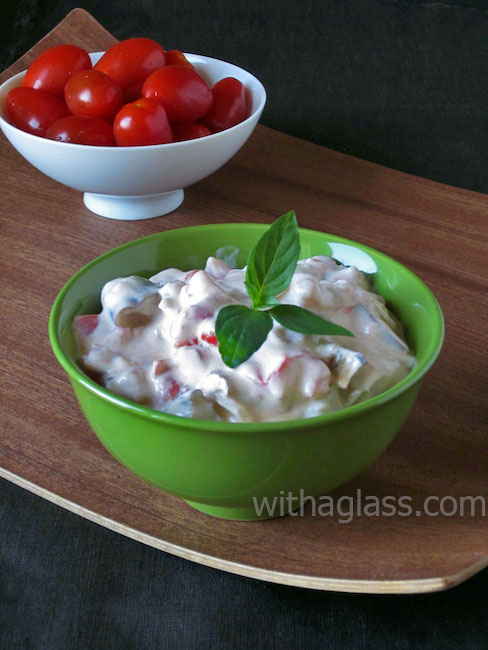
Ajvar (Balkan Pepper Spread)

ajvarpj

Ajvar (pronounced “aye-var”) is a roasted red pepper spread (or “relish”), extremely popular in Balkan countries, but apparently with Serbian origins. The simplest version of ajvar contains only peppers and garlic, but many people add aubergines and this is what I did. The Turkish biber salçası and Romanian zacuscă are similar spreads, although the latter contains a smaller proportion of peppers.

A couple of years ago I bought a jar of ajvar in a nearby shop. It was inedible. When Ping (from Ping’s Pickings) proudly presented her home-made ajvar, I realised I had probably been unlucky with the low-quality commercial brand. From what I know Ping doesn’t have Balkan origins and doesn’t even live in Europe, so her enthusiastic comments were even more convincing. Then Mr. Three-Cookies (Three Cookies and Easily Good Eats blogs) prepared it too and his successful results were more than enough to make me dream of home-made ajvar. Unfortunately I didn’t have time to prepare it last year, but I have never forgotten about it (I keep on seeing the hated commercial jars quite often!).

A couple of days ago I stumbled upon very cheap Hungarian (read: the best) long red peppers, the perfect variety to prepare ajvar. I have bought three kilos and embarked on the ajvar adventure too. I will not lie. Even though ajvar is not difficult, the whole process is long, requires a lot of work and the yield is low. Apart from these “details”, this spread (or relish) is totally worth all the hassle. It tastes like nothing I have ever eaten, is versatile, addictive and amazingly good. It’s a fantastic bread spread for toasts, sandwiches, wraps, tortillas and it can also be served as a dip with snacks or sauce with grilled meat. Look out for cheap peppers and prepare it. I promise you will not regret the efforts.

My recipe is a mixture of what I found on Ping’s blog, Mr. Three-Cookies’s blog and a Serbian blog called Palachinka. Thank you so much, Ping and Mr. Three-Cookies, for the inspiration and for emboldening me to prepare this unique, wonderful dish. Thank you, Marija, for the extremely helpful photos and useful tips!)

TIPS:  I wanted my ajvar a bit spicy, hence the chili peppers, but mild version is probably more popular.

Apparently the best texture is obtained with a meat grinder, but since I don’t have one, I quickly mixed everything in a food processor.

This is a short-term, fridge preserve. The author of Palachinka advises covering with hot oil and adding sodium benzoate (which I even happen to have), but since my yield was only about one litre and since it quickly “melts” every day, I thought I will not bother with it. If you want to keep the jars in the pantry, check how to do it on her blog.

Preparation: 2 days

Ingredients (yields about 1 litre):

3 kg (about 6,6 lbs) red long sweet peppers (at worst you can use bell peppers; they have a

thicker skin, so the yield will be higher, but they are less aromatic)

fresh chilies (I have added 3 medium hot chilies)


500 g (about 1,1 lb) aubergines

5 big garlic cloves, peeled

4 tablespoons oil

about 1 flat tablespoon salt (or more/less to taste)

Wash the peppers, grill them whole either on a grill or (like me) under the broiler until the skin is charred and starts showing “blisters”. Turn them to roast the other side and wait until the skin is charred too.

Put the still hot peppers in a well closed plastic bag or in a big pan, tightly covered with a lid, and leave overnight.

Proceed the same way with aubergines and chilies.

The following day, put on the gloves (otherwise your fingers and nails will be red for many days), peel the peppers and chilies, discarding the stems and removing all the seeds (the seeds you see on the photo come from the aubergine).

Peel the aubergines and remove the stalks.

Grind the aubergines, the peppers, the chilies and the garlic in a meat grinder or mix in a food processor. (Do not insist too much, the mixture should be slightly coarse).

Put everything into a pan, add half of the salt, all the oil and simmer on a very low heat for about two hours, constantly stirring (it burns easily) until there is no liquid separated from the ground vegetables. Taste after two hours and add more salt if needed. Simmer for 15 more minutes until the salt is completely dissolved.

Keep in a closed container or jars, in a colder part of the fridge for at least a month.

Ketchup

ketchuppp

Last weeks of summer are the best moment to make your own ketchup, but if you consider it an easily copied and uncomplicated sauce, think again. For long years all the home-made specimens I tasted or tried to make were only distant and ridiculous wannabes, not even meriting to be labelled as “ketchup”. Accepting the superiority of commercial brands was not easy to accept by a passionate preserver like me, so when two years ago I was offered a huge batch of untreated, ripe tomatoes, the old dream of making my own ketchup returned. I started searching on internet, leafing through my cookery books… Finally, thanks to Jeffrey Steingarten and his fascinating “The Man Who Ate Everything” (one of the best food-related books I have ever read), I discovered a marvellous sauce which beats every single commercial brand and which is no longer a home-made copy, but the best ketchup in the world.

I have slightly modified the ingredients’ amounts because the original recipe was intended for ten pounds of tomatoes. The process is not complicated itself, but a bit fussy and long. The initial volume of tomato pulp and juice will reduce up to 80%, so this sauce is quite costly, unless you cultivate tomatoes or have access to very cheap ones. The tomatoes must be very ripe and ideally untreated or almost untreated. If the tomatoes’ quality is good, the result is so excellent, you will find it difficult to believe you have made it on your own. The flavour balances between the concentration of a fresh ripe tomato taste and a subtler version of good commercial ketchup. Once you have tasted your first batch, you will realise this sauce is too good to be served with just any ordinary sausage or meat and definitely not to every guest…

TIP: If your tomatoes are far from being perfectly ripe or are rather watery, I strongly advise the Indian style Tomato Chutney. The recipe gives amazing results even with ordinary tomatoes.

Preparation: around 2 hours

Special equipment: a food mill (a sieve and a spoon may be used instead, but it takes much longer)

Ingredients: (for 1 kg tomatoes, but the volume will reduce up to 80%)

1 kg tomatoes (about 2 lbs)

1 garlic clove chopped

1/2 medium onion chopped

70 ml  (about 2,4 oz) cider vinegar (4,5%)

1 teaspoon peppercorns

1 teaspoon allspice berries

6 cm (about 2,4 in) cinnamon stick 

2 cloves

1/2 teaspoon chili powder

1/2 teaspoon dried ginger

1/2 tablespoon salt

1 1/2 tablespoon brown sugar

Chop roughly the tomatoes.

Put them in a pan, cover, cook over high heat 5-10 minutes, stirring until the chunks give off their juice.

Strain the juice, pressing gently to the sieve, so that the liquid goes through, but not the tomato pulp.

Add garlic, onion, spices and vinegar (not sugar!) to the liquid obtained by straining.

Cook over moderate heat until it becomes slightly syrupy (it will take 40 – 60 minutes).

In the meantime sieve the pulp or put it through a food mill (make sure the seeds and skins do not get into the pulp). Put aside.

Strain the syrupy liquid discarding all the spices, onion, garlic etc.

Pour it over the pulp, add the sugar and stir well.

Cook until you obtain the desired ketchup consistency (keeping in mind that hot ketchup is a bit more liquid than when it cools down).

Adjust the taste if necessary (some tomatoes need more sugar or more salt) and heat until the sugar is dissolved.

You can mix the sauce in a food processor if you judge the texture not smooth enough.

/At this point you can (after the ketchup has cooled down) either freeze it, or keep it in the fridge for a couple of weeks, or process it in the jars, as described below, and store it in your pantry for at least a year!/

Pour the ketchup, still hot, into sterilised jars. Cover with lids. Leave the jars to cool.

Place the cool jars into a big pan, bottom lined with an old kitchen towel folded in two (this will prevent the jars from breaking), cover up with hot – but not boiling- water to the level just below the lid. Bring to boil and keep on a very low heat, in simmering water, for around 20 minutes.
Stick on self-adhesive labels, write the name of the sauce and don’t forget to mark the date.

Hot Peach Sauce

hotpeachsaucep

Every year, especially when the busiest pantry-filling season arrives, I try to limit jars-related posts in case some of you, my dear readers, become totally bored with the preserving subject. This Peach Sauce is one of these which didn’t fit into my last year’s “quota” and I promised myself I wouldn’t skip it this summer. My recent discoveries of Jed’s (Sportsglutton) fabulous Peachy Western Bacon Cheeseburger and Eva’s (Kitchen Inspirations) marvellous Peach Salsa reminded me to present you this simple, but highly palatable hot and sweet sauce.

As some of you know, I am addicted to the mixture of sweet and hot flavours. This is one of the reasons why, instead of standard jams, “fruit” shelves in my pantry are mainly filled with hot sauces, jellies, chutneys and similar products. Most of them go exceptionally well with both Western and Asian dishes, so I will not exaggerate if I say I do not imagine my life without them. Some taste better with seafood, some with poultry, grilled meat, skewers, toasts or simple sandwiches and other, like this peach sauce, enhance practically every savoury meal or snack.

Visually and technically this sauce is very close to Mango and Chili Sauce I wrote about  in June. It is equally beautiful, easy and quick to prepare. In spite of a slight tanginess, this sauce is more versatile, probably due to a subtler fruit aroma. If you feel tempted by this simple preserve, now is probably the best moment to profit from ripe, end-of-season peaches.

Whatever you do with peaches, do not throw out the peel. It can be used to prepare amazingly good Peach Peel Butter.

In case you want to experiment with fruits and chili, you might also like these:

Hot Strawberry Sauce

 Mango and Chili Sauce

Apricot and Chili Jelly

TIPS: Vinegar and sugar amounts depend on the fruits’ sweetness and the ones below are only an example. Some peaches require more sugar and some more vinegar. Always put down the exact amounts so that you know what you should modify next time you preserve.

The hotness of this sauce should be adapted to your own preferences and your resistance. The below chili amounts are only an example and depend also on the chili variety. Several tips for those who are not used to handle hot peppers:

1-Wear gloves while washing or cutting them !

2- Add your peppers gradually. They vary a lot in size, in hotness, and even the same variety can be completely different depending on the season and country of origin.  I always first mix peppers in a food processor and then add them gradually until the sauce acquires the desired taste.

3-Do not throw away the seeds if you want the sauce to be even hotter! (they are the hottest part of the peppers).

4- Keep in mind that the warm sauce is always hotter in taste than the cold one… (Wait for the sauce to cool down, taste it and you can reheat it once more adding more chilies if you want).


Preparation: around 30 minutes + a couple of hours for cooling + 20 minutes for processing

Ingredients: (about 3 x 200ml jars, but it depends on the fruits’ juiciness and ripeness)

1 kg (about 2 lbs) peaches 

1 T salt

200 g (1 cup) sugar

200 ml (6 3/4 oz) white wine or cider vinegar (mine was 4,5% acid)

preferably fresh, red or green hot peppers (I put 3 flat tablespoons of mixed tiny “bird’s eye” chili peppers and my sauce was really hot)

Cut off the peppers’ stems. Cut in half lengthwise and throw away the seeds (or not! if you want your sauce extra hot).

Mix the peppers in a food processor. Put aside.

Peel the peaches putting them in a big bowl or pan filled with boiling water.

After five minutes empty the bowl/pan and cover them with very cold water.

After 5 more minutes they can be peeled with fingers.

Do not throw away the peel! Make Peach Peel Butter (I promise it’s delicious).

Cut up the flesh. Mix the peaches in a food processor.

Place the mixed peaches, the sugar, the salt and the vinegar in a heavy bottom pan (shouldn’t be aluminium or copper, otherwise the vinegar will react with the metal).
Add the chilies gradually (for example starting with half of the amount). Cook for about 30 minutes. Taste and, optionally, add sugar /vinegar/peppers to adjust the taste.

/At this point you can (after the sauce has cooled down) either freeze it, or keep it in the fridge for a couple of weeks, or process it in the jars, as described below, and store it in your pantry for at least a year./

Pour the sauce, still hot, into sterilised jars. Cover with lids. Leave the jars to cool.

Place the cool jars into a big pan, bottom lined with an old kitchen towel folded in two (this will prevent the jars from breaking), cover up with hot – but not boiling- water to the level just below the lid. Bring to boil and keep on a very low heat, in simmering water, for around 15 minutes.
Stick on self-adhesive labels, write the name of the sauce and don’t forget to mark the date (do not forget to put down the exact amounts of every ingredient).

In a dry place, with a moderate temperature, the jars should keep for at least a year.

Shiso and Garlic Infused Soy Sauce

garlicshisosoysaucep

Nami (Just One Cookbook) posted this recipe a long long time ago and I made it shortly afterwards. I loved this aromatic sauce at once and must have prepared it at least a dozen times since then. I intended to write about it much earlier, but somehow kept on forgetting to take a photo. I cannot say I’m happy about this one, but I didn’t want to wait any longer to share my impressions with you and to thank Nami for this surprising discovery, which has become a staple in my house.

As the title says, the recipe calls only for the garlic, the shiso and the soy sauce. They are simply assembled, put into a jar or a container and wait in the fridge for 24 hours. After a couple of days the leaves can be exchanged for fresh ones, the soy sauce added and thus this short-term preserve can be refilled and used for about three weeks. These few ingredients create a surprisingly good and complex sauce, which is a real delicacy for fans of garlic an shiso.

Shiso (紫蘇) or perilla, is widely used in both Korean and Japanese cuisines and you have probably seen it on my blog. I am mad for its herbaceous, slightly bitter flavour and its strong aroma and can no longer imagine many of  my meals without it. Here it has largely contributed to the complexity of flavours and gave this sauce a very original, fresh touch. This sauce is quite versatile. It can be used as a light dip for deep-fried dishes, added to fried rice, as a stir-fry seasoning and I even pour it on steamed rice instead of the standard soy sauce (I’m one of those Europeans who almost always add soy sauce to rice…).  Thank you, Nami, for this wonderful and easy recipe. (Click here to see Nami’s original post).

Shiso is in full season now, so in case you look for some other ideas, here are some of my previous recipes using this fabulous herb:

Tomato and Shiso Salad

Chicken and Shiso Balls

Chicken and Shiso Dumplings

Ume Shiso Chicken Skewers

Pork Rolls and Shiso in Tempura

Teriyaki Pork Rolls with Sweet Pepper, Shiso and Gochujang

TIP: Shiso is available in Japanese and Korean grocery shops, but I was surprised to find it in a Vietnamese shop and quickly noticed they have it almost every day in stock, so do check all the Asian grocers in your city.

Preparation: 5 minutes+at least 24 hours in the fridge

Ingredients:

10 big shiso leaves

3 cloves garlic, chopped

soy sauce (enough to cover the ingredients; I usually add 125 ml or 1/2 cup)

Put the garlic and the shiso leaves in a jar or a plastic container.

Cover with soy sauce. Close tightly and leave for at least 24 hours before tasting.

When the leaves become very dark, you can exchange them for new ones.

You can also keep on filling the container with more soy sauce.

Such a “renewal” can last for about three weeks.


Gochujang and Sour Cream Sauce

gochsourcreamp

I have been meaning to share this sauce with you for several months or even years. It includes only two ingredients, so I shouldn’t probably even call it a recipe. Observing blogs and reactions of my family and friends, I realised that even though simple, sour cream and gochujang are not only an uncommon, but also a surprising combination, hence the decision to write about it. I have been preparing this sauce for years, sometimes as often as several times a week. I serve it with dishes and snacks of as different origins as Hungarian and Japanese and make sure both ingredients are constantly available in my fridge.

Gochujang has been a staple for many years now. Actually I was addicted as soon as I tasted it. Its hot and sweet flavours and the sticky consistency have won me over instantly. For those who still don’t know it, gochujang is a Korean condiment, based on hot pepper and fermented soybeans, usually sold in red plastic tubs. It is dark red, a bit sticky, quite hot and slightly sweet (it has different degrees of hotness and I usually buy medium hot).  In Korean cuisine gochujang is put into soups, sauces and marinades.

I don’t remember when I had the idea to combine gochujang and sour cream, but somehow it felt very natural. Sour cream (or I should rather say “milk”, because what I use is called “sour milk” due to its low fat content) is extremely cooling and I often use it to tame down very hot sauces and dishes. Combined with gochujang it still is cooling, but gives a fiery “kick” and its taste is much more complex than a simple mixture of chili pepper and cream. Of course the “kick” depends on how much gochujang you have put and what kind of gochujang you buy.

I serve this sauce with grilled sandwiches, Japanese or Korean meat rolls, spring rolls, Indian curries, Mexican dishes such as chili con carne, Hungarian dishes (such as Szekély Gulyàs or Stuffed Pepper), skewers, grilled meat, fish and shellfish, roasts… It’s also a perfect dip for raw vegetables served as snacks at a party (celery, carrot, cauliflower…).

TIP & UPDATE: The Sour cream or milk can be substituted here with Greek yogurt, which is slightly sour.

Preparation: 5 minutes

Ingredients:

125 ml (about 1/2 cup) sour cream (I use thick sour milk) or Greek yogurt

1 tablespoon gochujang (or less/more depending on your preferences)

Mix the ingredients with a fork or, if you want to obtain a homogenous smooth result, with a food processor.

Mango and Chili Sauce

I am impatiently waiting for the peak preserving season which starts some time next month. In the meantime, since mangoes seem to be already in season in many parts of the world, last weekend I was very glad to be able to fill this year’s first jars with my beloved hot mango sauce. I have posted this recipe a long time ago, when I didn’t know most of my present web friends and I thought it would be such a pity if one of my most often prepared and served sauces remained forgotten or unnoticed. For me it’s such an extraordinary preserve, I think it may even merit to be posted regularly once a year.

Why do I find this sauce so exceptional? First of all, because I love mango and chili combination. Secondly, because of its simplicity. In fact, I haven’t followed any precise instructions and the recipe is the result of my experiments with chili, mango and obligatory preserving agents (vinegar and sugar). Thanks to the short ingredients list, this sauce is an extremely versatile seasoning or dip. You can serve it with roasts, stir fries, sandwiches, noodles, rice bowls,snacks…. Apart from those who hate hot and sweet combination, everyone seems to enjoy this sauce (this is one of my biggest “jar as a present” hits). Last but not least, mango season is quite long and since they are imported from different parts of the world they are available (at least in Europe) all year round, so this sauce can be prepared at practically any time of the year.

If you still hesitate wondering how you will use this sauce, here are some suggestions:

-Stir-fried asparagus, chicken and cashew nuts

-Sesame Coated Tuna Nuggets

-Japanese Chicken and Leek Skewers (Negima)

-Asparagus Teriyaki Pork Rolls

-Okra Teriyaki Pork Rolls

-Sesame Coated Chicken Nuggets

-Chicken Karaage

TIPS: The vinegar and sugar amounts depend on the mango sweetness and the ones below are only an example. Some mangoes require more sugar and some more vinegar. Always put down the exact amounts so that you know what you should modify next time you preserve it.

The hotness of this sauce should be adapted to your own preferences and your resistance. The below chili amounts are only an example and depend also on the chili variety. Several tips for those who are not used to handle hot peppers:

1-Wear gloves while washing or cutting them !

2- Add your peppers gradually. They vary a lot in size, in hotness, and even the same variety can be completely different depending on the season and country of origin.  I always first mix peppers in a food processor and then add them gradually until the sauce acquires the desired taste.

3-Do not throw away the seeds if you want the sauce to be even hotter! (they are the hottest part of the peppers).

4- Keep in mind that the warm sauce is always hotter in taste than the cold one… (Wait for the sauce to cool down, taste it and you can reheat it once more adding more chilies if you want).

Preparation: around 30 minutes + a couple of hours for cooling + 20 minutes for processing

Ingredients: (2 mangoes will yield around 3-4 200ml jars, but it depends on the fruits’ juiciness and ripeness)

2 mangoes

1 T salt

200 g (1 cup) sugar

200 ml (6 3/4 oz) white wine or cider vinegar (mine was 4,5% acid)

preferably fresh, red or green hot peppers (I put 3 flat tablespoons of mixed tiny “bird’s eye” chili peppers and my sauce was really hot)

Cut off the peppers’ stems. Cut in half lengthwise and throw away the seeds (or not! if you want your sauce extra hot).

Mix the peppers in a food processor. Put aside.

Peel the mangoes, cut up the flesh. Mix the mangoes in a food processor.

Place the mixed mangoes, the sugar, the salt and the vinegar in a heavy bottom pan (shouldn’t be aluminium or copper, otherwise the vinegar will react with the metal).
Add the chilies gradually (for example starting with half of the amount). Cook for around 30 minutes. Taste and, optionally, add sugar /vinegar/peppers to adjust the taste.

/At this point you can (after the sauce has cooled down) either freeze it, or keep it in the fridge for a couple of weeks, or process it in the jars, as described below, and store it in your pantry for at least a year!/

Pour the sauce, still hot, into sterilised jars. Cover with lids. Leave the jars to cool.

Place the cool jars into a big pan, bottom lined with an old kitchen towel folded in two (this will prevent the jars from breaking), cover up with hot – but not boiling- water to the level just below the lid. Bring to boil and keep on a very low heat, in simmering water, for around 20 minutes.
Stick on self-adhesive labels, write the name of the sauce and don’t forget to mark the date (do not forget to put down the exact amounts of every ingredient you used).

In a dry place, with a moderate temperature, the jars should keep for at least a year.

Fresh Cheese Spread with Radish and Chives

Simple combinations and cheap, basic products sometimes give amazing results and fresh cheese with chives is one of the best examples I know. Fresh cheese can be mixed with any herb you want, but in my opinion only chives make the combination perfect. Fresh Cheese and Chives Spread (I have written about it here) is one of my most distinct childhood food memories. I had it for breakfast, as a snack, as a light supper and my appetite for it has never decreased. In fact, even now this spread is my staple all year round. When spring vegetables appear, I do just like my mum and enrich it with chopped pink radishes. The crisp radish adds a strong peppery taste, makes the texture more interesting and embellishes the colour palette.

The fresh cheese I have in mind is called “curd cheese” and sometimes “farm” or “farmers cheese”, available in Polish/Russian/ Hungarian grocery shops all around the world. Curd cheese is widely used in Central and Eastern Europe (Russian творог, Polish twaróg or biały ser, Hungarian túró or Austrian Topfen are only some examples in both savoury and sweet dishes and is my absolute favourite in Baked Cheesecake (while its smooth, mixed version is ideal in Unbaked Cheesecake). Its texture might be described as something halfway between ricotta and feta, but its slightly tangy taste differs from both. Since it is produced by straining soured milk, curd cheese is a natural product and if low or medium-fat variety is used, it makes relatively healthy meals and desserts. (It shouldn’t be mixed up with the Canadian and US “cheese curds”!). This is how curd cheese, crushed with fork, looks like:

This spread is not only fresh, low-fat, quick and an excellent appetite suppressant, but it is one of the rare things which taste much better on wholemeal, black, crunchy bread or pumpernickel rather than white bread. The spread keeps for a couple of days in the fridge, in a closed container and tastes even better the following day, when the chives’ and radishes’ flavours are stronger. I always make a big batch to have it ready for breakfast or as a healthy snack.

TIP: If you cannot get curd/farmers cheese, you can use drained cottage cheese, but add some sour milk or sour cream or kefir (not yogurt) in order to make it tangy.

Other recipes calling for curd cheese:

-Potato and Curd Cheese Dumplings

-Pear and Curd/Cottage Cheese Pie

-Light and Moist Baked Cheesecake

-Fresh Cheese Spread with Chives

Preparation: 10 minutes

Ingredients:

150 g curd/farmers cheese (or drained cottage cheese)

4-6 tablespoons yogurt, kefir, sour milk or sour cream (or more if the cheese is dry)

salt

about 10 flat tablespoons chopped chives

7 -8 pink radishes, roughly chopped

Crush the curd cheese with a fork, add the yogurt, kefir or cream gradually, stirring until you obtain the desired consistency (this depends not only on the cheese brand, but also on your preferences).

If you use cottage cheese, crush the big grains with a fork before adding the yogurt.

Add the chives, the salt, the radishes, give it a good stir and taste if it’s salty enough.


Smoked Mackerel and Egg Spread

When about two weeks ago Charles (Five Euro Food) posted the famous Kedgeree recipe, using smoked mackerel, I was very glad to discover a new way to prepare this delicious fish. In fact, even though I love smoked mackerel, I have been preparing it for many years in only one way.  I promised Charles I would write about it, so here it is!

The addictive mackerel and egg spread you see above comes from Poland, where smoked Atlantic mackerel is very popular and often ends up prepared this way. The spread is very quick to prepare and makes a wonderful everyday sandwich filler (it keeps for several days in the fridge), but I also find it perfect as a canapé topping. Maybe it is due to the big egg content, but somehow I thought it could be a nice idea of an Easter snack.

This spread goes well with all types of bread (even the “diet” crunchy one), but the canapés you see above were a real hit. I made them with a recent find: tiny round slices of my beloved German pumpernickel bread. If you can find this bread, I strongly recommend it not only with this spread, but with any pickled or smoked fish.

TIP: If you cannot find smoked Atlantic mackerel, you can substitute it with another smoked fish, but choose the one which has very delicate, flaky flesh (smoked salmon is not a good substitute here).

Preparation: 10 minutes

Ingredients (makes about 300 ml): 

150 g smoked Atlantic mackerel without skin or bones (I also discard the darkest flesh parts, because they tend to taste bitter)

2 hard-boiled eggs

1 big pickled cucumber (fermented in salted brine or pickled in vinegar, both are ok)

1/2 medium white or yellow onion (the red one I used looked better but was somewhat not strong enough here)

salt, pepper

2 – 3 heaped tablespoons mayonnaise

(chives to decorate)

Shred the fish with your fingers, discarding all the small bones and put it in a big bowl.

Chop the cucumber as finely as you can.

Chop finely the onion and the hard boiled eggs.

Combine all the ingredients with the shredded mackerel, add the mayonnaise, season with salt and pepper.

Mix everything with a fork. Taste, add some more salt and pepper if necessary (you may also want to add more onion or cucumbers depending on your preferences).

Serve cold.

Pork Tocino, or Filipino Marinated Pork


I hardly know anything about the Filipino cuisine, not to mention tasting or cooking it. I don’t even have a Filipino cookery book, so my vague idea of what the Filipino cuisine looks like is based on what I see on food blogs. Ray’s (Wok with Ray) tempting recipes and beautiful photos made me decide to prepare the very first Filipino dish in my life.  Tocino, the dish I have chosen for this memorable event, was not only simple and made with easily available ingredients, but most of all was a new way to prepare my beloved pork.

Tocino is a Spanish word for “bacon” and in the Philippines it means cured and marinated meat, served grilled or fried. This preparation is apparently also popular in Puerto Rico and Cuba. I think I took decision to prepare it when I read in Ray’s post that this pork dish is traditionally served for breakfast. As someone who simply is not able to have a sweet breakfast, I started to dream about hotels where instead of the horrible and boring thing called “continental breakfast”, marinated pork is served. I suppose I have to visit Philippines in order to see such a delight served in the morning, but in the meantime I had tocino for lunch, dinner, late weekend breakfast and am very happy I have started to explore this fascinating cuisine by such a delicious and versatile dish. I don’t have a grill, so I have simply fried it, but I am sure it tastes even better prepared on a grill. The meat has a very delicate taste, it is slightly sweet and even the very lean pork loin I used was tenderised by the pineapple juice. I sprinkled it with Korean chili flakes because I love sweet and hot flavours together. Unfortunately I didn’t have necessary ingredients to make the mango salad Ray advises to serve with tocino, but the pork was also perfect with good crispy bread and my pickled sweet peppers. Thank you, Ray, for this wonderful recipe, which is my first, but not last stage in the exploration of the Filipino cuisine.

I haven’t changed anything in Ray’s recipe, but I have slightly modified the amounts of the ingredients (Ray’s recipe was adapted to 5 pounds of meat and I had only about 1 pound). Ray says cured pork freezes very well, so if you want to make a bigger batch, check his recipe and extraordinary photos.

Before I pass to the recipe I would like to invite you to visit Elin’s blog (Elinluv’s Sweet Delights) and see the beautiful savoury cake with shrimp and broccoli, modifying my Savoury Cake with Shrimp and Edamame. Thank you, Elin, for having used my recipe and for all the kind words you said about my blog.

Now let’s go back to this simple and delicious recipe.

TIPS: The meat should be marinated for at least 24 hours, but the taste improves after two-three days.

Of course slightly fatty cuts (like shoulder) will be more tender. I used pork loin because I happened to have it in my fridge and even though it was not as juicy and soft as shoulder would be, I loved it.

Preparation: 24 hours – 3 days marinating + 10 minutes grilling/frying time

Ingredients:

500 g pork  butt (a cut from pork’s shoulder; I used pork loin) cut into 1-1,5 cm slices

Marinade:

25 ml pineapple juice

1 tablespoon soy sauce

1 teaspoon Worcestershire sauce

1 teaspoon dry sherry

Tocino mix:

60 g sugar

10 g salt

1 teaspoon freshly ground pepper

Combine the ingredients of the tocino mix.

Take two tablespoons of the tocino mix and combine it with the marinade ingredients.

(Put aside the remaining tocino mix for further marinades).

Stir well until the sugar and salt are dissolved.

Put the pork slices into the marinade and keep on the fridge for at least 24 hours.

Fry or grill the meat.

Thick and Crunchy Japanese Chili Oil and Sauce (Taberu rayu)

I don’t have the habit of praising factory-made sauces or condiments, but when I discovered taberu rayu, I have instantly fallen in love. This Japanese condiment is sold in tiny jars filled half with chili oil, half with a crunchy mixture of fried garlic, sesame seeds and chili and it goes well with almost every dish I tested (not only Japanese). Since me and my husband are both addicted to this rather expensive sauce, I thought I should try reproducing it at home. I had no idea what to start with, so I turned for help to Robert-Gilles, my blogging friend from Shizuoka (Shizuoka Gourmet). Robert-Gilles has already saved me from many culinary troubles (daikon leaves rice topping is one of the best examples) and here he was once more extremely kind, generous and helpful. In short, as if by magic, the taberu rayu recipe appeared the following day on his blog!

As Robert-Gilles has written here, taberu rayu (食べるラー油) appeared in 2009 in Okinawa as a modified version of chili oil, originating from China. The name means literally “chili oil for eating” probably because, as I have mentioned above, a part of the condiment is solid. My Japanese grocers sell two types of taberu rayu: one contains dried garlic and the other both dried garlic and dried shrimp. Since I find the former version more versatile, I have left out the shrimp in this first experiment. The recipe proved quite easy (although I did burn the first batch of fried garlic…), rather quick and the result was surprisingly close to the “original” condiment. Home-made taberu rayu is hot and slightly sweet. It has a pleasant crunch due to the sesame seeds and garlic, combined with the stickiness of gochujang (Korean chili paste) and a wonderful bright red colour. Maybe because it lacks artificial after-taste, I find it even more addictive than the factory-made version. Thank you so much, Robert-Gilles, for this extraordinary recipe and for your kind help!

TIP: If you don’t find gochujang (Korean chili paste), you will find a recipe also on Shizuoka Gourmet blog. You can substitute it here with a bigger amount of chili flakes and a bit more sugar, but the texture will be different.

Preparation: 30-40 minutes

Ingredients (fills a 200 ml jar):

100 ml canola oil (or another oil with a neutral taste)

50 ml sesame oil

1 dried chili

3 thick slices of fresh ginger

10 cm piece of leek

2 tablespoons gochujang (Korean chili paste)

2 heaped tablespoons Korean chili powder (or half of it if you don’t like very hot seasonings)

1 tablespoon soy sauce

1 teaspoon sugar (I used agave syrup)

2 tablespoons white sesame seeds

(about 2 tablespoons dried shrimps, chopped)

Fried garlic:

deep-frying oil

5 big garlic cloves, finely chopped (or roughly mixed in a food processor)

Fried onion:

deep-frying oil

1/2 onion,  finely chopped (or roughly mixed in a food processor)

First prepare fried onion and fried garlic.

Heat some oil in a small pan and when it’s hot enough to fry the garlic (a bit of garlic thrown into the oil will stay at the surface, the oil will start bubbling around and instantly frying it), throw delicately the chopped garlic and take out as soon as it is slightly golden. It will take about one minute or less. Drain the excess oil on paper towel and put aside.

Filter the oil and fry the onion in the same way. It will take more time (a couple of minutes). Drain the excess oil on paper towel and put aside.

In a metal bowl combine the sesame seeds, (the shrimp), the chili powder and 1 tablespoon sesame oil.

Pour the remaining sesame oil and canola oil into a pan. Add the ginger, the leek and one dried chili.

Fry at low heat for a couple of minutes.

Take out the vegetables and heat the oils until they start smoking.

At this point pour slowly, stirring, the hot oils into the sesame and chili paste.

Add the remaining ingredients, stir well, put into a jar and keep for one month at room temperature.


Thick and Crunchy Japanese Chili Sauce on Punk Domestics

Onion Confit with Fig and Port


The busiest pickling and jam-making months are behind. However, I keep on making Apple and Pear Sauces, preserving exotic fruits (Mango Chutney or Hot Mango Sauce) and I have just started to prepare this year’s batches of onion confit. If you have ever been to a French deli, you have probably seen expensive small jars of “confit d’oignon”, seasoned with different alcohols and/or dried fruit. Confit is a long simmered, slightly sweet onion jam. It is typically served warm with foie gras (fat duck’s liver), but it is also excellent with black pudding, grilled or roast pork, chicken and duck. It works perfectly well also as a tart filling or even as a simple toast spread.

Since I have always found onion confit prices excessive and totally unfounded (onion being one of the cheapest and easiest stored basic European vegetable), I decided to experiment on my own. I quickly realised how cheap and easy the whole process was, even though it required several hours of long simmering. The fig and port version is by far my favourite, but even when both are skipped, the confit is excellent. I think a jar of confit is a very good idea for a home-made, edible Christmas present and an original alternative to flowers or chocolates when one is invited to someone’s house.

Onion confit can be made with any onion variety. I usually go for the cheapest ones, since they “melt” a lot during the long simmering process.

TIP: Onion confit can be either processed and preserved in the pantry or stored in the fridge for one or two weeks. If you don not intend to process it, reduce the vinegar and sugar amounts. Here they act as preserving agents, but if the jam is eaten quickly, their addition is merely a question of taste balance.

Preparation: 3-5 hours (it can be made in two days)

Ingredients (yield depends much on the onions and preferred consistency, but don’t count on more than 2x 150 ml jars):

1 kg onions, peeled and sliced

4 dried figs

50g brown cane sugar

1 tablespoon salt

soy sauce (to taste) or more salt

100 ml ruby port wine

100 ml white wine vinegar 4,5%

2 tablespoons good quality oil

(ground pepper)

Heat the oil in a pan, add the onions and let them soften a bit on a very low heat (you can put the lid on the pan, but remember to stir very often).

After about 10 minutes add the soy sauce, the sugar, finely chopped figs and the vinegar.

Let the whole mixture simmer on a very low heat for about an hour, frequently stirring.

Add the port wine.

Cover the onions with a lid, let them simmer for at least 2 more hours, stirring.

Adjust the taste, adding more vinegar or salt or sugar and let the confit simmer uncovered until the liquids evaporate and it takes a consistency of a jam.

/At this point you can (after the confit has cooled down) keep it in the fridge for a couple of weeks, or process it in the jars, as described below, and store it in your pantry for about a year/

Pour the confit, still hot, into sterilised jars. Cover with lids. Leave the jars to cool.

Place the cool jars into a big pan, bottom lined with an old kitchen towel folded in two (this will prevent the jars from breaking), cover up with hot – but not boiling- water to the level just below the lid. Bring to boil and keep on a very low heat, in simmering water, for around 20 minutes.
Stick on self-adhesive labels, write the name of the confit and don’t forget to mark the date.

NOTE: For the readers who live in the USA, this is not a USDA tested recipe and therefore not recommended for canning by their standards.


Green Tomato and Chili Jelly

I have just spent another weekend making King of the Pippins Sauce (they have finally appeared on my market) and preserving green tomatoes, which will soon be over. Contrary to the Green Tomato Salad, this recipe is, I can proudly say, my own invention. Of course it is not very original since I based it on Hot Pepper Jelly, modifying the proportions, but aiming at a similar blend of sweet and hot, my favourite flavours’ combination. I first made it as an experiment with a couple of leftover green tomatoes, but the result was so good, I have been preparing this jelly for three years now. In spite of being hot, this jelly has a very subtle, slightly refreshing taste. It is not as versatile as the Pepper Jelly. It goes well also on toast, with grilled or stir-fried meat, fish, vegetables, but I avoid pairing it with curry, red tomato sauce, spicy dishes or simply with very powerful flavours.

The process is very easy. You simply mix the tomatoes and the chillies in a food processor, then cook it with the remaining ingredients, add the pectin and put into jars.

Preparation: 45 minutes + hot water bath or another processing method

Ingredients:

1 kg green tomatoes

red or green chili peppers (here everything depends on how hot you want it to be; I usually add 10 bird’s-eye-chili peppers)

1 tablespoon salt

300 g white sugar

100 ml vinegar 4,5% acidity (or less if using stronger vinegar)

60 g pectin in powder

Wash the tomatoes and the peppers.

Cut off the stems.

Put both in a food processor and mix well.

Put into a pan, add the vinegar, the sugar and the salt and boil on medium heat for about 20 minutes.

Add the pectin, stir well and let the jelly simmer for 15 more minutes.

/At this point you can (after the chutney has cooled down) either freeze it or keep it in the fridge for a couple of weeks, or process it in the jars, as described below, and store it in your pantry for at least a year!/

Pour the chutney, still hot, into sterilised jars. Cover with lids. Leave the jars to cool.

Place the cool jars into a big pan, bottom lined with an old kitchen towel folded in two (this will prevent the jars from breaking), cover up with hot – but not boiling- water to the level just below the lid. Bring to boil and keep on a very low heat, in simmering water, for around 20 minutes.
Stick on self-adhesive labels, write the name of the chutney and don’t forget to mark the date.

NOTE: For the readers who live in the USA, the USDA-approved canning method is different. You can find it described here: http://www.uga.edu/nchfp/publications/uga/using_bw_canners.html.

Baba ghanouj/M’tabal or Lebanese Aubergine Dip

babaghpp

Baba ghanouj or baba ghanoush/ganoush (apparently meaning “spoiled dad”) is a Lebanese mixture of grilled aubergine flesh, olive oil and some other ingredients, such as garlic, lemon juice and sesame paste. It is less known than hummus, but is much much lighter. It is served as a dip with other mezze (a selection of small dishes) or as a side-dish with grilled meats and vegetables. Similar, mashed aubergine-based dishes exist in Egypt, Turkey, Pakistan, India, Bulgaria… In France every aubergine purée is called “caviar d’aubergines” (I know what most of you think…).

Since it is one of the most popular Lebanese dishes, probably every Lebanese home cook has his or her own recipe. I have found mine on the French blog Cuisine libanaise par Sahten, full of Lebanese recipes (and not only). Sahten says that when yogurt is added to baba ghanouj, it is called moutabal and I should probably say I have made m’tabal. On the other hand yogurt exists in many recipes still called baba ghanouj, so I have decided to put both names. The colour depends on the aubergine variety, ripeness and on how long you grill the skin. It can vary from light brown to almost white (like this one above).

Anyway, the taste is all that counts and here I haven’t been disappointed. This aubergine spread is light, flavoursome and, like lots of aubergine dishes, has a slightly mushroomy taste. If you grill the aubergines over the open flame, baba ghanouj will have a smoky flavour too. Apart from the above typically Lebanese serving ideas, I would advise it as a sandwich or wrap spread, certainly lighter than mayonnaise or butter.

Preparation: 30 minutes – 1 hour (depending on the aubergine preparation method) + about 2 hours in the fridge

Ingredients (serves 3-4 as a dip):

2 medium aubergines

1 tablespoon sesame paste (often called “tahini”)

juice from 1/2 small lemon

2 garlic cloves (crushed)

2 tablespoons natural yogurt

salt

good olive oil

(parsley)

Grill the aubergines in the oven, over the open flame or on a grill until the skin is completely black and burnt.

Take out the flesh, mix it with garlic, lemon juice, sesame paste and salt.

Put into the fridge for about 2 hours.

Serve sprinkled with parsley and a dash of olive oil.


Mango Chutney with Garam Masala

Long before I started to make my own savoury preserves, mango had always been my favourite in Indian hot chutneys and fiery mango sauce served in Indian restaurants. After my three years’ experience of Hot Mango Sauce and Mango Chutney preserving, this is still my favourite fruit to pair with spices and chillies. Mango is versatile, makes thick sauces and doesn’t have any acidity, so the preserves don’t require lots of sugar. There is also something I love about mangoes: they are available most of the year, since they are imported from different parts of the world.

According to most bloggers who have origins or family in the mango-growing countries neither the smell nor the taste of the mangoes available in Europe can be compared to the real, fresh mangoes’ flavour and aroma. I was always wondering what they meant. Finally, I had a chance to experience the difference and realise what the real mango meant the day when my husband was offered a box of these African beauties, coming straight from mango trees in Mali:

And here is a mango with a standard-sized lime to show you how big they were:

Not only were they huge, chubby, with a funny shape, but most of all, their aroma and taste were extraordinary. The first thing I noticed was they didn’t have the nauseous, overwhelming smell usually ripe mangoes have. Cut into pieces and eaten raw, the Malian mango was refreshing, firm and its smell was delicate. I would say it was a sophisticated version of the fruit I have been buying here for years. Since the mangoes had to be eaten quickly, we partly had them raw and the rest was preserved in a Mango Chutney with Garam Masala. Now, every opened will bring back the memories of this unusual discovery and make us think about Zeïnabou, a kind and generous lady without whom I would never know what a “good mango” meant. Thank you, Zeïnabou, for the discovery we would have never dreamt of and for the exquisite mango feast we shall never forget!

Mango Chutney with Garam Masala is a smooth, sauce-like type of chutney, different from this, chunky, British-style Mango Chutney and even though the recipe is not genuinely Indian, garam masala gives it a warm, rich Indian touch. The tamarind pulp or sauce can be replaced with lemon juice, but the taste is really better with tamarind.

I found this chutney a long time ago on the Discuss Cooking forum and am particularly grateful to Clive from Venezuela (cliveb) for sharing this excellent recipe, which I have only slightly modified.

I don’t need to add that this particular batch, made with Malian mangoes, was exceptionally luscious!

Preparation: 1 hour (+hot water bath processing)

Ingredients:

2 standard oval mangoes or 1 huge Malian mango

2 cm fresh ginger

120 g raisins

200 g brown, cane sugar

200 ml cider vinegar (4,5%) or white wine vinegar

40 ml tamarind juice/pulp or juice from 1/2 lemon

4 garlic cloves

1 teaspoon salt

1 teaspoon ground coriander seeds

2 teaspoons garam masala

3 teaspoons chili in powder

Peel the ginger, the mangoes, add the rest and mix in a food processor or a blender.

Cook everything on a medium heat, stirring, for 30-40 minutes.

Adjust the taste if needed (more chili if it’s not hot enough, more vinegar if it’s too sweet and more sugar if it’s too acid). If you have made any modifications, let the chutney boil for 10 more minutes.

/At this point you can (after the chutney has cooled down) either freeze it or keep it in the fridge for a couple of weeks, or process it in the jars, as described below, and store it in your pantry for at least a year!/

Pour the chutney, still hot, into sterilised jars. Cover with lids. Leave the jars to cool.

Place the cool jars into a big pan, bottom lined with an old kitchen towel folded in two (this will prevent the jars from breaking),, cover up with hot – but not boiling- water to the level just below the lid. Bring to boil and keep on a very low heat, in simmering water, for around 20 minutes.
Stick on self-adhesive labels, write the name of the chutney and don’t forget to mark the date.

NOTE: For the readers who live in the USA, the USDA-approved canning method is different. You can find it described here: http://www.uga.edu/nchfp/publications/uga/using_bw_canners.html.

Mango Chutney with Garam Masala on Punk Domestics

Sweet Pepper and Allspice Spread

Have you ever tried to deconstruct a dish and create a different texture with the same ingredients? I bet that if the result is satisfactory, you will feel like a professional chef, a magician or you will simply be very proud of your boldness. At least I was when, after mixing and thickening the Pickled Sweet Peppers (see the recipe here), I obtained a highly palatable sweet pepper spread.

I don’t remember how I got this crazy idea, but since the necessity is the mother of invention, I probably had too many peppers and not enough jars to pickle them… I remember I had also been looking for a smoother and less fiery alternative to the hot pepper jellies I make every year. I reduced the liquids, mixed everything, thickened with powdered pectin and, I don’t want to boast, but the result went beyond my expectations. Needless to say, I decided to double or triple the amount of preserved jars this year.

I prepare this spread with Hungarian kapia pepper (red and long), but of course bell peppers and other sweet peppers will also work perfectly well. The more aromatic and ripe the pepper, the better the taste will be. Thanks to the vinegar the colour stays vivid red even after a year spent in the pantry.

I use this spread on toasts, in sandwiches (instead of butter or mayonnaise), with grilled meat, with roast pork, on tarts and in crunchy rolls (see the recipe here). The possibilities are infinite.

Preparation: 2 hours + hot bath processing

Ingredients:

1 kg sweet peppers

400 ml 4,5% vinegar (I used cider vinegar)

450 ml water

170g sugar

2 tablespoons salt

12 allspice grains

1 teaspoon black pepper in grains

1 tablespoon mustard grains

2 small bay leaves or 1 big

8 garlic cloves

60 g powdered pectin

Wash the peppers, core them and remove the stems.

Cut them roughly in four or six pieces.

Combine all the ingredients apart from the red peppers.

Bring them to boil. Throw the peppers into the pan and let everything simmer for 20 minutes.

Put aside for one hour.

Mix everything in a blender. Put back into the pan, add the pectin and bring to boil, constantly stirring.

Let it boil at medium heat for 10-15 minutes.

/At this point you can (after the spread has cooled down) either freeze it or keep it in the fridge for a couple of weeks, or process it in the jars, as described below, and store it in your pantry for at least a year!/

Pour the spread, still hot, into sterilised jars. Cover with lids. Leave the jars to cool.

Place the cool jars into a big pan, bottom lined with an old kitchen towel folded in two (this will prevent the jars from breaking), cover up with hot – but not boiling- water to the level just below the lid. Bring to boil and keep on a very low heat, in simmering water, for around 20 minutes.
Stick on self-adhesive labels, write the name of the spread and don’t forget to mark the date.

NOTE: For the readers who live in the USA, the USDA-approved canning method is different. You can find it described here: http://www.uga.edu/nchfp/publications/uga/using_bw_canners.html.

Sweet Pepper and Allspice Spread on Punk Domestics

Tomato Chutney

Spices can make miracles and a mixture of Indian spices can transform an ordinary vegetable into a highly palatable side-dish, a cheap meat cut into a fantastic curry and a big bag of cheap, watery tomatoes into a luscious chutney. I learnt the latter last year, when, having bought a bag of rather bland looking tomatoes, I tried to transform them into the ketchup according to my favourite,  Jeffrey Steingarten’s recipe. The result was very disappointing and so far from the one obtained with high quality tomatoes, I decided to look for a different preserving idea.

After some research I managed to save the remaining couple of kilos with an Indian chutney recipe, which really acted as a magic wand. The result is complex, slightly sour, slightly sweet, with an intense tomato flavour and a hot kick from the chili peppers. I don’t remember where I have found it or if I have modified it (I suppose I did), but needless to say, this chutney is simply breathtaking if made with aromatic and ripe tomatoes. As usually the chili amount depends on everyone’s preference and on the chili variety. I use it as a sauce with deep-fried chicken (Chicken Karaage is a good example), with toasted sandwiches, with sausages…

Special equipment: a food mill (a sieve and a spoon may be used instead, but it takes much longer)

Preparation: 2 hours

Ingredients:

1 kg tomatoes

2 tablespoons oil

1 teaspoon mustard seeds

1 teaspoon fennel seeds

2 teaspoons nigella (onion seeds)

3 dried, crushed chili peppers

1 teaspoon powdered chili

100 g sugar (preferably cane sugar)

300 ml apple vinegar (4,5 %)

1 tablespoon salt


Chop roughly the tomatoes.

Put them in a pan, cover, cook over high heat 5-10 minutes, stirring until the chunks give off their juice.

Sieve the tomatoes or put them through a food mill.

Heat the oil in a pan, fry the spices a couple of minutes, add the vinegar and the sugar and let it simmer, stirring, for 10 minutes until the sugar is dissolved.

Add the sieved tomato juice.

Cook over moderate heat until it the chutney has the required consistency (I like it similar to the ketchup consistency).

Taste and add more chili/vinegar or sugar. Let it simmer 10 more minutes.

/At this point you can (after the chutney has cooled down) either freeze it, or keep it in the fridge for a couple of weeks, or process it in the jars, as described below, and store it in your pantry for at least a year!/

Pour the chutney, still hot, into sterilised jars. Cover with lids. Leave the jars to cool.

Place the cool jars into a big pan, bottom lined with an old kitchen towel folded in two (this will prevent the jars from breaking), cover up with hot – but not boiling- water to the level just below the lid. Bring to boil and keep on a very low heat, in simmering water, for around 20 minutes.
Stick on self-adhesive labels, write the name of the chutney and don’t forget to mark the date.

NOTE: For the readers who live in the USA, the USDA-approved canning method is different. You can find it described here http://www.uga.edu/nchfp/publications/uga/using_bw_canners.html.

Tomato Chutney on Punk Domestics

Apricot and Chili Jelly

I think I have always enjoyed the mixture of sweet and hot. Hot fruit chutneys, jellies and sauces often accompany my meals and constitute a big part of my seasonal preserves. Since apricot is often paired with savoury dishes and since my favourite pork roast is stuffed with apricots (see the recipe here), combining apricot and chili wasn’t a big risk to take when I first made it last Summer. Apricot resists even the hottest chili addition and doesn’t lose its recognisable tanginess, so this year I labelled one batch as “medium hot “and another as “very hot”. Apart from the pork dishes, the jelly is very good with roast chicken and I often use it as a toast or sandwich spread.

Since every pepper variety is different and everyone has different preferences (or chili resistance level), it is difficult to say exactly how many chilies should be used. Adjusting is not easy since the jelly tastes stronger when it’s still hot (and it should be put still hot into the jars). The best idea is to stick to the same chili variety, make a small first batch, put aside a couple of tablespoons and taste the mixture when it has cooled down. It will be too late for this batch, but it will give and idea of how the following ones should be modified. Needless to say, the below amounts should be treated rather as approximate.

Preparation: 40 minutes

Ingredients:

1 kg apricots

300 – 400 g caster sugar

200 ml cider vinegar (4,5%)

2 flat tablespoons salt

6 medium hot long Turkish “aci sivri” peppers (about 10 cm long, mine were green this time)

1 1/2 package pectin in powder (about 65-70 g)

Wash the apricots and remove the kernels.

Core the peppers, discard the stems and wash thoroughly removing the seeds (or not, if you want a very hot jelly).

Mix the peppers in a food processor. Add the apricots and mix thoroughly.

Combine the mixed fruit with the remaining ingredients in a big pan.

Bring to boil on high heat and, stirring, keep boiling for about 20 minutes.

Taste it and adjust the taste adding the vinegar, the sugar or the chili if needed (bearing in mind the chili and the vinegar taste is stronger when the jelly is hot). The most important is that the mixture doesn’t have a very sour taste (the apricot is a tangy fruit).

Add the pectin and, still stirring, keep on the heat for 10 more minutes.

/At this point you can (after the jelly has cooled down) either freeze it, or keep it in the fridge for a couple of weeks, or process it in the jars, as described below, and store it in your pantry for at least a year./

Spoon the jelly, still hot, into sterilised jars. Cover with lids. Leave the jars to cool.

Place the cool jars into a big pan, bottom lined with an old kitchen towel folded in two (this will prevent the jars from breaking), cover up with hot – but not boiling- water to the level just below the lid. Bring to boil and keep on a very low heat, in simmering water, for around 20 minutes.
Stick on self-adhesive labels, write the name of the jelly and don’t forget to mark the date.

In a dry place, with a moderate temperature, the jars should keep for at least a year.

Apricot and Chili Jelly on Punk Domestics

Daikon Leaves Furikake (大根葉 振り掛け)

Even though I grow my plants only in balcony boxes, I have several herbs (chives, mint, dill, basil, marjoram… and even mitsuba!) and such weird things as… daikon. A kind friend send me once several packages of grains from Japan and among those was daikon the big white radish). I suppose I should say rather daikon leaves, since only leaves were featured on the package and I suppose this variety is not supposed to have huge radishes, just like the parsley I have on my balcony, which contrary to my other parsley variety, doesn’t grow big roots.

Anyway, my daikon leaves grew extremely quickly and frankly even though their taste was pleasant, I didn’t know what to do with them. Imagine my joy when Robert-Gilles, from Shizuoka Gourmet blog kindly offered to help me and posted a Daikon Leaves Furikake recipe. Thank you, Robert-Gilles, for this thoughtful gesture and for the excellent recipe! This furikake was so good I made it already several times.

Furikake (振り掛け) means “a condiment sprinkled over a dish” and is something between a condiment and a topping put over the rice (I must say I had problems with classifying it in my Western categories…). It was the first furikake I have ever made, but thought it was an excellent idea and will certainly look for some more furikake recipes in the future.

I have slightly modified the recipe and used some leftover rice combined with green peas instead of white rice. Dried shrimp or fish is not obligatory and since I didn’t have either, I skipped it.

It’s a great way to use leftover rice and to avoid throwing away the daikon leaves if your radish has them.

Preparation: 10 minutes

Ingredients (serves one):

a big handful of finely chopped daikon leaves with stems (they will shrink)

1 1/2 tablespoons sesame oil

2 tablespoons cooking sake

1 tablespoon mirin

1 1/2 tablespoons soy sauce (or more if, like me you have a low-sodium soy sauce!)

3 tablespoons katsuobushi (shaved bonito)

2 tablespoons roasted white sesame seeds

(dried small shrimps or dried small fish)

Heat the sesame oil in a pan.

Fry the chopped leaves over high heat until they become soft.

Add sake, mirin and soy sauce, stirring before adding each of them.

Fry the fish or shrimp in a separate pan.

Add the fish/shrimp, the sesame seeds and katsuobushi to the leaves mixture and fry, stirring, for 30 seconds.

Put over a bowl of rice and serve.

(It can be kept in the fridge and served cold too).

Marmite Muffins

Marmite is a British dark brown spread made from brewer’s yeast, a by-product in the the beer industry. It has a very characteristic strong taste and either you love it or hate it (I love it of course). Launched in 1902 Marmite became very popular during the two world wars, when, due to its high vitamin B content, it was an important element of soldiers’ rations and became very useful in times when the vitamin deficiency was very frequent. Marmite was first sold in earthenware pots, shaped like a casserole dish, hence the name coming from the French world “marmite” (meaning “casserole” and pronounced “marmeet”). Australian and New Zealand Vegemite, as well as Australian Promite are very similar products. In Europe I think only the Swiss have a Marmite equivalent, called Cenovis (from the Latin “cenare”, to eat, and “vis” “strength”), which also used to be a staple in the army.

I have never tasted Vegemite or Promite, but I like Cenovis as much as Marmite and couldn’t really say which one I prefer. For me Marmite has an enticing and highly addictive smell and flavour. I even suspect it of being rich in umami (the famous 5th taste). Until now I have only had both spreads on buttered bread, but have always wanted to use them in more elaborate preparations.

When I saw the Sweet – Savoury Marmite Cake on the Baking Devils blog, I thought it was a perfect recipe to embark on a series of cooking adventures with Marmite. I was right, since this first “baking with Marmite” experiment gave extraordinary and original results, appreciated even by avowed Marmite haters. Thank you, Baking Devils, for this delicious recipe!

I have slightly modified the Baking Devils‘ recipe, mainly reducing the sugar and butter amounts and putting more Marmite, but most of all, as a big fan of individual snacks, I decided to make muffins instead of a big cake. I have filled some cups 3/4 full and some 1/2 full. I definitely preferred the latter, lower muffins, more “marmitey” and more addictive. These muffins are perfect for a savoury breakfast or afternoon tea. Baked in mini-muffin forms, they would make intriguing appetisers or party snacks.

If you want to learn more about Marmite, visit the http://www.marmite.co.uk website. For those interested in Cenovis, there is http://www.cenovis.ch (only in French or German).

Preparation: 1 hour

Ingredients (makes 12 muffins, with cups filled 1/2 full):

120 g flour

3 eggs

50 g sugar

1 teaspoon salt

25 g butter

3 teaspoons baking powder

150 ml water

Topping:

6 tablespoons melted butter

4 teaspoons Marmite

50 g grated cheese (I used gruyère)

Preheat the oven to 180°C.

Mix the butter with sugar in a food processor.

Add gradually flour and eggs, continuously mixing.

Add the remaining ingredients.

Fill the muffin forms 1/2 full and bake about 15 minutes.

Combine the Marmite with the melted butter and spread on the hot muffins.

Sprinkle with grated cheese.

Put under the oven broiler/grill and grill until the cheese melts.

Serve warm or cold.


Hot Pepper Jelly

Since I discovered a passion for preserving about two years ago, pepper jelly jars have been occupying a big space in my pantry. I don’t remember where I took my basic recipe from, but it’s very easy and no matter how much I modify it, it always works and preserves very well. The pepper jelly originates from the Southern United States. It can be prepared as well with sweet peppers as with hot chilies, but a combination of both is what I make most often. Pepper  jellies spice up every dish, cold or warm, I use them as a spread for toast, in sandwiches, on grilled meat and fish, with rice, noodles, mixed them into sauces… In short, if you like a mixture of sweet and hot, make a small batch and see the difference with all the industrially made chili sauces, spreads and pastes you have been buying.

Pepper jelly can be made with any pepper or chili variety, however the more aromatic the pepper, the better the jelly will be. The jelly you see here is the most recent one I made with a mixture of excellent hot and sweet peppers my friend A. very kindly brought me from Hungary (the green one is hot). They were extremely aromatic and flavoursome and made these jelly jars very special, not only tastewise. Thank you so much A.!

The below amounts can be modified according to your preference, but bear in mind the cold jelly is less hot,  the vinegar’s taste is less strong too and the consistency thickens while the jelly cools.

The jelly can be frozen, refrigerated or preserved (see below) and kept for at least a year in the pantry.

Preparation: 40 minutes

Ingredients:

200g sweet peppers

200g moderately hot peppers

200g caster sugar

250 ml cider vinegar (4,5%)

40 g powdered pectin

1 flat tablespoon salt

Core the peppers, discard the stems and wash thoroughly removing the seeds (apart from the hot pepper seeds, if you want your jelly to be hotter; I removed only half of those).

Mix the peppers in a food processor.

Combine them with the remaining ingredients in a big pan.

Bring to boil on high heat and, stirring, keep boiling for about 15 minutes.

Taste it and adjust the taste adding the vinegar, the sugar or the chili if needed.

Add the pectin and, still stirring, keep on the heat for 10 more minutes.

/At this point you can (after the jelly has cooled down) either freeze it, or keep it in the fridge for a couple of weeks, or process it in the jars, as described below, and store it in your pantry for at least a year./

Spoon the jelly, still hot, into sterilised jars. Cover with lids. Leave the jars to cool.

Place the cool jars into a big pan, bottom lined with an old kitchen towel folded in two (this will prevent the jars from breaking), cover up with hot – but not boiling- water to the level just below the lid. Bring to boil and keep on a very low heat, in simmering water, for around 20 minutes.
Stick on self-adhesive labels, write the name of the jelly and don’t forget to mark the date.

In a dry place, with a moderate temperature, the jars should keep for at least a year.

Pepper Jelly on Punk Domestics

Dry Tarator, or Bulgarian Dill Salad

I think I have already mentioned I am growing herbs on my balcony. Some grow easier, some less and some refuse to sprout. This year’s dill grains were very shy at the beginning, but now they grow like crazy reaching almost 50 cm height!. Finding a new, rich in dill recipe became vital! Something reminded me of a delicious dill salad I was served any years ago by a Bulgarian friend of mine and after a quick internet research I found the Angellove’s Cooking Bulgarian blog and there the dry tarator recipe.

Tarator is a famous Bulgarian cold soup made with yogurt, cucumbers and dill, while dry tarator, also called Snow White salad (Салата Снежанка), or yogurt salad (Млечна салата), is a thicker version of the soup, served as a salad. I have repared two versions of dry tarator: one with chopped cucumber and the other with grated cucumber. The latter was rather semi-dry, perfect as a dip or as a thick sauce (the above photo is my second, dip/sauce version). Both versions were excellent for the hot days we are having now in Switzerland. I think I’ll grow dill all year round only to be able to prepare it whenever I want.

Mina from Angellove’s Cooking advised me to add some water, if I wanted to obtain the tarator soup. I will certainly remember this advice on very hot Summer days. As usually I have modified a bit the original recipe (e.g. adding more dill since I really adore it and grating the cucumber since I wanted this to be a dip). This is the first Bulgarian recipe I have realised, but certainly not the last!

Preparation: 10 minutes

Ingredients:

400 ml drained yogurt (or not drained if using very thick yogurt)

3 tablespoons olive oil

5 tablespoons chopped dill (the recipe called for 2 tablespoons, but if I couldn’t stop myself from adding more)

1 tablespoon lemon juice

2 cloves garlic

a couple of tablespoons chopped/ground walnuts

1 long cucumber

2 teaspoons salt (or more)

(crunchy Chinese cabbage leaves or or other crunchy salad leaves)

Mix or grate the garlic (I mixed them with the dill in a food processor).

Either peel the cucumber and chop it finely or don’t peel it and grate it if you prefer this to be a dip/sauce.

Combine all the ingredients.

Taste the salad and add more salt if necessary.

Fill the crunchy salad leaves with dill salad or serve it in bowls.

Decorate with dill sprigs.

Snow Peas Shira-ae (白和え)

When I saw Green Bean Shira – ae recipe at Nami’s blog (Just One Cookbook) I knew I would love the dish. Miso, tofu and sesame seeds are my beloved Japanese cuisine ingredients, and shira-ae (白和え) is a dish of vegetables mixed with these ingredients. How could I resist? Instead of the green beans I used blanched snow peas, now in season, and the result was even better than I thought: delicate and light, but very filling at the same time. A perfect side-dish and maybe even a main dish for vegetarians? Thank you, Nami, for sharing this fabulous recipe!

Shira-ae means more or less “mixed/dressed with white” and belongs to the “aemono “, or “dressed dishes” category, which could be compared to the Western salads or side dishes, since it includes vegetables with a sauce without vinegar. Shira-ae is for me a double discovery: not only is it the first aemono dish I have ever made, but also the first one I have ever tasted. “Sunomono” is another, very close category  including vinegared dishes, but I haven’t explored it yet.

Even though my dish looks different from Nami’s one, I have followed her instructions to the letter, apart from substituting the sugar with mirin. I have also adjusted the amounts to make an individual dish (I am the only tofu fan at home). At the time I prepared it I didn’t have the Japanese mortar (now I do and intend using it very often!), but the Western type of mortar was very efficient in grinding sesame seeds too. You may use also an electric grinder, but the smell gradually created during the process of manual sesame grinding is incredible and worth the tiny effort.

Special equipment:

a mortar or a spice grinder

Preparation: 10 minutes

Ingredients (serves one):

100 g snow peas (trimmed and cut in two)

50 g tofu

2 tablespoons toasted white sesame seeds

1 teaspoon miso

1 teaspoon mirin (or sugar)

1 teaspoon soy sauce

Drain the tofu.

Grind the sesame seeds in a Japanese mortar (suribachi), a standard European mortar or in a spice grinder.

Add the remaining ingredients.

Blanch the snow peas.

Put the snow peas in a bowl and combine with all the above ingredients and the crumbled tofu.

Serve warm or cold.

Hot Strawberry Sauce

Posting the same recipe year after year looks probably weird, but I simply cannot resist presenting once more this extraordinary and surprising strawberry sauce. Last year I invented it for the first time, inspired by the strawberry BBQ sauce recipes I kept on seeing on internet and stripping them down to vinegar, sugar, peppers and strawberries.  I was amazed – and still am – at how hot peppers bring out the strawberry flavours. I thought I had preserved enough of the sauce to survive a year, but I was wrong. The tiny jars and bottles were disappearing so quickly, I had to limit myself to a certain amount opened every month. Now that the strawberry season has started I plan to make as many batches as I can manage and make sure I will not be forced to limit my consumption.

I used once more the Peruvian aji panca dried peppers, with their typical, but subtle smoky flavour. I buy them in a small shop selling the US, Mexican and Peruvian food products. Of course, if you cannot get aji panca, use any dried, moderately hot, but preferably whole peppers, without seeds. The taste will be very good too.

The sauce can be used straight away, kept in the fridge for at least a month, frozen practically forever or processed in sealed jars/bottles and kept in the pantry for one-two years. It’s excellent on grilled poultry and pork, on toast, on open sandwiches, with fried/grilled tofu, as a dip for dumplings, spring rolls, vegetables or savoury biscuits…

This time my strawberries were a bit acid, but the sauce was still fabulous. The colour depends on the fruit variety and the vinegar. This time it was particularly dark and I preferred it this way.

Preparation: 45 minutes+jars processing

Ingredients:

300g strawberries

100 – 150g white sugar

200 ml (white) wine or cider vinegar (mine was 4,5%)

1/2 teaspoon salt

3 whole dried aji panca peppers without stems and seeds (you can use any kind of  dried moderately hot peppers)

Wash the strawberries, remove the caps and stems.

Put all the vinegar and 100g sugar in a pan, add the whole peppers and let them simmer for 10 minutes on a very low heat. Put aside.

Mix the warm liquid in a blender, add the strawberries and salt, mix again. Pour back to the pan and let it simmer for 20 minutes. Check if the sauce is sweet enough and, if necessary, add more sugar (or vinegar if you think it’s too sweet). Let it simmer for 10 more minutes.

/At this point you can (after the sauce has cooled down) either freeze it, or keep it in the fridge for a couple of weeks, or process it in the jars, as described below, and store it in your pantry for at least a year!/

Pour the sauce, still hot, into sterilised jars. Cover with lids. Leave the jars to cool.

Place the cool jars into a big pan, the bottom lined with an old kitchen towel folded in two (this will prevent the jars from breaking), cover up with hot – but not boiling- water to the level just below the lid. Bring to boil and keep on a very low heat, in simmering water, for around 20 minutes.
Stick on self-adhesive labels, write the name of the sauce and don’t forget to mark the date.

Buckwheat with Miso

Buckwheat is cultivated in as different countries as Russia, Japan, France and Brazil. Japanese soba noodles and soba shochu, Russian blinis гречневая каша, French “gallettes” or savoury pancakes, boûketes in Belgium, Polish “kasza gryczana” (hulled grains, usually roasted), Italian pizzoccheri,… All those are made from the same plant.

Belonging to the Fagopyrum genus, buckwheat is not a grass, nor a cereal, even though it looks like one. Its qualities are so numerous, it is surprising most of the Western countries never consume it. It is very rich in protein, minerals, antioxydants, iron and doesn’t contain any gluten, so can be consumed by people who don’t tolerate it.  Apart from all these healthy sides, buckwheat grows very quickly and easily. That is why it can be cultivated in cold climate and crops can be easily multiplied in hot regions.

The older I get, the more I like buckwheat – based products, and especially buckwheat groats, e.i. hulled grains. They are a bit crunchy and a bit soft at the same time. They have a very pleasant nutty aroma and a tiny hint of bitter taste. I don’t know if it is due to my temporary deficiency of one of its healthy components or if it’s a simple food craving, but sometimes I want it so much, I must have it in the following hours. In Switzerland (like in most Western European countries) the only easily obtained buckwheat groats are not roasted and lack the nutty flavour the roasted ones have. Luckily Russian and Polish shops carry roasted groats and luckily they exist in most European countries and in North America, where the buckwheat groats’ name (“kasha”) has Polish/Russian origins.

I usually have buckwheat groats as a side dish (they are perfect with pork roast and the Polish pork stew with allspice), but they also make a good ravioli or vegetable stuffing. I don’t know why, but I have never tried to mix them with Asian ingredients. However, a couple of days ago, I thought about the Japanese soba noodles, remembered I had a miso (Japanese soybean paste) dressing in the fridge and decided to combine them. It is difficult to describe how excellent this Japanese-Polish fusion proved to be. Needless to say, since that day miso has become the buckwheat groats’ best friend. (UPDATE: It’s not really a fusion dish… I have just learnt that buckwheat groats do exist in Japan where they are called “soba gome”; they are however not very popular).

The White miso dressing recipe comes from my beloved Japanese Cooking. A Simple Art by Shizuo Tsuji (read more here). It keeps about 2 weeks in the fridge and is a good way to use up an egg yolk. If you don’t want to prepare the miso dressing, the buckwheat will be also good with miso alone (if you can add some mirin, it will be even better). This time, instead of pork, I had it with grilled chicken.

Update: Janet’s comment and cooking kasha experience made me think how buckwheat groats/kasha may be tricky to cook, especially for the first time. After two or three times it’ll become very easy. I changed a bit the cooking process description, more helpful this time – I hope  - for a beginner.

Preparation: 30 minutes

Ingredients (serves two):

150 g roasted buckwheat groats

1/2 teaspoon salt

4 tablespoons white miso

or White miso dressing:

1 egg yolk

4 tablespoons white miso

1 tablespoon sake

1 teaspoon sugar

1 tablespoon mirin

(dashi, Japanese stock, 出し)

Put the buckwheat groats into a cup.

Measure the double of the buckwheat volume in water.

Pour the water into a pan. Bring it to boil, add the salt.

Throw the buckwheat into the pan and let it cook partially covered at medium heat for about ten minutes.

Lower the heat and let it simmer, covered, for about 5 more minutes.

The water should be completely absorbed by the grains. If it’s not absorbed yet, put the pan aside, leave the cover on and it will get absorbed without cooking too.

Prepare the miso dressing.

Combine the yolk with the miso in a small pan.

Add the remaining ingredients one by one.

Put the small pan into a bigger one, with boiling water and let the sauce thicken (and the egg yolk cook), delicately stirring for about 5-10 minutes.

(The miso dressing can be diluted with dashi stock. It keeps two weeks in the fridge.)

Taste the buckwheat groats. They should be still crunchy, but cooked. If they are not soft enough for your taste, add a bit more water and cook them longer.

Drain the groats. Combine them with one tablespoon miso or miso dressing.

Serve the groats with a big dollop of miso/ miso dressing on top.

Cooling and Hot Mint Sauce


Mint is not the herb I often use in the kitchen, and yet I buy it sometimes when I simply cannot resist its fresh, enticing aroma. The sad thing is I usually end up drying it and then drinking as herbal tea. A couple of days ago I decided I had to break this vicious circle and start cooking with mint. Remembering how quickly I empty the mint sauce bowl in Indian restaurants, I decided to give it a try. Since every Indian mint sauce recipe I found called for the ingredients I didn’t have, I improvised my own recipe. Even though the result was different from what I had in Indian restaurants, it was really good. I especially liked its contrasting palate sensations: refreshing and cooling, it gives a hot kick at the same time. The aroma is still enticing.

Given my experiments with this sauce, I can recommend it as a dip for deep-fried dishes, with rice, with cold turkey cuts, and I think I couldn’t find a better company for the leftover, warmed Lamb Masala.

Special equipment: food processor

Preparation: 5 minutes

Ingredients:

1 big bunch of mint (100g)

200 ml yogurt

1 teaspoon of very hot powdered chili or green/red fresh chilies (amounts depend on their hotness and your personal taste)

salt

Cut off the hardest parts of mint stalks, leaving only the thin branches and leaves.

Mix the mint in a food processor, add the yogurt, mix again. Transfer to a bowl, add a bit of salt to taste (I added 2 teaspoons) and the chili.

Serve chilled.

Wild Garlic (Ramsons, Bear’s Garlic) Pillows

Having bought a serious amount of wild garlic and having made a lot of wild garlic pesto, I had been using it mainly as a toast spread or a thick sauce  with grilled chicken, fish and vegetables. Last Saturday I had friends for drinks and absolutely wanted them to taste this aromatic plant.  I thought it would be a good idea to use wild garlic pesto in snacks. I didn’t want to make anything time-consuming, so I took the short pastry I had in the fridge and invented the above wild garlic pillows.

As a reminder, a photo of wild garlic (ramsons) leaves:

Wild garlic pillows were excellent, crunchy snacks and even though I was afraid they would come out very garlicky, they had a very moderate ramsons flavour. These snacks are also a good way to use up leftover pastry and egg yolk.

Special equipment:

pastry brush

if you want to obtain fluted, ravioli-like edges, a fluted pastry cutter (wheel) comes handy; otherwise a simple knife is ok

Preparation: 40-50 minutes

Ingredients:

a portion of wild garlic pesto, drained off excess oil (see the recipe here)

short pastry sheet (230g), rolled out

one egg yolk

Preheat the oven to 180°C.

Divide the pastry sheet in two.

Cover one half with 3 mm thick pesto layer.

Cover it with the other half and pat slightly to make sure both sides are sealed.

Cut the pesto-stuffed pastry into 2 cm strips lengthwise and then 2 cm strips widthwise, so that you obtain 2 cm x 2 cm squares.

Place the squares on a baking sheet.

Brush them  with the egg yolk and bake until golden (about 20 – 30 minutes).

Serve cooled.

Ramsons (Wild Garlic, Bear’s Garlic) and Almond Pesto

Ramsons, wild garlic, buckrams, bear’s garlic, bear paw garlic… (Allium Ursinum) is a wild, wide-leaved plant with a very distinct garlic scent and apparently a favourite of bears, who would dig out its bulbs (hence the name). Its edible long leaves are very similar to those of the lily of the valley and mixing them up is very dangerous, since the latter are toxic. The strong smell created when the leaves are rubbed is the only way to distinguish them if one is not an experienced ramsons picker. Planting its bulbs in one’s garden (I have learnt it was possible on the Cottage Smallholder website) or buying from a trustworthy market stall is even safer!

Ramsons grow all around Europe (ail des ours, czosnek niedźwiedzi, megyhagyma, aglio orsino…), but while their use in the kitchen is popular in certain countries, it is almost non-existent in the others. In Switzerland they appear in April and disappear in May and are so popular, they can be found on many market stalls and even in supermarkets. Ramsons can be stir fried with vegetables or meat, put into soups or – my favourite way of enjoying them – act as a very bold basil substitute in pesto. Since, accidentally, I discovered how delicious the pesto with almonds can be, this year I decided to apply the same substitution in the ramsons pesto. The result was so satisfying I’m wondering if I’ll ever buy pine nuts again…

Beware! Wild garlic pesto is powerful, almost hot, advised rather for strong emotions’ amateurs and/or garlic fans! Have it preferably for dinner and take tic-tacs or chewing gums if you go out the following day. The garlic breath might linger for a couple of hours, but the wonderful taste is well worth this small inconvenience. Just like the basil pesto, this one can be kept for at least a week in the fridge, if covered with a thick layer of olive oil. Stir it into pasta, spread it on fresh bread, toast, grilled meat or fish, add it into salads, use it as a dip…

Special equipment:

pestle and mortar or a food processor (a mini-mixer is the best if making a small batch of pesto)

Preparation: 10 minutes (or more if using a mortar)

Ingredients:

3 handfuls of ramsons

3 heaped tablespoons ground almonds

1 flat teaspoon salt (coarse salt is better if using the mortar)

2 – 3 heaped tablespoons grated parmesan

10 tablespoons extra-virgin olive oil (or more if you want to keep in for a couple of days in the fridge)


If using a mixer put everything in the mixer bowl and mix. Adjust the taste.

If using the mortar start with almonds and salt, then add the cheese, the ramsons and the salt. Finish with olive oil.

If you don’t use pesto the same day, put it into a jar, cover with olive oil and close tightly. It will keep for at least a week in the fridge.

Fresh Cheese Spread with Chives


Even though the Spring is indeniably there, I still have to wait a bit for the local asparagus and try out Clarkie’s Asparagus and Parmesan Tart I have seen on Beloved Green. Meanwhile I have been watching, impressed, the jungle of Winter-surviving chives, growing like crazy on my balcony and serving as a joyful, green touch of Spring in my kitchen. Even though there are thousands of ways to use chives, my all-time favourite is the fresh cheese spread, a reminder of my childhood and probably the most innocuous of all my food addictions. Here is only a part of my chives jungle (including, on left, nira , Chinese chives, very kindly offered by my friend A. and also courageous – albeit  moderate – Winter survivors):

The fresh cheese I have in mind is called “curd cheese” and sometimes “farm” or “farmers cheese”, available in Polish/Russian/ Hungarian grocery shops all around the world. Curd cheese is widely used in Central and Eastern Europe (Russian творог, Polish twaróg or biały ser, Hungarian túró or Austrian Topfen are only some examples in both savoury and sweet dishes and is my absolute favourite in Baked Cheesecake (while its smooth, mixed version is ideal in Unbaked Cheesecake). Its texture might be described as something halfway between ricotta and feta, but its slightly tangy taste differs from both. Since it is produced by straining soured milk, curd cheese is a natural product and if low or medium-fat variety is used, it makes relatively healthy meals and desserts. (It shouldn’t be mixed up with American “cheese curds”!). This is how curd cheese, crushed with fork, looks like:


This spread is not only fresh, low-fat, quick and known as an appetite suppressant, but it tastes much better on wholemeal, black,  crunchy bread or even pumpernickel, which makes it even healthier (on the other, hand I have read somewhere fresh cheese is no longer considered as healthy as in the past…). Fresh cheese spread keeps for a couple of days in the fridge, in a closed container. Actually, I think it tastes better the following day, when the chives’ flavour is stronger. I always make a big batch to have it ready for breakfast or as a snack.

TIP: If you cannot get curd/farmers cheese, you can replace it with cottage cheese, but it has to be drained and combined with sour cream/milk or kefir (not yogurt) to make it tangy.

Other recipes which call for curd cheese:

-Potato and Curd Cheese Dumplings

-Pear and Curd/Cottage Cheese Pie

-Light and Moist Baked Cheesecake

Preparation: 10 minutes

Ingredients:

150 g curd/farmers cheese (or drained cottage cheese)

4-6 tablespoons yogurt, kefir, sour milk or sour cream (or more if the cheese is dry)

salt

about 10 flat tablespoons chopped chives

Crush the curd cheese with a fork, add the yogurt, kefir or cream gradually, stirring until you obtain the desired consistency (this depends not only on the cheese brand, but also on your preferences).

If using cottage cheese, crush the grains with a fork before adding kefir or sour milk/cream.

Add the chives, the salt, give it a good stir and taste if it’s salty enough.


Celeriac Remoulade, or Céléri rémoulade

Raw, cooked or fried, the celeriac was high on my “hated vegetables” list since I was a child. When I started to cook, the only time it appeared in my kitchen was in a  home-made stock composition. Once the stock cooked, celeriac would end up in the bin. Observing some of my French  friends enjoying their ubiquitous céléri rémoulade I didn’t know at the time I began to be intrigued. It took me however a long long time to dare tasting this despised root, albeit disguised. Celeriac Remoulade was a real revelation and I am convinced it has a power to convert more than one celeriac hater. In fact, hardly a couple of days after I tasted it, I bought the first celeriac in my life with another intention than making stock.

I was of course lucky to have my first céléri rémoulade in a good restaurant and not in a school cafeteria or bought in a supermarket. In fact, most of what is labelled as “céléri rémoulade” is terrible (from what I’ve heard not only in France) or simply hasn’t got much in common with the original preparation. Remoulade Sauce means basically seasoned mayonnaise with herbs, gherkins and capers, and a good Celeriac Remoulade is so simple and undemanding, it is hard to believe how efficiently and frequently it is spoiled.

My slightly modified recipe comes from the French classic “Petit Larousse  de la cuisine“, but many different traditional versions exist. Some advice blanching celeriac after it’s grated, but I think this way it loses the wonderful fresh crunchy side. Some literally soak the celeriac in the sauce, but I prefer to keep it light, with hardly any sauce. Of course you can adjust the mayonnaise’s amount to your own taste. Celeriac Remoulade keeps very well in the fridge, up to a week (unless the mayonnaise is home-made). Definitely a very healthy and good change from a green salad, it is excellent with a pork roastcold cutsEgg and Bacon Pie, toasts, sandwiches…

Preparation: 10 minutes if using a food processor or more, if you grate the celeriac on a traditional grater

Ingredients (serves four as a side dish):

1 big celeriac (approx. 500 – 600g)

Remoulade sauce:

100 ml mayonnaise

10 flat tablespoons chopped fresh herbs (I usually put parsley and chives, but my recipe mentions also tarragon and chervil; other recipes enumerate borage among the remoulade herbs)

5 small finely chopped French gherkins (cornichons) or two big pickled cucumbers

5 tablespoons drained capers

salt, pepper

(French mustard)

(anchovy essence or 2 mixed anchovies)

Peel the celeriac and grate it very quickly on a vegetable grater (the bigger holes).

Combine it with the mayonnaise, the herbs, the gherkins, the capers and the anchovies if using. Season with salt and pepper.

Stir well and taste. If it seems a bit bland, add some mustard.

Serve preferably chilled (if all the ingredients are very cold, it can be served straight away).

Sesame and Soy Sauce Vinaigrette

At first glance, putting down a salad dressing recipe may seem ridiculous. However, whenever I observe people preparing it, everyone uses different proportions and/or ingredients. For years I had been preparing mine traditionally, fiddling with the variations of the French vinegar/lemon+oil+mustard/garlic way, but as soon as I started to experiment with soy sauce and other Japanese products, my favourite – though not the only one – vinaigrette has changed. I still call it vinaigrette since it keeps – albeit vaguely -the main vinaigrette’s rules: something fat+something acid+something strong and salty. Apart from the evident Japanese touch, my favourite dressing is not in the dense, heavy, dripping from the spoon sauce category. It is extremely light, in terms of look, taste and fat content.

Even though it is not a strictly Japanese recipe, both the soy sauce and the vinegar must be Japanese. The Chinese are simply too strong. Of course the proportions can be adjusted to your personal taste.

Special equipment:

(for me a very small jar or plastic container with a lid is very handy in the sauce shaking step, but of course not necessary)

Preparation: 5 minutes

Ingredients (serves 2):

leaves from half a small iceberg salad torn into pieces (or the equivalent of any green salad leaves)

3 tablespoons Japanese soy sauce (or more if using the low-sodium sauce)

2 tablespoons Japanese rice vinegar

3 tablespoons grilled sesame seeds

2 tablespoons oil (strangely olive oil works here as well as sesame oil, but the taste will be completely different)

Put all the ingredients – apart from the sesame seeds – in a small jar. Close it tightly, shake it and combine with the salad in the serving bowl.

Sprinkle with sesame seeds.

Pesto with Almonds, or Pesto alle mandorle

Some pretend pesto (pronounced “pestu” in its home Liguria dialect), dates back as far as the ancient Rome. “Pesto genovese” (Genova is the capital of Liguria) has a DOC label (Controlled Origin Denomination) and shouldn’t be confused with “pesto alla genovese”, since labelling their jars this way producers are no longer obliged to follow the traditional recipe and include additional – read “cheaper” – ingredients.

Pesto genovese is traditonally composed of seven ingredients: basil leaves, pine nuts, garlic, salt, parmesan, pecorino (ewe cheese) and olive oil. However, even Italians, albeit known for their culinary conservatism, do not necessarily stick to the DOC version. Leaving out pecorino is one of the most frequent alterations and also the one I usually make.

Craving for pesto last weekend I was confronted however with a new absence: this time I ran out of pine nuts. I quickly realised the Italian web abounds with almond pestos and decided to give this substitution a go, too lazy to go and fetch pine nuts. Apart from the almonds’ inclusion I sticked to my usual preparation, namely the slightly modified recipe from the famous “Il Cucchiaio d’Argento” (The Silver Spoon), but still without pecorino cheese. For once my laziness paid off! Pesto with almonds was much more subtle and so impressing, I think will choose it often deliberately instead of the traditional one.

Pesto is usually served stirred into pasta, but it’s also a good idea to spread it on fresh bread, toast, grilled meat or fish, add it into salads, use as a dip…

Special equipment: pestle and mortar or a food processor (a mini-mixer is the best if making a small batch of pesto)

Preparation: 10 minutes (or more if using a mortar)

Ingredients (serves two in a pasta with pesto dish):

3 handfuls of basil leaves

2 heaped tablespoons ground almonds

1 flat teaspoon salt (coarse salt is better if using the mortar)

1 big or two small garlic cloves

2 – 3 heaped tablespoons grated parmesan

10 tablespoons extra-virgin olive oil (or more)

(pepper)

If using a mixer put everything in the mixer bowl and mix. Adjust the taste.

If using the mortar start with garlic, almonds and salt, then add the cheese, the basil and the salt. Finish with olive oil.

If you don’t use pesto the same day, put it into a jar, cover with olive oil and close tightly. It will keep for at least a week in the fridge.

Mango Chutney

Imported from different parts of the world mango is available all year round in Europe. The mangoes I buy in January usually come from Brazil and multiply the number of the jars preserved in Winter. I have never been a big fan of mango in sweet dishes or preserves, but together with the Hot Mango Sauce, chutney is one of my favourite transformations of this aromatic fruit. Apart from every chicken dish I can think of, this sweet and hot chutney is the best company I could imagine for the fried fat liver.

“Chutney” comes from the Hindi word “chatni” meaning pounding in to a pulp or finger-licking good. Indian chatni is a hot sauce, eaten freshly made. The British adopted the chatni during the colonial times, transforming it with time into their own, preserving versions, containing almost always raisins, cloves, sugar and vinegar. Usually made with fruit, chutney is nowadays one of the British staples and has gone quite far from its Indian origins.

This recipe is a compilation of several British-style chutney recipes I have found on internet. The amount of chilies (fresh or dried) depend on personal preference and resistance. Adjust it bearing in mind the warm chutney tastes hotter than the cold one. On the other hand, it will get hotter with time. The amount I give here makes – in my opinion – a medium hot chutney, but it becomes quite hot after 6 months spent in jars. Do not exaggerate however with the clove. It easily overwhelms the whole taste. If the mango is very ripe, it doesn’t require very long cooking and keeps the lovely yellow colour. However, even the underripe fruit makes a good chutney, unfortunately after long cooking hours it becomes brownish.

Preparation: 45 minutes

Ingredients:

3 yellow flesh mangoes

300g brown or white sugar

250 ml cider vinegar (4,5%)

6 heaped tablespoons raisins

5 cm chopped fresh ginger

2 tablespoons chopped garlic (approx. 3 garlic cloves)

2 tablespoons salt

1 tablespoon ground cloves

2 tablespoons crushed dried chili  or 3 fresh bird’s-eye chilies (with seeds if you want it really hot)

Peel the mango and cut it into small pieces. Put everything together in a pan and cook on medium heat for at least 30 minutes (or more, until the mango is soft enough to be crushed with a spoon).

Taste it and adjust the taste adding the vinegar, the sugar or the chili if needed.

/At this point you can (after the chutney has cooled down) either freeze it, or keep it in the fridge for a couple of weeks, or process it in the jars, as described below, and store it in your pantry for at least a year./

Spoon the chutney, still hot, into sterilised jars. Cover with lids. Leave the jars to cool.

Place the cool jars into a big pan, bottom lined with an old kitchen towel folded in two (this will prevent the jars from breaking), cover up with hot – but not boiling- water to the level just below the lid. Bring to boil and keep on a very low heat, in simmering water, for around 20 minutes.
Stick on self-adhesive labels, write the name of the chutney and don’t forget to mark the date.

In a dry place, with a moderate temperature, the jars should keep for at least a year.

This chutney is perfect with fried fat liver and roast or fried chicken.

Dried Apricot and Chili Jelly

This autumn I sowed the grains too late, but somehow managed to grow red hot peppers on my balcony at hardly 10°C. I assumed there are certain countries where pepper season is almost all year round and stopped worrying if the Thai or Moroccan chilies I buy were grown in a greenhouse or outside. I shall never know anyway. Having made several hot dishes, I was still left with a lot of red peppers and started looking for new preserving recipes. This way I discovered the Canadian  Bernardin Home Canning website, full of inspiring ideas, found there the Habanero Gold Jelly and … have completely ignored it, only stealing the excellent idea to combine dried apricots and chilies.

The result was sweet and hot, with a slight acid hint, due to the apricots’ presence. In fact, my jelly looked much merrier than the one featured on the Bernardin website. It was very thick, with a lovely golden-orange colour reminding of hot, Summer days, and had a definitely warming effect on the palate, perfect for these cold gloomy days! It is wonderful served with stir-fried vegetables, chicken, rice, in sandwiches… and in my opinion ideal with grilled or fried scallops.

Preparation: 30 minutes+ 30 min (apricot soaking time)

Ingredients (approx. 4 x 200ml jars):

350g dried apricots finely cut or mixed in a food processor

300 +100 ml cider vinegar (4,5%)

200g red moderately hot peppers (mine were red, came from Thailand and were more or less of the middle finger’s length)

400 g caster sugar

100 ml water

1/2 teaspoon salt

1 package pectin in powder (45g)

Bring the 300 ml vinegar to boil. Put aside.

Add the apricots and let them soak for 30 minutes. Take them out and chop finely.

Chop the hot peppers finely (discard the stalks and seeds) or mix them in a food processor.

Combine all the remaining ingredients (including 100 ml vinegar) with the vinegar and let them boil 20 minutes, constantly stirring.

Add the pectin and cook 10 more minutes.

Spoon the hot jelly into sterilised jars, cover with lids.

Leave the jars to cool.

/At this point you can (after the jelly has cooled down) either freeze it, or keep it in the fridge for a couple of weeks, or process it in the jars, as described below, and store it in your pantry for at least a year./

Place the cool jars into a big pan, bottom lined with an old kitchen towel folded in two (this will prevent the jars from breaking), cover up with hot – but not boiling- water to the level just below the lid. Bring to boil and keep on a very low heat, in simmering water, for around 20 minutes.
Stick on self-adhesive labels, write the name of the jelly and don’t forget to mark the date.

Guacamole My Way

With the words “My Way” I don’t pretend having invented this version of guacamole. It’s simply a mixture of what I read in different recipes and what I added or modified over the years, adapting it to my taste buds. Apart from the ingredients the texture is also my favourite one, e.i. roughly crushed with a fork, but not mixed. After several encounters with Mexicans outraged at the “fancy”, “overloaded” “falsified” Western avocado sauces and claiming the real guacamole is nothing but avocado, salt and lime juice, somehow I feel I should add “My Way”, thus proving I don’t pretend mine being the traditional recipe.

Preparation: 15 minutes+ 1 hour in the fridge

Ingredients:

1 avocado

juice from 1/2 small lime

1/2 flat teaspoon salt

1 teaspoon dried ground coriander

1 teaspoon dried ground cumin

1 small red onion

1 small tomato

1 tablespoon tabasco

Spoon out the avocado flesh. Put it into a bowl and squash roughly with a fork.

Sprinkle with the lime juice and stir.

Chop the tomato into small cubes.

Peel and chop the onion.

Add everything to the avocado, stir well and put into the fridge for at least one hour.

Serve with crackers, nachos or as a sauce for grilled chicken.

Plum/Damson and Tamarind Chutney

This is one of the numerous ways I transformed the huge amount of plums I was offered this year. Jams and sauces were an obvious choice, but I was very reluctant to try making a chutney again, since my last year’s experience was really disappointing. However, faced with so many kilos of plums to transform I tried to make out which ingredient could have spoiled the taste of my previous plum chutney. Onion was one of the candidates, so as soon as I saw a recipe without it, something told me I ought to try it. I found it on The Cottage Smallholder website, but slightly modified it, omitting grapes and putting more plums instead. I also crushed all the spices in a mortar. In spite of these changes the result was stunning! No more onions in my future plum chutneys!

This chutney is supposed to be cooked slowly for many hours and, as you observe the taste changing throughout the process, you understand why! It gets better every hour. At the beginning I was wondering whether I should mix everything just before putting into jars, but at a certain point the cinnamon stick and other spices simply started to fall into pieces and melt into the sticky and very dark paste.

Preparation: around 10 hours (can be divided into several days)

Ingredients:

1350g plums (mine were damsons, or at least very similar to damsons)

450g seedless grapes ( I simply put more plums, since I didn’t have grapes

1 lemon sliced fine (seeds discarded)

300g dried apricots (chopped at least into eight pieces)

200g dried sultanas

225g-450g soft brown sugar, depending on how sweet your plums are

125g tamarind block (soaked for 20 minutes in a mug of boiling water then sieve and reject the seeds) or 2 tablespoons tamarind paste. I added the tamarind infused water to the chutney too.

5cm stick of cinnamon

2 large garlic cloves chopped fine

1/2 teaspoon cayenne pepper

2 teaspoon  salt

3 teaspoons allspice berries

1 teaspoon ground ginger

750 ml white wine vinegar

3 small hot bird’s eye chillies (seeds removed) Chopped fine

2 teaspoon balsamic vinegar

5 juniper berries

15 black peppercorns

2 heaped teaspoons yellow mustard seed

Crush the spices in a mortar. Stone the plums, cut up roughly. Put everything into a big pan (at the beginning put only 225g sugar). After around 5 hours check the acidity level and see if you should add more sugar. Let the chutney simmer on a very low heat for at least one day (I cooked it for 2 days, totally for more than 10 hours).

Spoon the hot chutney into sterilised jars, cover with lids.

Leave the jars to cool.

/At this point you can (after the chutney has cooled down) either freeze it, or keep it in the fridge for a couple of weeks, or process it in the jars, as described below, and store it in your pantry for at least a year./

Place the cool jars into a big pan, bottom lined with an old kitchen towel folded in two (this will prevent the jars from breaking), cover up with hot – but not boiling- water to the level just below the lid. Bring to boil and keep on a very low heat, in simmering water, for around 20 minutes.
Stick on self-adhesive labels, write the name of the chutney and don’t forget to mark the date.

Hot & Smoky Strawberry Sauce


I know it’s becoming monotonous… hot mango saucehot plum sauce… but once you discover the taste of a home-made sauce, you’ll want to transform every existing fruit this way. Well, almost every fruit… As much as I love strawberries in sweet dishes or simply eaten fresh and raw, it has never been my candidate for any  savoury transformation.

Strawberry BBQ Sauce? There seemed to be quite a lot of these recipes on the web. I was very curious and finally decided to try out the strawberries in a savoury sauce. Since their season is coming to its the end, I thought “it’s now or never” and bought a small “experimental” punnet. Since all the BBQ sauce recipes looked unconvincing, I decided to forget them and adapt my own very simple hot sauce recipe I use for example with mango.

To save the BBQ idea, I added medium hot aji panca dried peppers from Peru which have a particular, smoky flavour (and look a bit scary!).

I don’t know what role the peppers’ choice played in it, but this hot sauce is the biggest and yummiest surprise in my preserving experience! Not only do the hot pepper and vinegar go well with this fruit, they actually boost to the maximum the strawberry taste and aroma! In short: I discovered the wild side of the strawberry!

Preparation: 45 minutes+jars processing

Ingredients:

300g strawberries

100 – 150g white sugar

200 ml (white) wine or cider vinegar (mine was 4,5%)

1/2 teaspoon salt

3 whole dried aji panca peppers without stems and seeds (you can use any kind of  medium hot dried peppers)

Wash the strawberries, remove the caps and stems.

Put all the vinegar and 100g sugar in a pan, add the whole peppers and let them simmer for 10 minutes on a very low heat. Put aside.

Mix the warm liquid in a blender, add the strawberries and salt, mix again. Pour back to the pan and let it simmer for 20 minutes. Check if the sauce is sweet enough and, if necessary, add more sugar (or vinegar if you think it’s too sweet). Let it simmer for 10 more minutes.

The sauce will take an orangy hue, ressembling tomato sauce.

/At this point you can (after the sauce has cooled down) either freeze it, or keep it in the fridge for a couple of weeks, or process it in the jars, as described below, and store it in your pantry for at least a year!/

Pour the sauce, still hot, into sterilised jars. Cover with lids. Leave the jars to cool.

Place the cool jars into a big pan, bottom lined with an old kitchen towel folded in two (this will prevent the jars from breaking), cover up with hot – but not boiling- water to the level just below the lid. Bring to boil and keep on a very low heat, in simmering water, for around 20 minutes.
Stick on self-adhesive labels, write the name of the sauce and don’t forget to mark the date.

Use this sauce on grilled meat, with poultry, on toast, on open sandwiches, with fried tofu (you’ll never look at tofu the same way again!), as a dip for dumplings, spring rolls, vegetables or savoury biscuits…

Hot Plum Sauce with White Wine

Filling up my pantry with jars has become inevitable in the summer, unless I stop shopping at my market. Even when I don’t plan buying anything for storage, there is always something so irresistible and beautiful, that when I finally come back home I see bags filled with fruit in quantities I’ll never manage to eat before they start rotting. The plums I saw were supposed to finish their existence in a pie, but I finally didn’t feel like baking for several days.

Trying to save the plums from the dustbin I started to look for something interesting to do and finally have chosen the plum sauce from “Jasmine Cuisine“, a lovely French Canadian food blog I have recently discovered. I modified the recipe aiming at a lazier version (e.g. I didn’t discard the skins as Jasmine did), so my sauce got very dark and wasn’t as beautiful as hers. I also added more spices, since my plums were a bit bland. In spite of that the result was surprisingly delicious and beautiful. The sauce goes perfectly with pork and is a yummy variation in sandwiches or on toast (must be also delicious with dim sum or other Chinese dumplings, as Jasmine suggests). ‘Somehow I feel this won’t be the last plum sauce I make this summer…

Preparation: around 1h 15 minutes+processing

Ingredients (my modified version, using 1 kg plums weighed before removing stones):

1 kg red round plums, weighed with stones

2 garlic cloves

1 big onion

180 ml cider vinegar (mine was 4,5%)

175 cane sugar

100 ml dry white wine

1 teaspoon ground coriander seeds

1 teaspoon ground cinammon

1/2 teaspoon fresh ginger root

1/2 teaspoon salt

1/3 ground cloves

7 tiny pili pili (bird’s eye) green peppers, with seeds (if you want to obtain a very hot sauce)


Dissolve sugar in vinegar and wine, warming it on a low heat.

Remove the plums’ stones, add the fruit to the above mixture, together with all the remaining ingredients. (click here to read my tips on preserving with hot peppers)

Let it simmer for around one hour. Mix it in a blender. Pour back to the pan, adjust the taste if necessary and cook 15 minutes or more if you want your sauce to be thicker.

/At this point you can (after the sauce has cooled down) either freeze it, or keep it in the fridge for a couple of weeks, or process it in the jars, as described below, and store it in your pantry for at least a year!/

Pour the sauce, still hot, into sterilised jars. Cover with lids. Leave the jars to cool.

Place the cool jars into a big pan, bottom lined with an old kitchen towel folded in two (this will prevent the jars from breaking), cover up with hot – but not boiling- water to the level just below the lid. Bring to boil and keep on a very low heat, in simmering water, for around 20 minutes.
Stick on self-adhesive labels, write the name of the sauce and don’t forget to mark the date.

NOTE: For the readers who live in the USA, the USDA-approved canning method is different. You can find it described here: http://www.uga.edu/nchfp/publications/uga/using_bw_canners.html.

Hot Plum Sauce with White Wine on Punk Domestics

Hot Mango Sauce

One is always advised to preserve only seasonal produce. I have no idea if July is the mango season, especially since it does not grow here and since I see it all year round on my market. Sometimes I am lucky to stumble upon big, ripe and cheap mangoes and then I can’t stop myself from buying some and filling jars for my pantry. This time I decided to do some more hot and sweet mango sauce.

This quick and easy sauce has a beautiful intense and sunny colour. It is delicious on roast pork, chicken, on toasts, rice, green salad, as a dip…

Several tips for those who are not used to handle hot peppers:

1-Wear gloves while washing or cutting them !

2- Add your peppers gradually. They vary a lot in size, in hotness, and even the same variety can be completely different depending on the season and country of origin.  I always mix peppers and add them gradually until the sauce acquires the desired taste.

3-Do not throw away the seeds if you want the sauce to be even hotter! (they are the hottest part of the peppers).

4- Keep in mind that the warm sauce is always hotter in taste than the cold one…

5- Decide the colour you want to obtain. If you add green peppers the sauce doesn’t usually change colour. It stays beautifully yellow with some green spots. When using red peppers,  be prepared for a slight change of coulour: it becomes orange or even reddish (if cooked for a longer time). I made those two with the same mango, but different peppers:

6-Make notes of the exact proportions of your sauce together with the date you’ll put on your jar label. This way next time you’ll know how to modify it if it is not perfect.

Preparation: around 30 minutes + a couple of hours for cooling + 20 minutes for processing

Ingredients: (2 mangoes will yield around 3-4 200ml jars, but it depends on the fruits’ juiciness and ripeness)

2 mangoes

1 T salt

200 g (1 cup) sugar

200 ml (6 3/4 oz) white wine or cider vinegar (mine was 4,5% acid)

preferably fresh, red or green hot peppers (I put 3 flat tablespoons of tiny “bird’s eye” peppers and my sauce was quite hot)


Cut off the peppers’ stems. Cut in half lengthwise and throw away the seeds (or not! if you want your sauce extra hot).

Mix the peppers in a food processor. Put aside.

Peel the mangoes, cut up the flesh. Mix the mangoes in a food processor.

Place the mixed mangoes, the sugar, the salt and the vinegar in a heavy bottom pan (shouldn’t be aluminium or copper, otherwise the vinegar will react with the metal).
Add the chilies gradually (for example starting with half of the amount). Cook for around 30 minutes. Taste and, optionally, add sugar /vinegar/peppers to adjust the taste.

/At this point you can (after the sauce has cooled down) either freeze it, or keep it in the fridge for a couple of weeks, or process it in the jars, as described below, and store it in your pantry for at least a year!/

Pour the sauce, still hot, into sterilised jars. Cover with lids. Leave the jars to cool.

Place the cool jars into a big pan, bottom lined with an old kitchen towel folded in two (this will prevent the jars from breaking), cover up with hot – but not boiling- water to the level just below the lid. Bring to boil and keep on a very low heat, in simmering water, for around 20 minutes.
Stick on self-adhesive labels, write the name of the sauce and don’t forget to mark the date (do not forget to put down the exact amounts of every ingredient you used).

In a dry place, with a moderate temperature, the jars should keep for at least a year.

Hot Mango Sauce on Punk Domestics