Category Archives: Soups

Thai Hot and Sour Shrimp Soup (Tom Yum Goong)

sshrimpsoupp

As promised, here is the shrimp soup I mentioned in my last post where I wrote about Roast Chili Paste, its key ingredient. Tom Yum Goong is apparently very popular, but even though I have heard about it and probably saw it on some restaurants’ menus, I had never tasted it because until recently I was convinced all the Asian dishes labelled as “sour” were also horribly sweet at the same time. I didn’t really know what to expect and was relieved the result was excellent and not sweetish at all. I was enchanted by the sharpness and complexity of the flavours, much more distinct than in the Thai dishes containing curry pastes or/and coconut milk. The elegance,  pureness and freshness of this soup reminded me a bit of the recently discovered Burmese-Style Pork Curry with Ginger, which also doesn’t contain coconut milk, but which is richer and slightly sweet. I also found it surprisingly quick and easy to prepare, the only difficulty lying in the correct balance between the sour and hot flavours.

I found this recipe in “Real Thai. The Best of Thailand’s Regional Cooking” by Nancie Mc Dermott and have only slightly modified it, mainly leaving out canned straw mushrooms which I don’t like (I have increased the amount of shrimps instead) and scaling it down to two servings.

TIPS: Lemongrass and lime (kafir) leaves freeze very well, so it’s easy to have them all year round. As for the Roast Chili Paste, it’s done in twenty minutes (see the recipe here) and keeps for ages, but you can also buy it in most Asian shops.

The author advises shrimps with tails on, but they make the eating process difficult and not very elegant, so I have removed all the tails, apart for two or three, for decoration.

Preparation: about 15 minutes

Ingredients (serves 2 – 3):

750 ml (about 3 cups) chicken stock

300 g (about 10 oz) shrimp, peeled, with or without tails

2 lemongrass stalks

8 fresh or frozen lime (kafir) leaves

2 – 4 fresh small chilies

juice of 1/2 lime

2 Asian green onions or 1 Western green onion (here the green part only), cut diagonally into 2 – 2,5 cm pieces

1/2 – 1 tablespoon roasted chili paste (see the recipe here)

fish sauce to taste

Heat the stock and in the meantime cut off the leafy part of lemongrass stalks and remove the dry outer leaves.

Crush the lemongrass stalks with a wide blade of knife or a handle (I always use a knife handle), so that they release the aroma.

Put 4 lime leaves and lemongrass stalks (you might need to cut them in two if your pan is small) to the stock and let it simmer for about five minutes.

Put the shrimps into the stock, add the Roasted Chili Paste, two tablespoons fish sauce and cook on medium heat until the shrimps are all pink.

Remove the fresh chili stems and crush them slightly.

Put the chilies, the remaining lime leaves, juice from 1/2 lime and green onions into a big serving bowl (I have divided them into individual bowls). Cover with the soup, give it a stir and adjust the taste adding more lime juice, more roasted chili paste or more fish sauce.

This soup can be made in advance and reheated.

Kimchi Soup (Kimchiguk) with Chicken and Potatoes

kimchisouppp

Kimchi (Korean fermented spicy vegetables) is known by us, foreigners, almost exclusively in its raw form, served as a cold side dish. Its use in warm dishes is less popular abroad and is not very tempting for some people. The first time I prepared Kimchi Fried Rice I realised that this kimchi has much more to offer than I had thought and its addition to leftover rice has become my regular trick to make this humble dish delicious and complex in just one gesture. With this soup I feel I have discovered a big new chapter of the kimchi possibilities. Just like in the case of fried rice, kimchi has released here complex flavours and aromas, giving a certain illusion of robustness to this evidently light and healthy dish. Unlike in fried rice, here kimchi mellows and loses some of its power, just enough to enchant even those who find raw kimchi too violent. It may sound strange, but there is something evidently comforting and homely about this soup, so exotic in appearance.

The original recipe comes from Growing Up In a Korean Kitchen by Hi Soo Shin Hepinstall, a fascinating book full of food-related childhood memories and homely Korean recipes, some of which are all but “tourist pleasers”. Apart from the famous dishes, I was glad to discover some interesting recipes most Korean cooking sources don’t mention. My first choice went to kimchi soup mainly because I had all the ingredients and because I have been tempted by the concept of a kimchi soup for quite a long time.

I have slightly modified the recipe. First of all, I jumped on the author’s suggestion and used chicken instead of pork. Apart from minor changes in ingredients’ amounts and procedures, my boldest step was to transform this soup into a one-pot meal, substituting tofu with potatoes. I can only hope my Korean visitors will forgive me and still allow me to call it “kimchi soup”. For the real kimchi soup recipe, I encourage you to buy the very special Growing Up In a Korean Kitchen.

If you wish to try kimchi in fried rice, here is a very simple adjustable recipe:

kimchifriedricep

Kimchi Fried Rice

If you feel like making kimchi yourself, here are some options, all very easy to prepare:

cucumberkimchip

Easy Cucumber Kimchi (Oi Kimchi)

daikonkimchip

Kkakdugi (White Radish Kimchi)

makkimchip

Mak Kimchi (Easy Chinese Cabbage Kimchi)

celerykimchip

Celery Kimchi (this is a short-term kimchi)

TIPS: The best kimchi to use here (or in kimchi fried rice) is well matured, strong kimchi, so it’s also a good way to use up kimchi leftovers.

I strongly advise here home-made chicken stock or at least good quality, natural stock (no taste enhancers, etc.).

If you wish a stronger, hotter soup, add 5-6 tablespoons of kimchi liquid.

Freshly squeezed ginger juice can be obtained by grating ginger and then squeezing the grated pulp (the below 1/2 teaspoon required about 1 cm fresh ginger).

Preparation: about 30 minutes

Ingredients (serves 2-3 as a main dish):

1 chicken breast

2 big potatoes peeled and cut into 2 cm/0,8 in cubes

7 heaped tablespoons Napa cabbage kimchi (cut into 1cm/about 1/2 inch pieces)

(5-6 tablespoons kimchi juice, if you want to obtain a stronger soup)

1 litre chicken stock

5 big shiitake mushrooms (fresh), sliced

3 garlic cloves, chopped

white part of 1 green onion, chopped

3 oz/ 85 g soybean sprouts (I have skipped them in the batch you see above, but they were marked as  optional in the book)

Chicken marinade:

1/2 tablespoon soy sauce

1/2 tablespoon rice wine (I used sake)

1 small clove garlic, crushed

a white part of green onion, very finely chopped

1/2 teaspoon fresh ginger juice (see above)

1/2 teaspoon sugar or syrup

1/2 tablespoon sesame oil

salt, freshly ground pepper

Cut the chicken breast into thin, short ribbons.

Combine the marinade ingredients and mix them with chicken pieces.

Put aside.
In the meantime heat one tablespoon oil in a big pan.

Fry the garlic cloves and mushrooms for a couple of minutes.

Add the stock, the chicken, the potatoes, the kimchi (and kimchi juice if you opt for a stronger soup) and cook at medium heat until the potatoes are soft.

Add the chopped white onion, salt, pepper and cook for 5 more minutes.

Serve with fresh green onion or chives, or just the way it is.

Thai Curry Soup with Tofu

I don’t cook many strictly Thai dishes, but red and green curry pastes are among the ingredients I constantly keep in my fridge and use quite often, in very unorthodox ways. Most of the time one of them ends up in a quick, flavoursome, vaguely Thai soups or sauces, usually prepared with my beloved, versatile chicken breasts. This quick fiery soup is my first experiment in pairing tofu with Thai seasonings. It was inspired by Kelly’s Spicy Thai Coconut Soup (on Inspired Edibles blog) which, even though made without red curry, instantly reminded me of this wonderful paste. Her soup looked gorgeous, appetising and the idea of serving tofu Thai way simply wouldn’t get out of my mind.

Too lazy to check Kelly’s exact recipe, I simply proceeded like in my usual vaguely Thai soups. I have substituted meat with tofu and added the vegetables I found in my fridge. The result was light, but filling and smelled divine. Tofu was so flavoursome, I bet it tasted better than the cardboard-like battery chicken breasts so many people buy. It was certainly much healthier too. In short, a recipe I can sincerely recommend even to those who are not very fond of tofu. Thank you so much, Kelly, for this excellent idea!

TIPS : Both lemon grass and kaffir lime leaves freeze very well. Kaffir lime leaves can also be dried. They lose of bit of their aroma, so their amounts should be doubled in this case.

Preparation: 15 – 20 minutes

Ingredients (serves one):

200 ml chicken or vegetable stock

100 g firm tofu cut into cubes

1 tablespoon red curry paste (or less if you don’t like very hot dishes)

1 crushed lemon grass stem or 1 big kaffir lime leaf

50 ml coconut milk

1 tablespoon fish sauce

vegetables of your choice (I took sliced red pepper and snow peas)

Combine all the ingredients in a pan (except for coconut milk and the vegetables you would like to keep crunchy) and let them simmer for about 15 minutes.

Add the soft, quick to cook vegetables (such as peas, snow peas or courgette), the coconut milk and let the soup simmer for 5 more minutes.

Serve.


Chicken and Potatoes in Miso Stew

As I have recently mentioned, I start getting bored with Winter vegetables. On the other hand, as much as I enjoy cucumber kimchi or refreshing citrus drinks, they will never feed me or keep me warm as much as a hearty, thick, potato and carrot soup. A couple of days ago I had some leftover chicken stock and decided to make a quick soup with what I had in the fridge at the moment. I tasted it and felt something was missing. I opened the fridge, took a big tablespoon of miso and was thrilled to discover that this simple gesture gave my basic soup a sophisticated, fusion twist. As a big fan of miso, I have always found its complexity amazing, but I would have never suspected a tablespoon of this condiment can transform such a simple dish into something worth writing about.

For those who still haven’t used miso (味噌), this thick paste made by fermenting soybeans and/or barley or rice, is one of the most important ingredients of the Japanese cuisine. Miso has three main colour types: white (shiromiso), red (akamiso), black (kuromiso), and also mixed miso (awasemiso). In general, the lighter the colour, the more delicate the taste. There are myriads of different misos, depending on the brand, the ingredients, the region… Miso is very healthy, packed with protein, vitamins and minerals. Miso soup is usually the first dish in which foreigners discover this Japanese staple, but it’s also used in simmered dishes, as a seasoning for grilled fish and meat, in sauces, pickles…

Here are some other miso use ideas:

-Garlic Miso Chicken Breast

-Aubergine with Ponzu, Miso and Sesame Sauce

-Miso Soup with Tofu

-Miso Soup with Shrimp and Tofu

-Mackerel Simmered in Miso

TIP: Adding the miso just before serving (not boiling it) preserves its precious nutrients.

Preparation: 20 minutes

Ingredients (serves one):

200 ml chicken stock

1/2 chicken breast, sliced

1 small carrot, chopped

1 small potato, peeled and cubed

1 tablespoon miso (or more)

(soy sauce if the soup is not salty enough)

Put the stock, the carrot, the potato and the chicken into a small pan. Cook it for about 20 minutes until the potato cubes are cooked.

Put the pan aside and stir one tablespoon miso, making sure it is well dissolved.

Serve.


Miso Soup with Shrimp and Tofu

I usually drink only a big coffee for breakfast and don’t start being hungry before 10 am. If I happen to work at home, this is the moment when I have my late breakfast and my absolute favourite meal is miso soup (miso shiru 味噌汁). It is quick, healthy, full of proteins, low in carbs and quick to prepare. In short, a perfect breakfast. However, by soup miso I don’t mean the tiny bowl which is a part of traditional Japanese meals. I have my miso soup in a bigger bowl and the ingredients I add are often more then unorthodox.

For those who have never had or made a miso soup, it is composed of dashi (Japanese stock) and miso (fermented soybean paste). The most popular dashi version seems to be made with dried bonito flakes and konbu (a type of seaweed). It can be bought ready-to-use, but making dashi at home is very easy and in some countries (like in Switzerland) it is simply cheaper. I make my dashi stock every other week, in big batches, and then store it in the fridge, ready to be reheated. For me the biggest advantage of a home-made dashi is the lack of salt (present in instant dashi). It means I can add more of the delicious miso paste or soy sauce when using my stock. (Click here to see Primary and Secondary Dashi recipes.) Apart from the miso soup, dashi is necessary in many Japanese dishes, such as Fish in Barbarian-Style Marinade, Oyakodon or Udon Soup.

Going back to the miso soup, I always make sure it is packed with proteins, which keep my hunger away for much longer than anything rich in carbs. Tofu is the most frequent ingredient I add, but I also like to use leftover cooked vegetables, mushrooms, seafood or meat. Shrimps are among my favourites; I often have them in my freezer and they are very quick to cook. Today, apart from the shrimps, I have also added some of my beloved firm tofu and sprinkled everything with frozen dill, which is not only ideal for shrimps, but, strangely, goes perfectly well with miso soup on its own. If someone had told me a year ago that dill is the ideal seasoning in miso soup, I wouldn’t believe it, but now I keep it chopped and frozen all year especially for my regular shrimp soups.

Preparation: 15 minutes

Ingredients (serves one):

300 ml dashi stock

6 medium cooked shrimps

60 g tofu cut into cubes (I prefer the firm one here)

1/2 teaspoon fresh or frozen chopped dill

1 heaped tablespoon miso

Combine the dashi with miso.

Add the shrimps and the tofu and heat in a small pan, stirring from time to time.

(Do not let it boil!).

When the soup acquires the desired temperature (I prefer it warm, not hot), pour it into a bowl and sprinkle with chopped dill.

Mushroom Soup

I should probably call this recipe “THE Mushroom Soup” because this is the only mushroom soup I have ever made and my all-time favourite, in spite of its evident simplicity. Last week, when I saw Hiroyuki’s mushroom picking adventures and his Japanese mushroom stew,  I almost instantly ran to buy some mushrooms and made a big pan of my beloved soup. I haven’t picked mushrooms for ages and awfully miss this activity, but this soup is one of the rare dishes where I don’t regret wild mushrooms. It is one of the rare cases when humble, farmed button mushrooms are just perfect.

This soup has all the advantages a meal can have. It’s healthy and light, but nourishing. It is easy, cheap and quick. It also calls for very few, basic and easily available ingredients. Leek can be substituted with onions, but parsley is not here merely for decoration. Without parsley the taste is a bit boring and flat. A tiny amount of cumin enhances this basic mushroom’s flavours, but it’s not necessary.

Preparation: 30 minutes

Ingredients (serves two):

1 liter chicken stock (or water + granulated stock) or vegetable stock if you want a vegetarian version

200 g button mushrooms

1 big carrot

1 medium leek (only the white part) or 1 medium onion

pepper, salt, cumin

2 -4 tablespoons cream

parsley

(butter)

Clean and slice the mushrooms and the carrots (these should be sliced very finely).

Slice the leek’s white part or the onion.

Put everything in a pan filled with the chicken stock.

Bring the soup to boil and let on medium heat for about twenty minutes (or until the mushrooms start losing water).

Add the cream or the milk and, if you want, 2 tablespoons butter.

Season with salt and pepper

Serve sprinkled with chopped parsley.

Udon Soup, or Kake Udon かけうどん in a Ramen Disguise

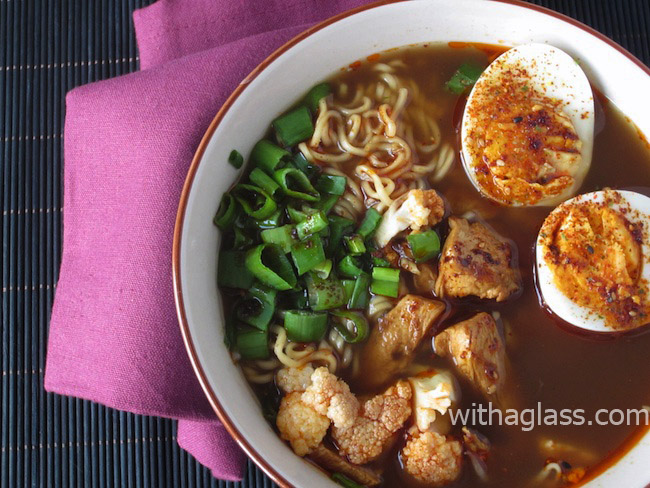
What you see above is my very first udon soup and the unorthodox toppings have only one explanation: I wanted to prepare a ramen soup*. I have been planning it for months, but when I discovered I had a choice between three different broth types, I was unable to take a decision. Hot Summer days were not very motivating either. I kept on reading attentively Hiroyuki’s Blog on Japanese Cooking, his instructions, recipes, testing his patience with endless questions and discussions… Then, I also searched Nami’s blog (Just One Cookbook) for all her Japanese soup recipes, asked her some more questions, received precious advice and… still hesitated. Thank you both for your patience!

Finally, when it started to rain and the temperature fell, I felt ready for my first ramen, but I realised I only had thicker and slightly chewy udon noodles. Then I remembered the questions Charles (from Five Euro Food) asked on my blog about a good noodle broth recipe and Hiroyuki’s answer (see both here) and decided to switched to kake udon idea (かけうどん), in other words, udon soup made with kakejiru broth (meaning “soup for pouring on”).

Even though in some source (such as Shizuo Tsuji’s “Japanese Cooking“) kakejiru contains salt and sugar, I sticked to the broth recipe given by Hiroyuki, slightly modifying his ingredients ratio (12:1:1). Since I use only low-sodium soy sauce, I doubled it and I must say it was not too salty at all. Finally, I ended up with 25:5:2 ratio for, respectively, (home-made) dashi, soy sauce and mirin and found this broth particularly good and versatile enough to withstand the strong taste of the pork marinated in ginger and garlic. Thank you, Hiroyuki, once more for all your patient and detailed advice!

IMPORTANT UPDATE: Having exchanged several messages with Hiroyuki, I have decided to add something important: if you use instant dashi (containing sodium), stick to Hiroyuki’s original 12:1:1 ratio and adjust the taste afterwards. I was able to add so much soy sauce and created 25:5:5 ratio only because home-made dashi is not salty and because I use low-sodium soy sauce.

The kake udon photos I have seen didn’t feature as many toppings and I admit the garnish was chosen rather to match my original ramen idea. However, I was right to dare it since the soup taste was simply fabulous. Looking at my photo I think I should still work on an efficient method to cut neatly a medium-cooked egg in two… It’s not as easy as I thought!

*Ramen is a nourishing wheat flour noodle soup with different toppings, served in a big bowl and adored by most Westerners, for example my husband.

Preparation: 30 minutes

Ingredients (makes one big bowl):

Broth (kakijuru):

250 ml home-made dashi (I have posted the recipe here, but you can use the instant dashi, however stick to Hiroyuki’s original ratio 12:1:1, since instant dashi contains salt; afterwards you may adjust the taste of course)

50 ml low sodium soy sauce or 25 standard soy sauce

20 ml mirin

1 egg

100 g thinly sliced pork (mine was lean)

1 small clove garlic, grated or crushed

1 cm fresh ginger, grated

1 tablespoon soy sauce

chopped chives

finely sliced small red onion

1 package udon

Combine the soy sauce, the garlic, the ginger and the pork and put aside to marinate for 15 minutes.

Prepare udon according to the instructions on the package.

Put the egg into a small pan with cold water (just enough to cover it) and cook it exactly 6 minutes after the water starts to boil.

Put it aside.

In the meantime stir fry the pork and put aside in a warm place (slightly heated oven is a good option).

Warm up the broth ingredients and put aside when they are almost boiling.

Put the noodles into a big bowl. Cover with the broth.

Carefully place the pork, the egg cut in half and chopped chives.

Serve.

Secondary Dashi (Niban Dashi 二番出汁)

As a continuation of the Primary Dashi recipe I posted last week this post will be a very short one. As a quick reminder, dashi (出し) is the most popular Japanese stock made with konbu seaweed (昆布) and dried bonito fish flakes (although there are some other types of Japanese stock…).

After the primary dashi’s preparation, more delicate and lighter in coulour (see the recipe here), the konbu and the bonito flakes (katsuobushi かつおぶし) should not be thrown away. In fact they will be used to make a secondary dashi (niban dashi 二番出汁), a bit stronger and slightly darker, perfect for nourishing soups’ base or for soups with strong tasting vegetables. The recipe is also taken from “Japanese Cooking. A Simple Art” by Shizuo Tsuji.

Preparation: <25 minutes

Ingredients:

konbu and bonito flakes leftover from the Primary Dashi

750 ml cold water

5-7 g fresh bonito flakes

Place the leftover konbu and bonito flakes in 750 ml cold water. Put it over high heat and when it starts boiling, reduce the heat and let it simmer until it is reduced by 1/3 or 1/2 (the latter will have a stronger taste).

Add the fresh bonito flakes and immediately put aside.

Wait 30 seconds – 1 minute until the flakes fall to the bottom.

Remove the foam from the surface and strain through a piece of gauze.

This time the konbu and the bonito flakes can be thrown away.

Primary Dashi, or Japanese Stock (Ichiban Dashi, 一番 出し)

Dashi (出し) is the Japanese word meaning more or less “stock”. However dashi cannot be compared to the Western countries’ stock’s concept. Dashi is THE cornerstone of the Japanese cuisine.  Without dashi cooking Japanese is not possible, “it is merely à la japonaise”, says Shizuo Tsuji. In his extraordinary “Japanese Cooking. A Simple Art“ the author very justly explains that using the instant dashi is understandable, but it is very important to understand how the traditonal dashi is made and how it tastes when prepared according to the state-of-the art rules. Thanks to Shizuko Tsuji I learnt the dashi recipe I had been preparing for years (as in the Simplified Miso Soup, using only katsuobushi, or shaved bonito fish flakes) was a shortcut used by many home and restaurant cooks. This popular method skips the first of the two stages, the one where konbu 昆布 seaweed plays the crucial role.

Konbu/Kombu 昆布 kelp, also called giant kelp  (Saccharina/Laminaria japonica in Latin), is a kind of seaweed found at Japanese and Asian grocer’s and in health food shops. It is used in the stock preparation, the sushi rice preparation, in side dishes, cooked as a vegetable… The one used in stock is sold in dry, thick, almost black strips, it is also commonly consumed  in Korea (다시마) and is quite popular in other East Asian countries. The earliest known written mention of the use of konbu in Japan dates back to the VIIIth century and gives an idea on how important konbu is in the Japanese cuisine. Click here to see different types of konbu. These are hidaka-konbu strips (also called mitsuishi-kombu) I used in my last dashi:

Following the steps in Shizuo Tsuji’s book, I prepared the Primary Dashi (Ichiban Dashi, 一番 出し) and realised the stage I had been missing for years is very short, very easy, but makes a huge difference in flavour and aroma. In fact, one can wonder how a piece of wrinkled seaweed and dried fish flakes can create something so extraordinary… Closing my eyes, inhaling the cooled dashi I found myself in my childhood years smelling the freshly caught, river fish… I closed my eyes once more and remembered the first time in my life I saw and smelled the fresh mediterranean sea breeze…

The explanations are long and detailed, but the process is very simple. Both ingredients used in primary dashi can be reused to make another stock! Click here to read the secondary dashi (niban dashi) recipe.

Preparation: 10-15 minutes

Ingredients (for 1/2 litre dashi):

1/2 litre cold water

15 g konbu strip(s)

15g dried bonito flakes (katsuobushi かつおぶし)

Put the konbu into the cold water in a pan (don’t wash it!). Hat uncovered for about 10 minutes and when it is just before the boiling point, remove the konbu.
If inserting your thumbnail into the konbu you feel the flesh is soft, it means the water has the sufficient flavour.

If it still remains tough, out back for 1-2 minutes into the water adding some more (2 tablespoons) cold water to stop it from boiling.

Remove the konbu.

Bring the stock to a boil.

Add 2 more tablespoons cold water and add immediately the bonito flakes.

Bring once more to a boil and quickly put aside.

Wait for the flakes to fall down to the bottom of the pan (it will take at most 1 minute).

Remove the foam and filter the stock through a sieve line with a piece of gauze.

Reserve both the konbu and the dried bonito flakes for the secondary dashi.


Curried Pumpkin Soup with Shrimp

I haven’t posted any soup recipe for a long time. In fact, the only one I posted was miso soup, the main reason being its extreme versatility. In fact, every time I have miso soup my impression is having a completely different dish. Moreover, since miso soup has become my staple breakfast, even when my first meal is different, I don’t feel like having soups for other meals. That being said, when the other day I saw a beautiful pumpkin on my market and realised I haven’t had any pumpkin soup this winter yet, I felt I had to repair this mistake!

I must say I’m not a big pumpkin fan. I like its colour, its fresh smell when raw (pleasantly recalling cucumber and watermelon), but I find it bland and tasteless in sweet dishes (the only pumpkin pie I have ever made was luckily devoured by a friend of mine, otherwise I would have thrown it away). On the other hand, pumpkin seems to me far too sweet for savoury dishes. Up till now, for me, the only spice mixture pumping some life into this bland fruit and disguising its sweetness is Indian curry powder. If the curry I use is mild, I also add a bit of dried chili peppers. The soup improves greatly after a night spent in the fridge and it is ridiculously easy, provided you have a mixer, a blender or a food processor.

Special equipment: a mixer, a blender or a food processor

Preparation: 1 hour

Ingredients:

1 kg pumpkin

300g fresh or frozen shrimp (deveined and shelled)

3 tablespoons curry powder

2 teaspoon chili powder (I skip it if the curry is hot)

150ml coconut milk

2 garlic cloves (crushed or grated)

1 litre chicken/vegetable stock (powdered, home made etc.)

salt, pepper

(fresh coriander)

Peel the pumpkin.

Cut up the flesh roughly. Put into the stock and cook until soft.

Mix the pumpkin and stock mixture until smooth.

Add the coconut milk, the shrimps, the garlic and the curry.

Let it simmer for 15 minutes (or more if the shrimps were frozen when you were putting them).

Adjust the taste with salt and pepper.

Serve with fresh coriander or another herb you prefer.

Miso Soup (misoshiru 味噌汁) with Tofu (Simplified)

The Japanese Miso Soup (misoshiru 味噌汁) is my favourite… breakfast. It has all the possible breakfast advantages (although it can be served at any meal!). A perfect morning meal for cold days and, in my case, hangover days too! It is also one of my comforting dishes. To sum up, miso soup is quick, low-fat, low-calorie, nourishing, very healthy, versatile… but first of all deliciously addictive.

To make a quick and simplified miso soup you need only three ingredients: miso (fermented soybean) paste, dried fish (bonito) flakes and dried wakame seaweed, all sold in Japanese groceries and all keeping for ages! This time I used a very light mild-tasting miso paste, but any other miso type can be used. Dried bonito flakes (katsuobushi, necessary to make a simplified stock, or dashi (出し), the first step in the preparation of a miso soup) are sold in big bags and keep in an airtight container for years. (See here how to make also quite quickly a REAL primary dashi, not a simplified shortcut). As for wakame seaweed, it can be bought in whole strips or already cut into tiny pieces which, in contact with water will expand into bite-sized pieces.

The rest of the ingredients depend only on your imagination and preference (hard-boiled egg, cooked vegetables, potatoes, shrimps, cooked leftover meat… anything can be added), but miso soup with tofu is a kind of basic version.

If you still have some instant miso soup or dashi stock bags, throw them away (I did after I had made my first miso from the scratch)! Dashi can sometimes be useful as a base for simmered dishes and sauces, but the instant miso soup is not even half as good as the soup made from the scratch, the whole process taking only 10 minutes! There is no excuse for the shortcuts of the shortcut (the stock version I describe here is already a simplified one).

I have been making this recipe for ages and took it (maybe with slight modifications) from Harumi’s Japanese Home Cooking by Harumi Hurikara. Easy and clearly explained recipes with Harumi’s very warm and personal comments and hints are a perfect introduction to the basic Japanese home cooking.

Preparation: 10-15 minutes

Ingredients (serves 1):

250 ml water

1 tablespoon dried bonito flakes

1 teaspoon cut and dried seaweed (or a 5 cm whole dried wakame seaweed piece)

1 tablespoon miso paste (or more, it depends on the saltiness of the miso)

100 g silken (soft) tofu

Put the seaweed in a glass of cold water to let it expand and soften. (It still amazes me how quickly the tiny teaspoon is transformed into half a glass of beautiful green leaves!)

In the meantime pour the water and dried bonito flakes into a small pan. Bring to a boil and let it boil two minutes.

Put aside. The fish flakes will go into the bottom very quickly, and then you can strain the liquid.

Throw the flakes away or boil them once more with another batch of water to obtain a milder dashi stock for the following day. (It should be stored in the fridge).

Pour back the stock into the pan (without the bonito flakes of course!). Add the miso paste and the drained seaweed (cut into bite-sized pieces if you are using a whole piece). Warm the soup for 3 minutes, stirring constantly, until it’s hot, but don’t let it boil! Cut the tofu into square pieces and put into the pan for 30 seconds.

Serve in a bowl.