Category Archives: Vietnamese

Vietnamese Green Papaya Salad

greenpapayasaladp

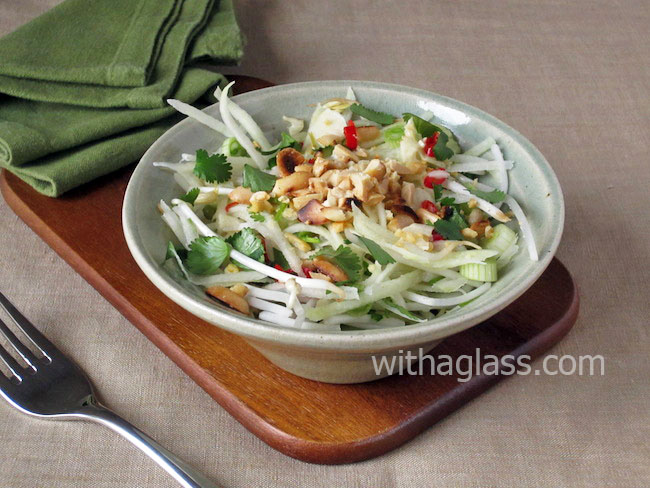
This salad has become my obsession and addiction of recent weeks. Maybe it is due to the green papaya which I have tasted here for the first time or maybe it’s the unusual, perfectly balanced hot, sour and sweet dressing… The truth is that after five or six meals in recent two weeks, instead of getting bored, I crave it more and more.

I suspect that a big part of my enchantment is due to the green papaya. Did you know that green papaya is simply unripe papaya? I suppose all my Asian friends will laugh here at my ignorance, but I’m still in awe at how huge is the difference between unripe and ripe fruit stage. While I am not fond of the ripe papaya’s overwhelming aroma, I adore the green one’s subtle, delicate scent and crunchy texture. I intend to explore more recipes from South-Eastern Asian countries and India, where apparently green papaya is very popular. Apparently papaya is not only flavoursome, but also healthy, so I hope it’s better than being addicted to bacon.

This salad is also my first step into the discovery of real Vietnamese cuisine. Frankly, since my only memories of “Vietnamese” food were greasy, heavy dishes in thick, sticky floury sauces, this salad was a revelation. The recipe comes from “Vietnamese Street Food” by Tracey Lister and Andreas Pohl, a book I have recently bought when I realised I didn’t know much about this country’s cuisine and didn’t have a single Vietnamese cookery book. The book is not an introduction to the Vietnamese cuisine, but only to its street food which for me is a fascinating world, so absent in European culinary culture. It is beautifully designed, contains luscious photos and tempting recipes. While reading it I realised that many ingredients used in Thai cuisine are also used in Vietnam and, as I have already mentioned in a previous post, Vietnamese use my beloved shiso quite a lot (called tia to or ti to, but don’t ask me how to pronounce it).

I have slightly modified the recipe, skipping dried beef  and fried shallots I didn’t have. I don’t know how much I missed without these ingredients (every time I made it I skipped them), but the result was awesome and far beyond my expectations.

Preparation: 15 minutes

Ingredients (serves 2 as a side dish):

1/4 medium green papaya

a handful of soybean/mung bean sprouts

3 Asian spring onions (white and whiteish parts only) or 1 Asian shallot (advised in the original recipe)

1 heaped tablespoon toasted and roughly crushed peanuts

1 heaped tablespoon fried onion/shallot (I have skipped it)

leaves from 4 branches of coriander

Sauce:

1 small bird’s-eye-chili, finely chopped

1 garlic clove, thinly sliced

2 flat tablespoons sugar or Agave syrup

1 tablespoon fish sauce

juice from 1/2 lime

(shredded dried beef)

Peel the papaya and cut it into long matchstick threads (a mandolin is a good tool here).

Combine it with the sprouts, chopped spring onions and coriander leaves.

Mix the sauce ingredients and pour them over the vegetables.

Stir well, sprinkle with peanuts and serve.


Spring Rolls with Soba Noodles and Cucumber

sobaspringrollsp

Still in a joyful mood as a recent Charles’s guest blogger, here I am, travelling far across the ocean, straight to MJ’s Kitchen. Fascinated by MJ’s Southern cuisine, so exotic and different from mine, and impressed by her meticulous approach to every single recipe and ingredient, I am very proud to guest post for her today and sincerely hope you will visit her beautiful blog.

Given my passion for the Asian cuisine, I was glad that MJ suggested it for today. The last hot sunny days are still there, so I have chosen to present you a recent snack discovery. It is a cross between Vietnamese and Japanese cuisine, driven by an inspiring recipe on a… Korean blog. It sounds a bit complicated, but in reality this four-ingredient recipe is quite quick and simple.

Vietnamese rice paper used to prepare the famous spring rolls is a versatile staple I enjoy every summer. It is easy to stock, it has a very long shelf life and filled with vegetable or meat leftovers, it can be transformed into delicious, light sandwich alternatives. Even though I experiment a lot with rice paper, I would have never thought of combining them with Japanese soba noodles (see below), if I hadn’t spotted Soba and Kimchi Rolls at Heart Mind and Seoul blog. The rolls looked delicious and the presence of soba noodles was particularly surprising and tempting. The day I decided to recreate this recipe I ran out of kimchi, so I decided to replace it with cucumber for a crunchy, fresh note.

These simple rolls proved one of these rare vegetarian (and even vegan) snacks in which, even as an avowed carni- and piscivore, I didn’t mind the absence of fish or meat. This was probably due to the fact that soba noodles have a high protein content and are quite filling. They are satiating, but not heavy thanks to the substantial amount of the cucumber and the light, hot dipping sauce. They are an excellent alternative to sandwiches and I have particularly appreciated them as an afternoon snack. Halved horizontally, they make original party finger food. For a more complete meal, I can imagine them as a side dish with grilled meat or fish. Thank you, Sook, for the inspiration!

Soba (蕎麦) means in Japanese both buckwheat and buckwheat noodles. Soba noodles have a nutty taste and a characteristic strong aroma and can be served in both hot and cold dishes, the latter being particularly popular in cooling summer dishes.  They are popular in whole Japan, but are apparently particularly in Tokio. According to wikipedia, in the Edo period (from 1603 to 1868) the rich population of Edo (the ancient name of Tokio) who consumed only white rice, poor in thiamine (vitamin B1) the deficiency of which lead to beriberi. When it was discovered that soba was rich in thiamine, the Edo population started to consume it in big amounts.

Buckwheat is not only transformed into flour and  consumed not only in Japan. In fact hulled and roasted buckwheat grains are very popular in several Central and Eastern European countries (Russia, Poland, Ukraine…). In France “gallettes” or savoury crêpes originating from Brettany region are also made with buckwheat flour. Belonging to the Fagopyrum genus, buckwheat is not a grass, nor a cereal, even though it looks like one. Its qualities are so numerous, it is surprising most of the Western countries never consume it. It is very rich in protein, minerals, antioxydants, iron and doesn’t contain any gluten, so can be consumed by people who don’t tolerate it.  Moreover, buckwheat grows very quickly and easily. That is why it can be cultivated in cold climate and crops can be easily multiplied in hot regions. If you ever have the chance, taste buckwheat honey. It has an unforgettable aroma and taste.

TIP: Dried noodles called “soba” can be bought in Japanese grocery shops, but most of them contain a mixture of buckwheat and wheat flours, so check well the ingredients before buying. My favourite are 100% buckwheat soba (juwari 十割 or towari) because of their intense flavour and aroma, but some people find it too strong. Soba noodles are usually light brown, but they can also be green when mixed with green tea (cha soba) or seaweed (hegi soba) and light pink when flavoured with cherry (sakura soba).

Preparation: about 20 minutes

Ingredients (for 5 – 6 rolls):

6 rice paper sheets (22 cm/about 8,6 in. diameter)

50 – 60 g (about 2 oz.) soba noodles

1/2 big cucumber

2 – 3 tablespoons toasted sesame seeds

Dipping sauce:

5 tablespoons low sodium soy sauce (or less if using standard soy sauce)
1 tablespoon chili oil
2 tablespoons rice vinegar

Cook the soba noodles for 3-4 minutes in boiling unsalted water (the time depends on the brand and the kind of noodles, so check the exact time on the package).

Drain the noodles with very cold water to stop them from further softening.

Cut the noodles in two (shorter noodles will be easier to use here) and put aside.

Prepare the cucumber cutting it in 6 cm sticks.

Fill a big wide bowl with warm (not hot) water.

Dip rice paper sheets one by one in the water, immersing them delicately so that you don’t break them.

As soon as the sheet softens (about ten – twenty seconds), put it onto a chopping board.

Place horizontally, about 5 cm/2 in. from the rice paper edge which is closest to you, a stack composed of noodles and cucumber pieces.

Sprinkle with sesame seeds and roll tightly but delicately, starting from the edge which is closest to you.

Proceed in the same way with the remaining rolls.

Serve them immediately as they are or cut in two horizontally.

If you wish to serve them later, wrap them individually in cling film because they dry out very quickly.

Spring Rolls with Surimi Crab Sticks, Avocado and Lettuce

surimispringrollsp

Despised by many people, surimi crab sticks (or imitation crab sticks) are one of the rare processed products I regularly buy. They are the lightest snack I can imagine, have a long shelf – or rather fridge – life, they are easy and quick to use in salads, maki sushi and are quite enjoyable if paired with certain ingredients. There is also a question of brand because imitation crab can easily become awful. Among all the French brands I have tested, only one (Coraya) is edible. In short, I stick to one brand, I don’t expect too much from surimi sticks and they never disappoint me.

I often use surimi crab sticks in maki sushi and this was the first time I tested them in spring rolls. When a couple of days ago I saw A_Boleyn’s appetising Shrimp Summer Rolls, I thought I should write about my rolls which, apart from rice sheets, are completely different from hers. I left out glass noodles and even though I haven’t followed any recipe, I must have been influenced by the Japanese Nama Harumaki, raw spring rolls containing lettuce. The rolls were really good and refreshing, not as filling as the traditional ones (with glass noodles), but perfect as a light meal or snack or why not a breakfast on a hot summer day. Since they contain already mayonnaise, Worcestershire sauce and Tabasco, they do not necessarily need any additional dipping sauce, but a simple mixture of low-sodium soy sauce, chili oil and vinegar is the best option for me.

TIP: Do not use bitter lettuce here (I used here my favourite “rougette” with slightly violet leaves, but the international iceberg would be perfect too)

Preparation: 15-20 minutes

Ingredients (10 rolls):

10 (22 cm or 8 3/4 in) rice paper sheets

10 small lettuce leaves (or 5 big leaves, halved); 

1 avocado

10 surimi/imitation crab sticks

1/2 big cucumber

mayonnaise

Worcestershire sauce

Tabasco

Cut both the avocado and the cucumber into thick strips.

Remove the thick and tough parts of lettuce leaves (they might tear the delicate rice sheets).

Fill a big wide bowl with warm (not hot) water.

Dip rice paper sheets one by one in the water, immersing them delicately so that you don’t break them.

As soon as the sheet softens ( after about ten – twenty seconds), put it onto a big chopping board.

Place first a lettuce leaf, then, horizontally (at the edge which is closest to you) cucumber strips, avocado strips, some mayonnaise, Worcestershire sauce, Tabasco and a crab stick. Roll tightly starting from the edge which is closest to you.

Proceed in the same way with the remaining rolls.

Serve them immediately as they are or cut in two horizontally.

If you wish to serve them later, wrap them individually in cling film because they dry out very quickly.


Spring Rolls with Leftover Roast, Carrot and Mint

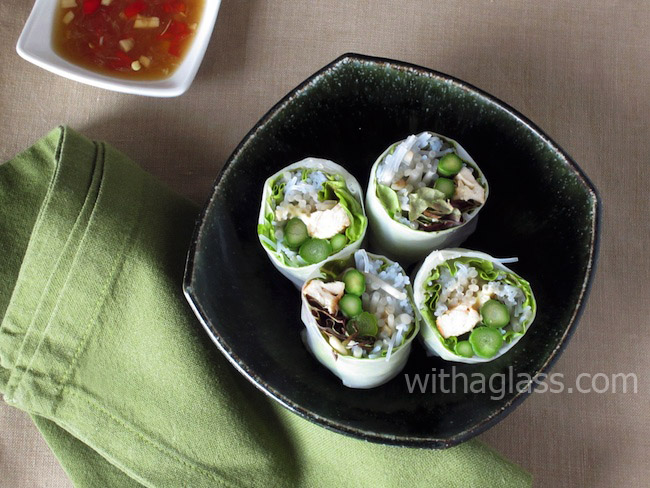
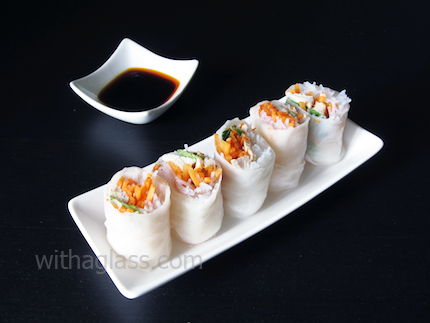
What do you do with leftover roast? For many years I used to put it into salads, sandwiches or stir-fries and then one day I simply wrapped them in rice paper with some vegetables and glass noodles, making very unorthodox version of spring rolls. Since then this is the first thing I think about when I take out the leftover roast from the fridge. Spring rolls with leftover meat proved not only easy, quick and healthy, but most of all extremely versatile and convenient. They can be made with any vegetable found in the fridge, while rice paper and glass noodles can be stocked for long months or even years. If you have ever made spring rolls you probably know that they can be served for any meal of the day, as a starter, a snack or a main dish. They are also an excellent choice for a picnic, for packed lunch at work and I often prepare them for long car journeys instead of traditional sandwiches. (If you are not the one who drives, you can even dip them in a bowl of sauce!). Last but not least, they can be made well in advance and kept in the fridge for several days (as long as they are tightly wrapped in cling film).

The rolls can be served with any sauce of your choice, but my absolute favourite now is a mixture of soy sauce, chili oil and vinegar. It’s hot and slightly acid thank to the vinegar.

Preparation: 30 minutes

Ingredients (serves two):

2 big slices of roast chicken, turkey, pork, beef, lamb…

6-8 (22 cm or 8 3/4 in) rice paper sheets

1 small individual package of glass noodles (40 g)

2 big carrots

mint leaves

(roast sesame seeds)

Dipping sauce:

5 tablespoons low sodium soy sauce (or less if using standard soy sauce)
1 tablespoon chili oil
2 tablespoons rice vinegar

Cover the noodles with boiling water. Put aside for 15 minutes.

In the meantime cut up the carrots into matchsticks and cut the roast slices into rectangular pieces.

Combine the sauce ingredients in a bowl.

Fill a big wide bowl with warm (not hot) water.

Dip rice paper sheets one by one in the water, immersing them delicately so that you don’t break them.

As soon as the sheet softens ( after about ten seconds), put it onto a chopping board.

Rinse the noodles.

Place horizontally a stack of the carrot and roast pieces, a bit of the noodles and the mint leaves close the the rice paper edge (the
one which is closest to you).

Sprinkle with sesame seeds if you like them and roll tightly starting from the edge which is closest to you.

Proceed in the same way with the remaining rolls.

Serve them immediately as they are or cut in two horizontally.

If you wish to serve them later, wrap them individually in cling film because they dry out very quickly.