Category Archives: Scallops

Korean Pancake with Shrimp and Scallop (Haemul pajeon 해물파전)

koreanpancakep

What you see above is my first, partly successful, attempt to prepare the famous Korean seafood pancake. I say “partly successful” because in spite of a burnt part and some other mistakes, I was literally spellbound by this extraordinary snack. First, I thought I would wait a second, better prepared and better looking batch before posting it, but finally I couldn’t wait to share with you my first experience with for what I consider as one of the most memorable dishes I have discovered in recent months or maybe even years.

Seafood pancake (haemul pajeon 해물파전)  is a very popular Korean snack or starter. Apparently it is served cut into small pieces and eaten with hands (I say “apparently” because I have never seen it in any restaurant here). It is composed of a batter made with two types of flour, several seafood species, chili peppers and spring onions. The original recipe (found in The Food and Cooking of Korea by Young Jin Song ) calls for five marine creatures and enoki mushrooms, but since I had leftover shrimp and scallops, I used only these and adapted the amounts to a smaller batch. As I have mentioned above, I had made some mistakes, but the preparation was really easy and quick (I was just a bit distracted) and the result impressive. Frankly, when I had prepared the pancake I didn’t imagine it even half as good as it proved, so the first bite was a huge surprise. I felt as if I were eating a very distant, more sophisticated cousin of a pizza, but it has also slightly reminded me of the Japanese okonomiyaki (see my last chicken version here). Both me and my husband were blown away by the result and the whole batch disappeared in no time at all. I will not exaggerate if I say I know I will prepare it dozens or rather hundreds of times in the near future and serve it for brunch, lunch, picnic or party snacks.

You will be surprised to notice that apart from the dipping sauce the recipe doesn’t require a single Korean (or in general Asian) ingredient. In fact, it can be prepared with very international ingredients, available worldwide. On the other hand the sauce, which brings an important Korean touch was a pure delight and I will never skip it.

Preparation: 20 minutes

Ingredients (serves 2 as snacks):

10 medium shrimps shelled and deveined (cooked or raw)

4 scallops

3 spring onion stalks

1/2 medium hot green chili

1/2  medium hot red chili

1 clove garlic

Batter:

1/2 cup plain flour

2 tablespoons cornstarch

200 ml ice cold water

1/3 teaspoon salt

1/2 teaspoon sugar

1 egg, beaten

Dipping sauce:

3 tablespoons soy sauce

1 tablespoon rice vinegar

1 stalk of spring onion finely cut

1 clove garlic, crushed or grated

1/2 teaspoon sesame oil

1/2 teaspoon toasted sesame seeds

Prepare the dipping sauce and put aside.

Prepare the pancake ingredients. Cut the scallops in two horizontally in order to obtain eight flat, round slices.

Slice the garlic finely.

Slice the chilies into very thin strips.

Slice the spring onion stalks into thin strips.

Prepare the batter combining all the ingredients.

Heat some oil in a big pan. (Keep the pan on medium heat, otherwise the pancake will be burnt like mine).

Pour 1/3 of the batter and make sure it spreads on the whole surface.

Scatter the shrimps, scallops, spring onions, chilies and the garlic over the batter and quickly pour on top the remaining batter.

Cover and fry on medium heat until the seafood is cooked.

Turn it over and fry for about two or three minutes just to brown this side a bit too.

Slice the pancake into small pieces (one or two bite-sized) and serve with the dipping sauce.


Scallops with Green Curry

I always seem to have too much food stocked in my cupboards, in my fridge and, most of all, in my freezer. From time to time, when I feel my kitchen is overflowing, I make freezer/fridge/cupboards-emptying days, which allow me to make some free space and are ideal occasions to create new dishes playing with what is on hand.

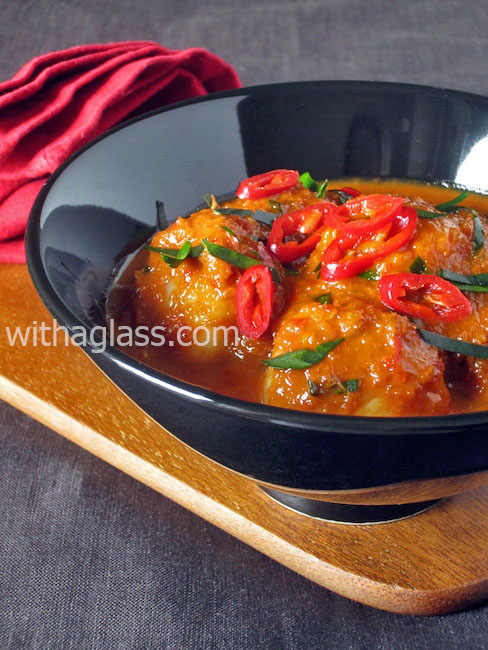
Scallops with green curry are one of the results of my last week’s freezer-emptying action. First, I should emphasize this is not the famous Thai curry dish. Thai curry has several obligatory ingredients, such as galangal root, and I didn’t have them, so I won’t pretend it was a curry. However, I always have some curry paste in the fridge, coconut milk in the cupboard, lime leaves and lemongrass in the freezer, so such “vaguely Thai” sauces or soups appear quite often on my table.

This dish is particularly well adapted to frozen seafood. It can be cooked without being thawed beforehand, which makes the whole process quicker and easier. Some time ago I would never dare combining scallops with fiery spices, but since I started to grill them with gochujang (see the super-easy recipe here), I realised they can support even very hot seasonings without losing their delicate taste. Green peas also come from my freezer, but they can be substituted with any vegetable of your choice. I thought it was important to add some bright vegetables, since, contrary to its name, green curry is not really green, but has a dull greyish colour…

Before I pass to the recipe details I would like to thank Helen and Mai (who are not blogging as far as I know) for their kind messages concerning my Easiest Apple Cake baking results. I am very happy you have enjoyed this cake and am very grateful for your result “reports”. I am very surprised and proud to say that with Zsuzsa’s last week’s beautiful version, this is the most successful recipe I have ever posted!. I would also like to thank Kelly, from Inspired Edibles, who in the meantime has become the biggest specialist of the Shoyu Chicken and who leaves heartwarming messages whenever she prepares it. Having one’s recipe realised is the most rewarding part of food blogging, so thousand thanks to all those, who have ever prepared a recipe from my blog!

Preparation: 30 minutes

Ingredients (serves 2):

10 scallops (fresh or frozen, without the orange part)

100 g green peas (frozen, not canned)

1 red bell pepper, sliced

1 stalk lemongrass

3 lime (kafir) leaves

200 ml chicken or vegetable stock

a couple of tablespoons fish sauce

50-100 ml coconut milk

3 tablespoons green curry paste (or more/less depending on your curry hotness level and on your preferences)

Cut the lemon grass in two or three pieces and crash them with your knife’s handle.

Put them in a pan with the chicken stock, add the curry and the lime leaves.

Let the stock cook for about 10 minutes.

Add the coconut milk, the scallops, the bell pepper (or other harder vegetables) and let it simmer for about 15 minutes.

At the end add the fish sauce and the frozen peas and finish the cooking process simmering for 5 more minutes.

Serve with rice or with bread.


Scallops Fried in Nori, or Hotate no nori age

This simple, but surprising way to prepare scallops is another palatable – but maybe not visually appealing – discovery I owe to the Japanese Cooking. A Simple Art by Shizuo Tsuji. I have already written about this incredible book for example here, so I will not bore you with my enthusiastic impressions or details. I will just say that not only do I praise it as highly as at the beginning, but the longer I have it, the more I am convinced it is the best cookery book I have ever seen in my life.

This frying method is defined as “Kawari age”, meaning “variation frying”. According to Shizuo Tsuji, it is quite a recent innovation in the Japanese cuisine (although the book was written about 30 years ago). Just like tempura, this method consists in deep-frying, but first the food is dipped in the egg white and then in different types of coating.

As a recent, but avowed fan of deep-fried scallops (see here the recipe for Deep-Fried Breaded Scallops), I decided to try them in one of the kawari age coatings. I experimented with several of them, with more or less successful results (e.g. I strongly advise you against poppy seeds, which become very bitter), but chopped nori seaweed (the one used for maki rolls) was the absolute winner. Fried nori darkens and becomes crunchy, but doesn’t lose its delicate “oceanic” flavour or aroma and proves extraordinary with scallops. Strangely, scallops in crunchy nori remind me a bit of the freshly caught, fried, small river fish.

The instructions are quite easy to follow, the only really tricky part being the stickiness of the chopped nori. While coating the scallops I would advise placing chopped nori on a flat surface, a portion only for one scallop at a time.

I have almost forgotten to emphasize it’s an excellent way to use up leftover egg whites.

Preparation: 30 minutes (or more, depending on the batch and the size of the deep-frying pan)

Ingredients (serves 2):

10 scallops without the coral and opaque, tough “foot” (cut horizontally in two, if they are very big)

3- 4 sheets of nori seaweed

a couple of tablespoons flour

1 egg white

(salt)

Preheat the deep-frying oil (it’s hot enough when a tiny piece of bread thrown into the fat doesn’t “sink” and stays on the surface instantly browning).

Chop the nori seaweed very finely (scissors are very handy here) and place a portion for one scallop on a flat surface.

Beat slightly the egg white with a fork or with chopsticks.

Sprinkle some salt on the scallops (this step is not necessary) and dip them first in the flour, then in the beaten egg and then roll them in the chopped nori.

Deep-fry the scallops until they are golden.

I found them delicious served simply with soy sauce and rice.

Scallops and Red Onions on Toast

One more desacralization of the venerated scallop! And a pure delight at the same time! The above seemingly simple toast was realised following a recipe from “La Cuisine de Fumiko Kono” by Fumiko Kono (狐野扶実子), a Japanese chef fascinated by the French cuisine. When my husband offered me this book I had been dreaming of, I was in heaven, but at the same time thought it would be one of those cookery books I read, admire, devour with my eyes, but never use in the kitchen. However, I quickly realised Fumiko’s style, albeit obviously in the category of what the French call haute cuisine, lacks the usual stiffness and seriousness, adds a joyful and playful dimension and thus emboldens the reader, namely me, to try out the scarily precise and beautifully presented inventions and even to omit and modify certain points.

Scallops and Red Onions on Toast were my first choice, since the scallop is one of my favourite sea creature. Even though serving scallops on toast may seem very down-to-earth or even disrespectful, the ingredients create a very unusual and surprising combination. If prepared with good quality bread (a nice crunchy baguette is perfect here) these toasts impress everyone.

Preparation: 10-15 minutes

Ingredients (serves 4):

12 big scallops (3 per person)

4 slices crunchy good quality bread or 1 baguette

30 g salted butter

4 heaped tablespoons cream cheese (in France St – Môret is the best)

40 g radish (I didn’t have any, so you won’t see it at the above photo)

320 g red onions

fresh coriander leaves

2/3 teaspoon Indian curry (madras)

1 tablespoon white wine vinegar (the second time I made these toasts I used good, Japanese rice vinegar and the result was very good too)

1 tablespoon extra virgin olive oil

good quality sea salt (fleur de sel if you can find)

Peel the onions. Put aside one onion, slice the rest and sauté in butter until they are soft and slightly caramelised.

Pour the vinegar, let it evaporate, stirring.

Put aside.

Slice the radish and the remaining onion very thinly  and let them soak 3 minutes in ice cold water. Drain them, pat them dry and put aside.

Sauté the dried scallops in oil, 2 min on each side, on a very hot frying pan.

Cut them in two (height-wise) and sprinkle with a bit of salt.

Spread the cream cheese on bread, place the fried onions, the scallops, the radish and the thin raw onion rings (I have forgotten this step on the photo above, but don’t forget to add the thin rings, the crunchy side is delicious!).

Decorate with coriander leaves and serve.

Deep-Fried Scallops

I have a very quickly growing affection for scallops. They are delicious, smell divinely (the detail which I find rare in seafood), are beautiful and even very pleasant to manipulate – I love their soft texture and smooth surface. They are also difficult to spoil, the only faux pas being overcooking. Not to mention the low-calorie and low-fat factor. Moreover, the constantly increasing fish and seafood prices eliminate them out of the luxurious sea products group and embolden me to even very adventurous experiments.

Yesterday I think many rigid, French cuisine fans would have said I crossed all the limits of decency in scallops experiments. I simply wanted to transform them into a warming, down-to-earth, home dish… All the French cookery books were of course out of question and I was right opting for The Boston Cooking-School Cookbook by Fannie Merritt Farmer. I have chosen the Fried Scallops. The sacrilege I committed was not only deep frying them, but sticking completely to the recipe and  coating them with breadcrumbs, a culinary technique often associated with fast food. The only modification I introduced was using duck fat for frying, and, as always, it hasn’t let me down.

If I haven’t dared this “barbarous” recipe I would have never imagined scallops could be so tender and mellow, almost juicy. The taste was unforgettable. Even though they lose here their low-fat and low-calorie advantage, I’ll certainly deep-fry them hundreds if not thousands of times. (I don’t advise trying to make this recipe lighter by baking the crumbled scallops in the oven; I did it once and the result was more than disappointing… On the other hand the oven is very handy in keeping the plates warm keeping scallops warm while the following batches are made.)

Preparation: 30 minutes (or more if more batches of scallops are fried)

Ingredients (serves 2):

14 big scallops (without the coral and opaque, tough “foot”)

10 tablespoons breadcrumbs

1 egg, slightly beaten

salt, pepper

deep frying oil or duck fat

Wash the scallops and pat them dry.

Add salt and pepper to the beaten egg and place it on a small plate.

Place the breadcrumbs in a small bowl.

Heat the plates in the oven.

Heat the deep frying oil or fat (it’s hot enough when a tiny piece of bread thrown into the fat doesn’t “sink” and stays on the surface instantly browning).

Dip the scallops first in the beaten egg, then in the breadcrumbs.

Shake off the excess coating and fry them only several at a time, otherwise the oil temperature will lower and they’ll be soaked in fat. The number of scallops in one batch depends of course on the size of your pan.

Fry the scallops around 3 minutes until they are golden.

Put them on paper towels, shake off the excess fat and put them quickly on the warm plates kept in the oven at 50°C.

I serve them with a green salad and slightly hot fruit sauces, jellies, spreads etc. (they go perfectly well with Gold Chili Jelly).

Scallops in Teriyaki

Teriyaki is a Japanese cooking method, which consists in broiling or grilling meat or fish in a glazing sweet sauce. Teriyaki sauce is composed of mirin (sweet cooking sake), soy sauce and sugar. Chicken teriyaki is on the menu in most Japanese restaurants abroad and its recipe is in all the cookbooks for foreigners. The fish prepared with teriyaki method is apparently much more frequent in Japan. Since the Japanese have even teriyaki hamburgers, why not scallops?  Since the day I dared – and never regretted – putting gochujang (the Korean hot pepper paste) on the scallops, I have been making further experiments, and glazing them with teriyaki sauce was another one worth trying (although I am certainly not the only one who tried preparing scallops this way…).

Ready made teriyaki sauce can be bought in every Japanese shop, but making it at home is very quick, easy and leaves a full control of sweet and salty balance. Its four ingredients are not difficult to obtain. Soy sauce can of course be found everywhere, and mirin and sake can be bought in every Japanese or Korean shop, very often in other Asian shops. I have even seen mirin in certain “normal” supermarkets.

Preparation: 15 minutes

Ingredients (serves 2):

16 – 20 shelled scallops without the roe

2 tablespoons oil

teriyaki:

3 tablespoons mirin

2 tablespoons soy sauce (or 3 if you have low sodium soy sauce)

1 teaspoon sugar

3 tablespoons sake

(grilled sesame seeds)

(ground pepper)

Wash and pat dry the scallops. If you want a stronger taste, sprinkle them with ground pepper.

Bring mirin and sake to boil, add the soy sauce and the sugar. Stir until the sugar is dissolved and put aside.

Warm the oil in a big pan. When it’s very hot, put the dried scallops and colour them 1-2 minutes on each side.

Pour the teriyaki sauce over the scallops, stirring a bit. Wait until it thickens and starts coating them.

Put the scallops on a plate, pour the thickened sauce over them and sprinkle with sesame seeds.

Serve with rice and stir – fried vegetables (snow peas go very well with scallops).

Scallops with Gochujang

Have you ever heard that preparing scallops with strong tasting or hot condiments is the biggest faux pas?  I’ve read or heard it thousands of times. Sometimes not believing the “specialists” and taking risks, even with expensive products, is worth it. In fact, the day I tried scallops in Thai green curry sauce (click here to see my version of Thai curry) was a huge revelation! Scallops might look innocent, but they support perfectly well even very hot sauces (unless one is not used to or doesn’t like hot dishes of course!).

Talking of hot condiments…. if you shop sometimes at Asian groceries, you might have come across this red box:

Gochujang is a Korean condiment based, among others, on hot pepper and fermented soybean. It is dark red, a bit sticky, very hot and slightly sweet. In Korean cuisine gochujang is put into soups, sauces and marinades, and that is also how I often use it. If, like me, you love the combination of sweet and hot, you will become addicted to gochujang! I have been using it for a couple of years and frankly cannot imagine finding my red box empty one day!

Anyway, let’s get back to the point! The last time I had scallops in my fridge I was in a lazy mood and didn’t want to cook anything complicated or/and long. Whenever I opened the fridge to find an idea the scallops seemed to wink at me… When I noticed my eternal gochujang box in the fridge, I simply had the idea to put them together! Personally I really liked the result, and to make matters worse for culinary purists, I found it really luscious with… sour cream! (My idea of trying the sour cream came from the gochujang and sour cream cold sauce I often use as a dip).

Preparation: about 15 minutes (depending on your oven)

Ingredients:

as many scallops as your appetite dictates you (shells and corals discarded)

a dollop of gochujang per each scallop

sour cream (or sour milk for a lighter version) served as a sauce

Preheat the oven upper grill.

Wash the scallops. Pat them dry and place on a dish or baking paper.

Spread some gochujang on every scallop and put them under the grill (not too close to the grill though, otherwise they’ll get burnt while still raw inside).

Grill them checking if the bottoms of the scallops are well cooked (no longer transparent, but white and opaque).

Serve with rice or good quality crunchy bread and do try the sour cream or milk!