Category Archives: Duck

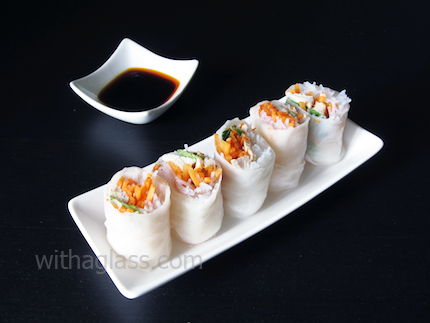
Spring Rolls with Leftover Roast, Carrot and Mint

What do you do with leftover roast? For many years I used to put it into salads, sandwiches or stir-fries and then one day I simply wrapped them in rice paper with some vegetables and glass noodles, making very unorthodox version of spring rolls. Since then this is the first thing I think about when I take out the leftover roast from the fridge. Spring rolls with leftover meat proved not only easy, quick and healthy, but most of all extremely versatile and convenient. They can be made with any vegetable found in the fridge, while rice paper and glass noodles can be stocked for long months or even years. If you have ever made spring rolls you probably know that they can be served for any meal of the day, as a starter, a snack or a main dish. They are also an excellent choice for a picnic, for packed lunch at work and I often prepare them for long car journeys instead of traditional sandwiches. (If you are not the one who drives, you can even dip them in a bowl of sauce!). Last but not least, they can be made well in advance and kept in the fridge for several days (as long as they are tightly wrapped in cling film).

The rolls can be served with any sauce of your choice, but my absolute favourite now is a mixture of soy sauce, chili oil and vinegar. It’s hot and slightly acid thank to the vinegar.

Preparation: 30 minutes

Ingredients (serves two):

2 big slices of roast chicken, turkey, pork, beef, lamb…

6-8 (22 cm or 8 3/4 in) rice paper sheets

1 small individual package of glass noodles (40 g)

2 big carrots

mint leaves

(roast sesame seeds)

Dipping sauce:

5 tablespoons low sodium soy sauce (or less if using standard soy sauce)
1 tablespoon chili oil
2 tablespoons rice vinegar

Cover the noodles with boiling water. Put aside for 15 minutes.

In the meantime cut up the carrots into matchsticks and cut the roast slices into rectangular pieces.

Combine the sauce ingredients in a bowl.

Fill a big wide bowl with warm (not hot) water.

Dip rice paper sheets one by one in the water, immersing them delicately so that you don’t break them.

As soon as the sheet softens ( after about ten seconds), put it onto a chopping board.

Rinse the noodles.

Place horizontally a stack of the carrot and roast pieces, a bit of the noodles and the mint leaves close the the rice paper edge (the
one which is closest to you).

Sprinkle with sesame seeds if you like them and roll tightly starting from the edge which is closest to you.

Proceed in the same way with the remaining rolls.

Serve them immediately as they are or cut in two horizontally.

If you wish to serve them later, wrap them individually in cling film because they dry out very quickly.


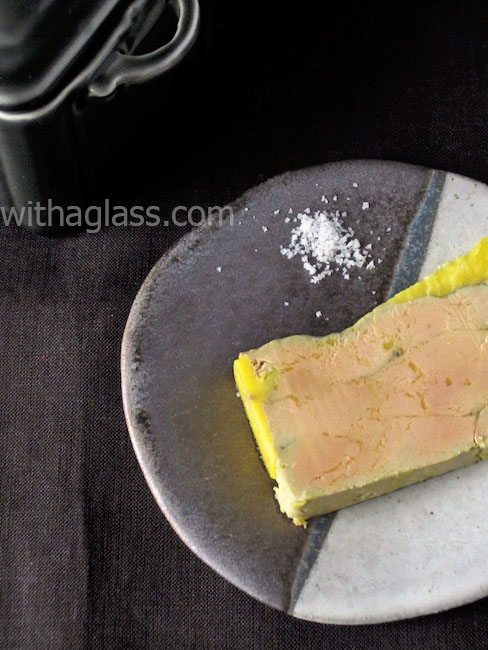
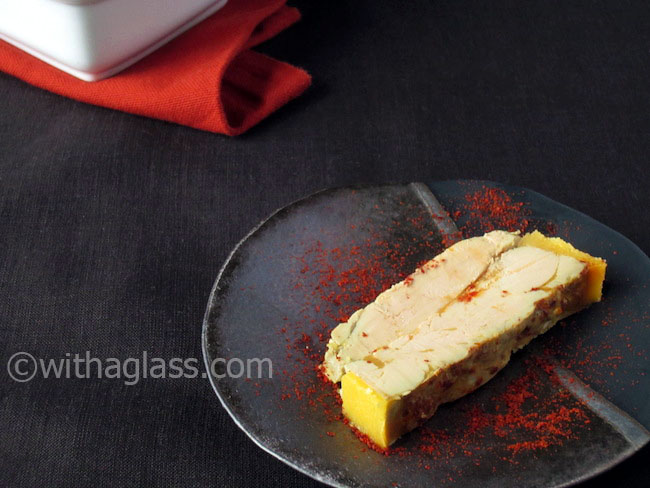
Fat Liver Terrine with Port, or Foie gras au porto

Foie gras, or fat liver, was my love at first bite. Only later did I realise the foie gras I tasted for the first time in my life was a particularly excellent one, brought by a French friend’s mother living in Perigord, the most renown French fat liver producing region. I quickly realised I wouldn’t taste such a good fat liver very often (or never!), since this delicacy doesn’t  accept lower quality or careless preparation compromise. It can be prepared in many ways, the most famous two being very simple, quickly fried “steaks” and, more elaborate and complex “terrine”, cooked in the oven, in hot water bath, and served cold. The cooked fat liver takes several days to develop its aroma and taste, so if one wants to follow the French trend and serve it for Christmas, today is the best day to start preparing it.

Fat liver production dates as far back as Ancient Rome, when birds were force-fed figs, and the method was so widely  practised that the latin “ficum” is a root word for French “foie” or Italian “fegato”. Nowadays, France is by far the biggest fat liver consumer and producer in the world. Many people don’t know that Hungary is another European country largely consuming and producing fat liver, but mostly goose liver, while in France duck liver dominates.

Most people don’t dare preparing fat liver at home. I was also afraid of doing it, but after my first attempt I understood that obtaining excellent results (especially from the visual point of view) was difficult, but preparing a good terrine wasn’t that hard. Even my first clumsy overcooked terrine was actually much better than any other I have ever bought in a shop. In fact, even though my terrines look always messy in comparison to those served in restaurants, the taste is sometimes even better!

Apart from the waiting time, the most difficult part in the preparation is deveining. The liver has bigger and smaller veins, and more of those are removed, the better. The trick is to find the right compromise between removing as many veins as possible and not tearing the liver apart in hundred pieces.

Fat liver terrine recipes are galore and mine is loosely based on the mixed sources, such as my family advice, internet tips and cookery books recipes. Different alcohols can be used and mixed (armagnac, cognac…) to marinate the liver, but I often make it with cheap tawny port and it’s really good too. I have never cooked goose liver, so I don’t know if goose liver should be prepared in a different way.

Foie gras is usually served as a starter, with toast on individual plates in slices (which should never ever be squashed and spread on the bread like a vulgar supermarket pâté!), but it also makes wonderful finger food when served on small toasts. Good quality – flaked or big grained – salt sprinkled over a piece of the terrine or a toast is the ultimate touch. Every meal and every time of the day is perfect for foie gars. A late Sunday breakfast is one of my favourite moments to enjoy it…

Special equipment:

good tweezers (the best would be the special ones for fish bones removal, but good eyebrow tweezers should do)

a “terrine” dish (with a cover)

a cooking thermometer (this is not obligatory, but makes the cooking time control much easier)

Preparation: 2,5 hours + 24 hours in the fridge + 30-40 minutes cooking+minimum 48 hours in the fridge before serving

Ingredients:

1 duck liver

10 tablespoons port or another aromatic alcohol of your choice

1/2 litre water

1/2 litre milk

salt, pepper

Take the liver out of the fridge.

Let it warm up to the room temperature.

Divide the two lobes and carefully take out first of all the main veins and as many small ones as you manage.

Put it into tepid mixture of water and milk for 2 hours.

Take it out, pat dry. Put the first part of the liver in the terrine dish.

Season with salt, pepper and half of the alcohol.

Put the second part, season, add the rest of the alcohol and slightly press.

Cover the dish and leave in the fridge for 24 hours.

Preheat the oven at 130°C.

Put some hot water (60°C) in a big shallow dish, put the dish with the liver inside, so that the water covers 3/4 of the dish height.

Cook in the oven for around 40 minutes, checking the central temperature of the liver.

It shouldn’t have more than 50-65°C inside.

Take it out and let it cool.

Discard most of the fat formed at the top of the terrine.

Press it slightly (or press with something heavy, such as a wooden board).

Put into the fridge for at least 48 hours.

Serve it either in individual slices with bread/toast aside or on small toast (dipping the knife in hot water makes the cutting easier).

It tastes particularly well with fruit chutneys.

Traditionally sweetish sauternes wines are advised with fat liver, but apart from the very old toned down sauternes, I drink it only with red or white fruity, dry wines.

Duck Confit, or confit de canard

Duck confit is roughly duck’s meat cooked slowly in fat. It doesn’t sound very exciting or light, however I still have to find someone who doesn’t like this dish and, frankly, I am sure it actually does less harm to your body than having a pizza. Confit is like a magic wand transforming fat, ordinary and rather dry duck legs into soft, tender and addictive delight. A full-bodied good red wine is its inseparable friend!

Duck confit comes from the South-Western France, also renowned for its foie gras (fat duck’s liver), but it’s found in restaurants all over the country and canned, ready to be warmed or fried in every supermarket. Confit is usually made with duck legs, but sometimes includes also other carcass parts. Even though the duck is much fatter than for example the chicken, apparently its fat is actually good for your health! It contains almost 50% of “good” monounsaturated acids (olive oil contains almost 75% of those, and butter a bit more than 20%). Personally I like using duck fat in most fried and especially deep fried dishes. It doesn’t burn as easily as oil and gives a richer taste to the fried food.

“Confit de canard” is ridiculously easy to prepare (mind you, I didn’t say “quick”!), much better than the industrial one, and sometimes than the one you can have in a restaurant too! In theory it may even be canned at home for later use, but preserving meat without a special pressure cooker is very dangerous. The hot water bath method used for jams, pickles, sauces etc. is simply not safe enough. You may however prepare the confit and keep it covered in fat, in the fridge, for several weeks.

This is a slightly modified recipe from “Ripailles. Traditional French cuisine” by Stéphane Reynaud, an extraordinary and beautifully edited book containing hearty, country French, mostly meat and offal dishes.

Preparation: 3 hours+ 24 hours in the fridge

Ingredients (serves 2):

2 duck legs

around 1 litre of duck fat or half duck fat + half  oil for deep frying such as grape seed oil*

bay leaves

thyme

salt, pepper

(a couple of garlic cloves, not obligatory, but they go very will with duck)

a bottle of sturdy red wine, preferably from South-Western France, is a must (a good bottle of Portugese wine from Alentejo region will be very good too)

Rub the duck legs with a big handful of sea salt, a couple of teaspoons thyme, 4 crushed garlic cloves and some ground pepper (2- 3 teaspoons). Put into a closed container and leave in the fridge for 24 hours.

Rinse well the legs. Put into a saucepan together with fat, oil (if using), bay leaves, thyme, slightly crushed garlic cloves and simmer covered for around 3 hours, turning the meat delicately 2-3 times (unless it’s completely covered with fat, then the turning is not necessary).  When slightly pushed with a fork the flesh should come off the bone easily.

Either put the legs in a big jar/container, cover with fat and keep in the fridge for up to several weeks, or let the legs cool down and fry them, of course in its own fat (I like the skin and the lower, fleshy part, to be very crunchy).

Strain the cooled fat into a jar, cover it and put into the fridge for later use.

If you want to reduce the fat content, pat dry the legs with paper towels before serving.

I like serving confit with preferably small (or cut up if big) potatoes, cooked, and then fried – of course in duck fat – with thyme, pepper and salt, and of course a green salad with mustard vinaigrette.

*To make this recipe you need enough duck fat to cover et least up to 3/4 the cooked legs. In most countries duck’s fat is very expensive, so if you don’t want to buy it, there are two options. You buy a whole duck, cut it on your own, take away the fat and melt it, than you can add some deep frying oil (grape seed oil for example) to obtain the required amount. You can also cook the legs in oil, but the taste will not be as intensely “ducky”.  Whatever happens, never throw away the duck’s fat! It keeps very well for months in the fridge and can be strained and reused several times.