Category Archives: Chicken and Turkey

Chicken, Carrot and Mizuna Spring Rolls

mizunarollsp

In spite of the coldest spring I remember, mizuna has been growing like crazy on my balcony. I have sown this delicious Japanese plant for the first time and am thrilled to see it adapts so easily to a different climate. Actually, it grows with such a speed, I have already harvested several handfuls in recent weeks. The only, very simple way I knew to enjoy mizuna was to make it into a green salad or mix with other leaves, but these spring rolls were well worth the small additional effort.

Mizuna (水菜) is one of the most popular Japanese leaf vegetables, used both raw and briefly cooked. Its long, thin fringed leaves are in a certain way similar to rocket (aka arugula) or dandelion, but they have a much more delicate taste, with a subtle peppery note (the younger the more delicate they are of course). Until now I have been using it only in salads, but given its growth easiness, I will certainly have many occasions to experiment.

These fresh spring rolls (also known as summer rolls) are very similar to those I posted here (with surimi, avocado and lettuce) and are a nice alternative to a salad starter, appetiser or a lighter replacement of a sandwich, for example at a picnic. I have always associated uncooked rice paper rolls with Vietnamese cuisine, but I have recently learnt they are also known in Japan as “harumaki” (春巻き), though I think mizuna is not their usual ingredient. In my opinion the extremely versatile rice paper can be filled with practically everything one likes, as long as it’s not leaking, and mizuna has been an interesting change.

You can serve these rolls with a mixture of soy sauce, chili oil and vinegar, but they were particularly good with this sesame paste dressing treated as a dip.

TIPS: If you add transparent (glass) noodles, these rolls will be more filling (in this case cut down the carrot and mizuna amounts).

Preparation: 15-20 minutes

Ingredients (8 rolls):

8 (22 cm or 8 3/4 in diameter) rice paper sheets

2 big handfuls of mizuna leaves 

2 big carrots

1 big baked, grilled, boiled or steamed chicken breast

mayonnaise

(chili paste or sauce)

(mint leaves)

Julienne the carrots.

Cut the mizuna leaves in two.

Cut the chicken breast in two horizontally and then into thin strips.

Fill a big wide bowl with warm (not hot) water.

Divide the mizuna, the chicken breast, the carrot (and the mint if you use it) into ten equal portions.

Dip rice paper sheets one by one in the water, immersing them delicately so that you don’t break them.

As soon as the sheet softens (after about ten – twenty seconds), put it onto a big chopping board.

Place first 2/3 of 1 portion of mizuna leaves in the middle, horizontally (at the edge which is closest to you) julienned carrot, a piece of chicken breast, mayonnaise, (chili paste and mint leaves if you choose to do so), cover with the remaining 1/3 of mizuna’s portion. You should aim at approximately 9cm/3,5 in long roll.

Roll tightly starting from the edge which is closest to you.

Proceed in the same way with the remaining rolls.

Serve them immediately as they are or cut in two horizontally with the sesame paste dressing/dip or with a mixture of soy sauce, chili oil and vinegar.

If you wish to serve them later, wrap them individually in cling film because they dry out very quickly.

Korean Sweet Potato Noodles with Dark Soy Sauce

koreannoodlesp

Since I started to explore Asian cuisine (at least 15 years ago), I have tasted a big array of noodles. Whether made of buckwheat, rice, mung bean or wheat, I am fond of all them, but my absolute number one are the Korean dangmyeon, the main ingredient of the famous japchae. I buy them in huge bags and cook them more often than any other noodle kind, but, in spite of that, I have never prepared them Korean way. I have recently been talking to Sue (from My Korean Kitchen) about the non-traditional – though very simple – way I treat these noodles and decided to share it with you.

Dangmyeon (당면), also spelled dang myun or tang myun, fall into the category of cellophane noodles. They are made of sweet potato starch and are easy to spot in Asian grocery shops: they have a characteristic (not very attractive) brown paper, greyish colour. Why do I like them so much? First of all, they are slightly thicker, chewier than other transparent noodles and have the “bounciness” I am very fond of. Obviously, like all the transparent noodles, these also marvellously absorb the flavours from sauces and seasonings. What makes them really different is that they actually have their own mellow, delicate taste I have never experienced in any type of cellophane noodles.

The first time I bought dangmyeon I didn’t cook Korean at all, so I simply started to treat them like other Asian noodles, i.e. stir-frying them with randomly chosen ingredients and sauces and it has stayed this way. One day my husband convinced me to add some Chinese dark soy sauce in order to obtain a more powerful, deeper flavour. It was a sensational discovery and I strongly encourage you to try it. Whatever meat or vegetables you include in the stir-fry, the deep, mushroomy flavour of dark soy sauce is a terrific pairing for mellow, slightly chewy and bouncy noodles.

TIPS: Apart from the sauce, the meat and vegetables vary according to my mood and, more often, to what I find in the fridge, so feel free to substitute them as you wish.

Chinese dark soy sauce has a very dark brown colour, it is thicker than light soy sauce and it’s sold in every single Asian shop I know. Usually the same Chinese brand carries both light soy sauce and dark soy sauce. Sometimes the bottles look almost identical, so pay attention to the description.

Chinese sweet potato starch noodles also exist, but the ones I have tasted lacked the chewiness and bounciness I appreciate in dangmyeon so much.

Preparation: 25 minutes

Ingredients (serves one):

50 g chicken breast cut into strips or bite-sized pieces

1 teaspoon sake

half a medium bell pepper

a small courgette

(one fresh chili, sliced)

50 g Korean sweet potato starch noodles

1 small clove garlic

1/5 cm fresh ginger

1 small onion

Sauce:

tablespoon Chinese dark soy sauce

clove garlic (grated or crushed)

tablespoon light soy sauce

tablespoon sake (or other rice wine)

tablespoons water

teaspoon corn starch

(green onion)

Cut up the chicken breast into bite-sized strips.

Grate the ginger.

Combine with the chicken with 1 teaspoon sake and ginger.

Put aside.

Boil about a liter of water, pour into a big bowl or pan. Let the noodles soak in freshly boiled water, covered, until they are soft (it usually takes about 15 minutes, but some people prefer them much softer, so test them every now and then).

Slice the onion, cut the bell pepper into thin strips.

Cut the courgette into very thin lengthwise julienne strips (a julienne grater is the best here).

Warm some oil on a pan or a wok.

Drain the chicken pieces, dry them with paper towel and fry them.

When the chicken starts browning, add the onion and after 5 minutes add the bell pepper and the chili, if you use it, still stirring.

In a small bowl combine the sauce ingredients.

Drain the noodles and put into the wok together with the julienned courgette.

Stir well all the ingredients. Add the sauce and keep on stirring until the sauce starts thickening.

Serve sprinkled with some chopped green onion (not obligatory).

Chicken with Soy Sauce, Garlic and Molasses (Treacle)

soymolasseschick2p

I am not scared of twenty-ingredient Indian curries or similar laborious meals. I prepare them quite regularly, but most of the time I don’t have time or patience for long cooking sessions which require  my constant attention. Apart from totally improvised everyday dishes, I have a mental list of straightforward recipes I keep on going back to even when I’m very tired, in a hurry or simply feel lazy. No matter how exotic they seem, such dishes don’t require much attention or time and I manage to memorise them sometimes even before I prepare them. This is exactly the category into which falls this soy sauce and molasses chicken, a slightly modified version of Honey Soy Sauce Chicken posted by Nami from Just One Cookbook.

Sticky chicken pieces marinated in a simple soy sauce mixture looked both attractive and original and seemed so easy, I couldn’t resist testing Nami’s recipe hardly a few days after seeing it. I had different chicken cuts (Nami has used drumettes) and no honey, so I had to modify it slightly. Apart from using halved skinned chicken legs, I have replaced the honey with molasses (also called treacle) and added some garlic (sometimes I just cannot help it… I am a garlic addict). It was one of the most rewarding chicken dishes I have ever had and, most of all, one of the rare meals where I wouldn’t replace legs with my usually preferred chicken breasts. The taste and stickiness reminded me a bit of teriyaki glaze, but with a deeper flavour (probably thanks to dark molasses) and a garlicky kick. Thank you so much, Nami, for this terrific recipe. I will think of you every time I prepare it and something tells me I will do it very often…

If you prepare drumettes instead of legs, check Nami’s recipe here.

TIPS: The baking time depends on the chicken’s rearing conditions: the more the chicken walked, the more time the legs will stay in the oven, i.e. free-range and organic legs will require more time.

I have used molasses (also known as treacle) because I always have them in stock (you will not believe me but it’s mainly in case I suddenly long for my beloved Guinness Gingerbread), but you can substitute them with honey, originally used by Nami, or anything similar (such as a syrup).

Preparation: 45 – 60 minutes + min. several hours in the fridge (it’s best to leave the chicken to marinate overnight)

Ingredients (serves two):

2 chicken legs (skinned or not) cut in half

Marinade:

3 tablespoons molasses (also known as “treacle”) or honey

3 tablespoons soy sauce (you can use more if you have low-sodium soy sauce)

2 tablespoons sake

(salt)

(2 medium garlic cloves)

ground pepper

If you want to skin the legs, do it before you cut them in half. (It’s very easy if you start separating the skin from the meat at the thicker end, helping yourself at first with a small sharp knife; then the skin can usually be torn away with your hand and occasionally cut off with your knife).

Cut the legs in two pieces and prick them all over with a fork.

Put the marinade ingredients in a ziplock bag or other thick plastic bag and mix them well.

Put the chicken pieces in the bag, close it and rub the meat making sure it’s well coated in the marinade.

Put the legs for several hours in the fridge (I left them overnight).

Heat the oven to 200°C.

Place the chicken pieces in a baking dish and bake them until they are tender (it will take 45 – 60 minutes; check it with a fork), basting them with the marinade twice during the baking process.

After 30 minutes check if the meat is not too dark. If it is well browned but not soft yet, cover it well with aluminium foil.

Baste with the marinade from the bottom of the baking dish and serve with a green salad.

Chicken with Wild Garlic (Ramsons, Ramps) and Cashew Nuts

wildgarlicchp

Wild garlic is finally there! Since its season is very short, I am particularly attentive to its appearance at my farmers’ market and try to include it into my meals as often as I can. Possibilities are galore, but this simple stir-fried dish is one of the easiest way to introduce wild garlic to one’s culinary repertoire. I cannot remember how many times I have prepared it, but I am always amazed at the transformation the delicately seasoned chicken undergoes thanks to a handful of green leaves. Sliced and added just before the end of the frying process, wild garlic laces the meat pieces with a subtle garlicky and unique flavour. My beloved cashew nuts create a pleasant difference of textures.

Wild garlic, also called ramsons, ramps, buckrams, bear’s garlic or bear paw garlic, grows all around Europe and in North America (ail des ours, czosnek niedźwiedzi, megyhagyma, aglio orsino…). Unlike its domesticated and well known cousin, wild garlic’s most important part are long wide fragrant leaves (see the photo above) and flowers. Wild garlic has a very distinct garlic scent and apparently a favourite of bears, who would dig out its bulbs (hence the Latin name: Allium Ursinum). While its use in the kitchen is widespread in certain countries, it is almost non-existent in the others and I must admit I discovered its existence thanks to its popularity in Switzerland, but only about two years ago.

Until now I have posted only two other recipes using wild garlic (see below), but it is a very versatile herb. The leaves are equally good raw and cooked, so have a look around your forests and markets and start experimenting with it. You can add it into salads, serve with fish, meat, stir-fries and you should definitely dry it and powder it, so that you profit a bit from wild garlic’s aroma also out of season. You might also like one of the two recipes I have posted:

ramsonspestopp

Wild Garlic Pest with Almonds

ramsonspillows3pp

Wild Garlic Pillows

TIP: Wild garlic’s long leaves (like the one in the background of the photo above) are very similar to those of the lily of the valley and mixing them up is very dangerous, since the latter are toxic. The strong smell created when the leaves are rubbed is the only way to distinguish them if one is not an experienced ramsons picker. Planting its bulbs the garden (I have learnt it was possible on the Cottage Smallholder website) or buying leaves from a trustworthy market stall are the safest options.

Preparation: about 15 minutes

Ingredients (serves one):

1 small chicken breast, skinned

1 generous handful of sliced wild garlic leaves

2 tablespoons cashew nuts

1 teaspoon sake + 1/8 teaspoon salt

Sauce:

1 tablespoon soy sauce

1 tablespoon sake

1 teaspoon mirin or syrup or sugar

1 teaspoon cornstarch

Cut the chicken breast into bite-sized pieces.

In a small bowl combine them with salt and sake. Put aside.

Warm a pan, grease it slightly and toast the cashew nuts.

Put them aside.

Slice the wild garlic leaves horizontally (you can leave the stalks or remove them, it’s up to you).

Drain the chicken breast pieces.

Add a tablespoon oil to the pan.

When it warms up, fry the chicken pieces and when they are well cooked, add the cashew nuts and the sliced leaves.

Stir-fry about 20 seconds and then add the sauce.
When it thickens, the dish is ready to be served.


Asparagus and Chicken Stir-Fried with Miso Sauce

aspchickmisop

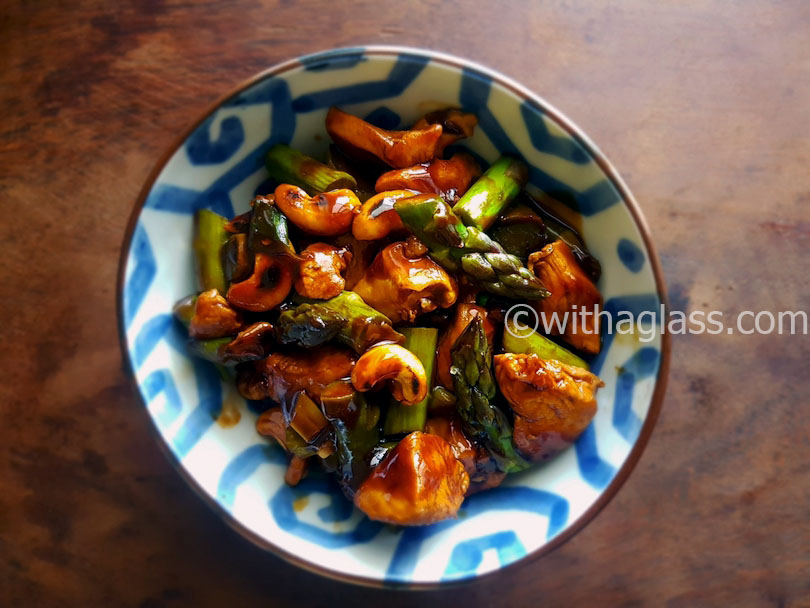
As you might have guessed by this second appearance of asparagus in one week, this is one of my favourite vegetables. Its season is quite short, so I try to profit from its presence as much as I can and cannot promise this will be the last time I talk about it this year. Green variety, especially when not too thick, is in my opinion the most versatile asparagus. Most of my experiments prove it is excellent in both Western and Asian dishes and pairs well even with unexpected products, such as miso (Japanese fermented soybean paste; see below). The stir-fry you see above was a part of one of the quick and simple, improvised “donburi”, or Japanese-style rice bowls dish I prepare quite often (thank you, Nami!). The crunchy blanched asparagus, the creamy miso sauce and tender chicken breast created a pleasant spring topping for rice and will probably be my staple until asparagus is in season. /UPDATE: I have just learnt that a stir-fried dish with miso sauce is called “miso itame”. Thank you, Hiroyuki!/

Miso (味噌), a thick paste made by fermenting soybeans and/or barley or rice, is one of the most important ingredients of the Japanese cuisine (Korean and Chinese cuisines use very similar pastes too). Miso is healthy; it is packed with protein, vitamins and minerals and some people claim it even helps to fight the radiation sickness. In Japan miso has three main colour types: white (shiromiso), red (akamiso), black (kuromiso), and there is also mixed miso (awasemiso). In general, the lighter the colour, the more delicate the taste, but it’s not always the case, so it’s worth asking the shop assistant or reading the label before buying it. The only downside of miso is that is can be very high in sodium, so watch out for special “low sodium” misos (some high quality misos don’t even have this mention, but are less salty). Whatever the salt content, white miso has always a milder taste, so it’s a good idea to start one’s adventure with light coloured miso. Apart from the three basic colours, there are myriads of different misos, depending on the brand or producer, the ingredients, the region…

Miso soup is usually the first dish in which foreigners discover this Japanese staple, but it’s also used in simmered dishes, as a seasoning for grilled fish and meat, in sauces, pickles… Its complex flavour is an excellent taste booster in stir-fries and I love the creaminess it adds to sauces. Miso is, at least for me, highly addictive, probably because it is rich in the umami, or fifth taste, made famous by a Japanese professor.

If you are still hesitating if you should invest in a package of miso, here are some other ways to use it:

-Garlic Miso Chicken Breast

-Aubergine with Ponzu, Miso and Sesame Sauce

-Miso Soup with Tofu

-Miso Soup with Shrimp and Tofu

-Mackerel Simmered in Miso

-Chicken and Potatoes in Miso Stew

-Chicken and Aubergine in Garlic Miso Sauce

TIP: The less you boil/cook miso, the more you preserve its precious nutrients, so it’s best just to heat it at the end.

The garlic’s presence is not obligatory in this sauce, but since I discovered garlic and miso combination thanks to Nami’s Garlic Miso Chicken Wings (Just One Cookbook blog), I have fallen in love with it. I adapted Nami’s recipe in Garlic Miso Chicken Breast and used miso and garlic sauce in Chicken and Aubergine in Garlic Miso Sauce).

Preparation: about 20 minutes

Ingredients (serves two):

12-14 green, medium thick or thin asparagus stalks

1 chicken breast

1 tablespoon sake

1/8 teaspoon salt

Sauce:

2 tablespoons miso

2 tablespoons sake

1 tablespoon syrup (I used agave syrup) or 2 tablespoons mirin

2 tablespoons soy sauce (or more if using low-sodium soy sauce)

1 clove garlic, grated or crushed (the garlic is not obligatory)

(toasted white sesame seeds)

Bring to a boil one litre of water in a big pan.

Cut up the chicken breast into bite-sized pieces, combine with sake and sprinkle with a bit of salt.

Cut off the toughest part of the the asparagus stalks’ (I usually cut off 1/4 if I use the above-mentioned, medium thick asparagus).

Blanch the asparagus for one minute (or even less if the stalks are very thin) and quickly put into very cold water to stop the cooking process.

Cut into bite-sized pieces.

Combine all the sauce ingredients. Put aside.

Heat two tablespoons oil in a pan or wok.

Drain the chicken, pat it fry.

Stir-fry the chicken until it is cooked.

Than add the asparagus and stir-fry for 30 seconds.

Add add the miso sauce and heat for about 30 seconds, stirring, until everything is well heated.

Serve with rice and, if you wish, sprinkle with sesame seeds.


Chawan Mushi with Asparagus (Japanese Savoury Egg Custard with Asparagus)

chawanaspergesp

Chawan mushi is a perfect representative of these comforting, universally enjoyable dishes, which are hardly known in Europe and which surprise all those who still associate Japanese food with sushi and raw fish. For me it has all the qualities of a perfect dish: it is light and healthy, but filling; it is extremely versatile, both in terms of ingredients, as well as serving occasions, and, most of all, it tastes wonderful. It can be made in advance, then reheated or served cold and since it is prepared in individual containers, it also looks cute on the table. The only obligatory Asian ingredients here are sake and soy sauce, so I hope it’s accessible for home cooks all around the world. Accidentally, it’s perfect after short food indulgence periods, such as Easter.

Chawan Mushi (茶碗蒸し) was the first recipe I made from “The Japanese Cooking. A Simple Art” by Shizuo Tsuji, one of the best cookery books I have ever had and I have only slightly modified the amounts’ ratio. I have already written about this amazing dish almost a year ago, but here is a quick reminder. Chawan mushi, meaning “steamed in a tea cup”, is a light custardy mixture of seasoned stock (Japanese or Western) and eggs, to which different “fillings” are added. The traditional version includes a long list of ingredients (including ginko nuts!), but in my opinion this is a typical versatile dish that can easily be modified depending on one’s preferences, seasons or simply contents of one’s fridge.

My first chawan mushi was made with shrimp and green peas (see the recipe here), but I have already played with different meats, seafood, vegetables, mushrooms and the results were satisfactory every time. The ways to serve this custard are also endless: it’s perfect as a part of the main course, with rice and some Asian pickles, or Western way, with bread and a bowl of green salad dressed with vinaigrette. I find it excellent as a cold or warm starter, as an afternoon snack, as breakfast, as a picnic snack… Possibilities are endless.

Asparagus and egg are a well known successful pairing, so you will not be surprised if I say this is – at least now – my favourite version of chawan mushi. As a notorious carnivore I have added small pieces of chicken breast marinated in sake, but you can forget them and keep it strictly vegetarian. Shizuo Tsuji advises chicken stock if dashi is unavailable and, I will probably shock some Japanese cooks, but here, with bits of chicken I have definitely preferred chicken stock (I have tested both). (Of course vegetarians can use vegetable stock I guess).

If you don’t like asparagus, you might enjoy chawan mushi with shrimp and green peas:

chawanshpp

TIPS:  Even though chawan mushi is easier to prepare in a steamer, Shizuo Tsuji’s suggestion to use a water bath in the oven gives excellent results. Actually this is the way I prepare it because the steamer plate in my rice cooker is too low for my heatproof cups.

If you don’t have a nearby Japanese grocery shop, individual, but high heatproof cups may be difficult to get. I have found very good ones at IKEA (even though without lids), but as soon as I got hold of the beautiful Japanese chawan mushi cups you see above, I stopped using the old ones.

Mitsuba is the traditional herb served with Chawan Mushi (it is usually steamed on the top of the custard), but as you see I haven’t added it because my mistuba hasn’t even sprouted yet (check the lovely mitsuba decorated version on Nami’s blog (Just One Cookbook)). You can add any herbs on top, as long as they suit the ingredients, but frankly these custards were perfect without any herb.

Special equipment:

individual heatproof cups (at least 6 cm high, mine were 6,5 cm high,with a 7,5 cm diameter)

Preparation: 45 minutes

Ingredients (4 portions):

10 medium thick green asparagus (less than 1,5 cm thick in the thickest place) or double this amount if you want a vegetarian meal

2 small chicken breasts

1 tablespoon sake

salt

(mitsuba leaves)

Custard:

2 eggs

300 ml dashi (Japanese stock) or chicken stock

1/4 teaspoon salt

1 teaspoon sake or mirin (with mirin the custard will be slightly sweetish)

1 teaspoon soy sauce

Preheat the oven to 220°C (or prepare your steamer).

Cut up the chicken breasts into bite-sized pieces, combine with sake and sprinkle with a bit of salt.

Put aside.

Cut off the toughest part of the the asparagus stalks’ (I usually cut off 1/4 if I use the above-mentioned, medium thick asparagus).

Cut the rest into bite sized pieces.

Boil a lot of water and prepare a big baking dish at least as high as the heatproof cups.

Mix the eggs very delicately in a bowl. In another bowl combine the dashi (or chicken stock), salt (it depends on how salty your stock is), sake/mirin and soy sauce. Pour the stock mixture over the eggs and stir well, without beating.

Strain the chicken pieces. Divide them and asparagus equally into four heatproof cups.

Put mitsuba leaves on top (click here  to see how Nami ties them in a cute traditional way).

Strain the custard mixture and pour into the garnished cups.

Cover the cups with aluminium foil or the lids if you have special cups with lids.

If you use the oven, place the cups in a big baking dish. Fill the dish with hot water (not boiling). The water should arrive up till 3/4 of the cups’ height.

Put the dish in the oven and let the custards bake for 30 minutes.

If you use a steamer, steam for about 20 minutes.

If you use herbs which do not support well the heat, sprinkle chawan mushi with them just before serving.

Serve hot or cold with bread/toast for breakfast, with a salad for a lunch, as a snack or as a starter.

You may serve it with soy sauce. Personally I think it is not necessary.

Even though the eggs’ mixture sets during the cooking process, the mushrooms or other vegetables might release juices, so think about putting a spoon on the table!

Easter Party Ideas

wontoncupspj

Wonton Cups, or Edible Snack Containers

Zsuzsa, my blogging friend from Zsuzsa is in the Kitchen, has recently invited me to join her and other bloggers (Eva from Takarékos Konyha, Elisabeth from Food and Thrift and Eva from Kitchen Inspirations) and, just like them, post my Easter menu suggestions. I was honoured, but at first I panicked because apart from a Chicken Terrine (see below) I don’t really have traditional Easter dishes on my blog. Both Zsuzsa and Elisabeth have convinced me to present whatever I might serve for such an occasion, even if it is not traditional in any country or region of the world. Thank you, ladies, for your advice! Thus, I have chosen some festive dishes I love, regardless their origins or relation to Easter celebrations. Thank you so much, Zsuzsa, for your kind invitation. I hope my eclectic choice, far from Easter traditions will not disappoint you.

Here is a list of dishes I would take into consideration if I had guests for Easter (of course I wouldn’t serve all of them!). All of them can be served at a buffet-style party, my recent favourite way to entertain. Such a concept usually means more work beforehand because, contrary to traditional meals, one cannot serve just three dishes, but this way I offer a bigger choice to the guests, who are not forced to eat all they are served, but most of all such a party has a more relaxed atmosphere. Apart from one exception, I have chosen easy recipes, which either can be prepared very quickly or made in advance. They have both Western and Asian origins, so I hope you will find here some useful ideas, not necessarily for Easter.

First of all, I would never skip the obligatory Wonton Cups, or Edible Snack Containers (see the photo above). Versatile, cute and easy, these edible containers are nowadays a staple not only when I have guests (thank you, Juliana!).

lastmcrackersp

Last-minute Crackers can be prepared really just before the guests arrive as long as you have some puff pastry in the fridge. These star-shaped crackers were prepared for Christmas, but you can give them any shape you wish, such as bunnies…

olives2pp

These olives are so easy to prepare you will never consider buying them seasoned by someone else again.

mackerspreadp

This Smoked Mackerel and Egg Spread can be prepared with any smoked fish of your choice, of course.

taramosalatapj

Recently discovered Taramosalata (Fish Roe Spread) is one more thing I will never ever even think of buying. Home-made version is incomparably better.

patepp

Light Chicken Terrine with Nutmeg is actually the only dish I used to have as a child for Easter and other festive occasions.

goatcakepp

Savoury Cake with Goat Cheese and Dried Tomatoes (aka Goat Cheese and Dried Tomatoes Bread) is a wonderful alternative to canapés.

cakejamp

Cake with Ham and Olives, another canapés substitution, is a real crowd-pleaser.

makishrimpp

If you feel like serving Japanese food (why not?), try preparing Maki Sushi with Shrimp, Avocado and Cucumber. They will not necessarily look as perfect as in your sushi shop, but they are really easy to prepare.

roastrollspp

Spring Rolls with Leftover Roast and Carrots, an Asian sandwich alternative, can also be prepared with the remains of your roast, after the Easter holidays.

chickensesamep

Sesame-Coated Chicken Nuggets (Tori no goma age) can be made in advance and will please all the sesame fans.

chickenleekp

Japanese Chicken and Leek Skewers (Negima) are brushed with teriyaki glaze and usually please every guest.

asparagusporkpp

Asparagus Teriyaki Pork Rolls are incredibly easy to prepare and are one of my favourite ways to serve asparagus.

chterrinespeculoospj

Unbaked chocolate Cake with Biscuits (Chocolate Terrine with Speculoos) is a rich creamy dessert which doesn’t require baking and is incredibly simple to prepare.

bountytrufflespj

Coconut, Chocolate and Rum Truffles (Bounty Truffles). Who doesn’t like chocolate truffles?

matchatruffles3p

Matcha and White Chocolate Truffles are the only ones which might be tricky to prepare, but they are green, fresh, festive and have this amazing slightly bitter matcha flavour…

prunechdp

Chocolate and prunes are all you need to prepare these luscious Prunes in Chocolate, a quicker and easier alternative to chocolate truffles.

kiwic4p

This Kiwi and Rum Cocktail seemed perfect for a spring party.

I strongly encourage you to check the wonderful Easter menu suggestions proposed by my blogging friends and would like to wish you all a very happy Easter and wonderful holidays to those who don’t celebrate it!

Light Chicken Terrine with Nutmeg

patepp

Home-made terrine always brings my best food-related childhood memories and, therefore, is one of the rare dishes I consider as both festive and comforting. My mum would bake it for most family parties and holidays and it was obligatory for Christmas and Easter. Thus, every year, when Easter approaches, instead of being tempted by the chocolate bunnies that invade all the Swiss shops, I start longing for my beloved humble-looking terrine and its inebriating, festive nutmeg aroma. I have already written about this terrine/pâté some time ago, but when I made it last weekend, I took the opportunity to change my old photos and decided to share this recipe with you again.

France is probably the country which comes to mind when we think about pâtés and terrines. They can be made in France with any kind of meat and/or liver. While pâtés are usually made with pork or duck or game and/or liver and sometimes are baked in a crust (pâté en croûte) or simply made soft and spreadable, terrines can also be made with fish, seafood, vegetables or even fruit and are always baked in a rectangular dish and are eaten only sliced. However, when you observe French butchers’ products, you realise that what some call “terrine”, others label as “pâté” and in some cases (especially in the case of pork products), the difference is not that clear. I am still hesitating what term I should use for this Polish recipe, but I think that for non-French readers, “terrine” might be easier to understand.

The Polish terrines I have been making for years are based on my mum’s recipe and differ a lot from the French ones. Not only are they made with previously cooked meat and liver (French products are baked with raw meat), but they are also very finely ground or mixed, but most of all, there is the amazing nutmeg which is the key ingredient here. My mum would usually prepare her pâté with a mixture of pork and beef, but this lighter, poultry version, would also appear on the table from time to time and this is the one I prepare most often.

The preparation is long, but very simple and difficult to fail. Once it has cooled down, the terrine can be kept in the fridge for about one week or frozen until the day we want to use it. It can be served as a starter, as a snack, on small canapés or crackers and it goes particularly well with all kinds of pickles (pickled pepper, gherkins, onions, beetroots and even kimchi!) and cranberry  or bilberry jam/sauce. Personally, I love it with a fiery horseradish sauce and/or my Pickled Sweet Peppers.

TIPS: As the recipe name suggests, nutmeg is the main seasoning, so unless you hate it, do not skip it (at least for the first time). Every time I tried omitting it and putting other seasonings instead, I was very disappointed. Do use freshly grated nutmeg because it loses its aroma very quickly.

As I have mentioned above, this terrine can be frozen in big or small portions and even though the crust will not be crunchy, the taste will stay more or less the same.

You can use either deboned, skinless chicken/turkey cuts or a whole small chicken. The latter version will of course take a bit more time, but it can prove cheaper. If you want, you can skin the chicken before the first, cooking stage. This way the stock you add to the terrine will be less fatty.

Be generous with ground black pepper: this poultry version tends to be a bit bland compared to the pork pâté for example, so freshly ground black pepper gives it more character.

Preparation: 2,5 – 3 hours + cooling time

Ingredients (fills a 20 cm x 10 cm baking tin):

500 g/about 20 oz chicken breast, or a mixture of leg and breast meat or a whole small chicken (you can also use turkey cuts)

green part of 1 leek

1 parsley root or a couple of parsley branches

1/4 celeriac or 2 branches celery

1 big carrot

1 medium onion

100 g/about 4 oz chicken livers

2 slices white, sandwich bread 

1/2 nutmeg (freshly grated)

3 heaped tablespoons semolina

pepper, salt

2 eggs

2-3 tablespoons oil or duck fat

(dry breadcrumbs)

If you use the whole chicken, place it in a big pan filled with water. If you want, you can skin it. Add the carrot, the halved onion, the leek, the celeriac and the parsley. Season with salt and pepper and cook on a medium heat until the meat well cooked. The whole chicken will take much more time than cut up meat.

If you use separate meat cuts, cut the meat into equal chunks. Put them in a pan filled with water. Add the carrot, the halved onion, the leek, the celeriac and the parsley. Season with salt and pepper and cook on a medium heat until the carrot is very soft and the meat well cooked.

When the meat or the chicken are cooked, remove them from the stock and wait until they cool down.

Pour 500 ml/about 17 fl oz of the stock into a small pan and cook the livers for 15 minutes.

Put the livers aside.

Place delicately the bread slices in the stock remaining after the livers have been cooked and let them soak for one minute.

Put the livers, the meat (if you use the whole chicken, remove the meat from the carcass, making sure there are no bones or skin), the soaked bread, the carrot and the parsley root (discard the branches) in a food processor and mix into a smooth paste. (Do not throw away the stock in which the meat was cooked!).

Preheat the oven to 180°C.

Put the mixed meat into a bowl.

Add the nutmeg. Season with salt and pepper and taste if there is enough salt (this is the best moment to taste; afterwards tasting might be a bit unpleasant with raw eggs and semolina). Be generous with ground black pepper: this poultry version tends to be a bit bland compared to the pork pâté for example, so freshly ground black pepper gives it more character.

Stir in the eggs, the semolina and about 125 ml (1/2 cup) of the stock in which the meat was cooked at the beginning.

Mix well with a spoon.

Line a baking tin with baking paper or grease it and sprinkle with breadcrumbs.

Spoon the terrine mixture into the baking tin, smooth the surface with a spoon and sprinkle it with oil or melted duck fat.

Bake about one hour until the top is golden brown and don’t pay attention to the unpleasant smell from the oven (it will be irresistible once the terrine has cooled down).

After it cools down either freeze it or keep it refrigerated (tightly wrapped in cling film) for one week.


Kenyan Coriander Chicken (Dhania Chicken)

corianderchickenpp

This is one of the most unusual dishes I have ever eaten and an extraordinary feast for coriander lovers. I saw the recipe in The Ultimate Curry Bible by Madhur Jaffrey, but I needn’t have bookmarked it: the dish was instantly engraved in my memory. Its Kenyan origins were obviously intriguing, but what made my eyes sparkle was the huge amount of fresh coriander (aka cilantro) the dish called for. Do you realise how much 50g (about 1,8 oz) fresh coriander represents? It’s actually an extremely big bunch, especially since the author says to use only leaves, discarding the stems. As scary as it may sound to coriander haters, it was one of the best curries in my life.

Apart from its unique taste and fragrance, Dhania Chicken/Cilantro Chicken is filling and warming, especially given the high level of hotness, in my case provided by three mixed green bird’s-eye chilies. At the same time, it’s one of the lightest curries I know: the sauce is composed only of coriander and yogurt.

I have followed the original recipe, roughly adapting it to a meal for two. The cooking time depends on the chicken cuts you use and on the chicken quality: organic chicken legs will require more time since they are tougher.

TIPS: Frankly, I would advise this dish only if you are fond of coriander. Otherwise, there is a certain risk (but maybe also a challenge?). Its strong aroma is of course subdued during the cooking process, but the typical scent and taste is still recognisable. It’s also quite fiery and the hotness goes so well with the abundance of coriander here, I cannot guarantee if the magic of this dish can survive the absence of chilies.

The yogurt used here cannot be acid, so if you taste yours and feel tanginess, I advise using Greek yogurt or fresh smooth cheese (quark/fromage frais) instead. Otherwise the dish will be tangy and it doesn’t improve the taste (I know what I’m talking about: I prepared it three times and the first time I used slightly tangy yogurt).

Preparation: 1 – 2 hours

Ingredients (serves 2):

Marinade:

1/2 teaspoon salt

3 cm (about 1,5 in) fresh ginger

2 big garlic cloves

1 teaspoon lemon juice

2 chicken legs or breasts (cut in two pieces ) or a mixture of both, skinned

1 small tomato or 3 tablespoons canned chopped tomatoes+ 1/2 teaspoon tomato purée

50 g (about 1,8 oz) coriander leaves (without bigger stems)

3 bird’s-eye green chilies or the equivalent in other chilies

125 ml (1/2 cup) not tangy yogurt (the best would be Greek yogurt) or fresh smooth cheese (quark/fromage frais)

2 tablespoons oil

1/2 teaspoon salt

Mix the salt, the garlic and the ginger to a smooth paste with 1 tablespoon water.

Rub the mixture into the chicken pieces and marinate for at least 30 minutes (you can leave it overnight too).

Just before cooking, in a food processor mix well the coriander, the chilies, the tomato, the tomato purée, 1/2 teaspoon salt and 5 tablespoons water.

Heat 2 tablespoons oil.

Fry the chicken pieces until slightly browned.

Add the coriander mixture, cover and simmer until the chicken is soft (check from time to time if it doesn’t burn and add water if necessary).

Add the yogurt, cook at medium heat, uncovered until the sauce thickens and clings to the chicken.

Adjust the taste, adding more salt if necessary, and serve.

Chicken Katsu チキンカツ (Japanese Breaded Chicken)

chickenkatsup

Japanese cuisine can be divided roughly into washoku 和食, traditional Japanese food, and yoshoku 洋食, which defines dishes inspired by Western cuisines. Unsurprisingly, the former is healthy and light, while the latter contains many deep-fried, rich dishes. I quickly realised my heart goes very often (maybe too often) to the westernised cuisine and such deep-fried delicacies as korokke コロッケ(potato croquettes), ebi fry (breaded shrimp) or tonkatsu 豚カツ (breaded pork loin) are among my favourite Japanese dishes. The fact that these dishes were the only ones I could read on menus in Japan (they are in majority written in one of the two Japanese syllabaries, much easier to decipher than Chinese characters) makes me love them even more.

Breaded chicken cutlets, or chicken katsu, (“katsu” is a Japanised version of the word “cutlet” or “côtelette”), are at least as excellent as tonkatsu, their close cousins, but in my opinion they are easier, quicker and more crowd-pleasing. Some of my friends call them Japanese chicken nuggets. The main difference in the preparation is that, unlike pork loin, chicken breast is often cut into smaller pieces and briefly marinated before being fried. (Although I have seen also bigger chicken katsu versions too).

I know I’m repeating myself, but I have to emphasize that Japanese breaded dishes are not mere copies of their Western counterparts. First of all, Japanese flaky panko creates a lighter, crunchier result than simple dried bread crumbs. Moreover, thanks to deep-frying, the dishes cook quicker, absorb less oil and are juicier. (Of course, if you prefer shallow-frying, you can easily shallow fry chicken katsu).

As a big fan of Nami’s blog (Just One Cookbook), an infinite source of well-explained and beautifully photographed Japanese recipes, I naturally chose her Chicken Katsu recipe and wasn’t disappointed. The result was perfect, as every time I follow Nami’s instructions and advice. Thank you so much, Nami, for one more infallible recipe!

If you prefer pork, you might like my Thin version of Tonkatsu, or Breaded Pork Cutlets (as you see this is one of my favourite bowls…):

thintonkatsupj

TIPS:

Traditionally both tonkatsu and chicken katsu are served with a dark, thick sauce called “Tonkatsu sauce”. It is available in Japanese grocery shops, but is too sweet and too heavy to my taste. Thanks to Hiroyuki’s kind advice (Hiroyuki’s Blog on Japanese Cooking), I make my own version mixing ketchup, Worcestershire sauce and soy sauce. I also serve chicken katsu with mayonnaise and hot chili oil sediments you see above or with hot chili paste, such as Korean gochujang.

Deep-frying scares many people, but becomes easy and quick with time. Everyone has different preferences of course, but the basic rule to observe is to make sure the food is completely dry before it’s fried (or breaded) to minimise the risk of oil splashes. Personally I prefer deep-frying in a small cooking pan (I have one which is only for deep-frying) using a small amount of oil. I also place the pan as far as possible from myself, just in case the oil splashes. If you are really not comfortable with deep-frying or don’t have enough oil, you can of course shallow fry this dish.

Deep-fried food should “swim” easily, so do not overcrowd the pan (otherwise the temperature becomes lower, the food fries slowly and absorbs more oil).

You will probable have to fry in several batches (unless you have a big deep-frying dish or make a small batch). In order to make sure all the chicken pieces are hot when served, I place a baking dish in the oven at 100°C/212°F, line it with paper napkins and put there deep-fried bits, one by one, until the whole frying process is finished. This way they keep warm and if you serve them in the same hot baking dish, they will stay warm on the table too.

Frying oil can be used as long as it doesn’t darken and is always filtered after each use (I usually throw it away after three times, but it depends on what you fry… Fish for example can make the oil smell strong, so keep it only for fish or seafood frying).

Preparation: about 30 minutes

Ingredients (serves two):

2 medium chicken breasts

about 10 heaped tablespoons of panko

5 tablespoons wheat flour

1 egg, slightly beaten

salt, pepper

tablespoon sake

oil for deep-frying

tonkatsu sauce to serve (or a mixture of ketchup, Worcestershire sauce and soy sauce) or mayonnaise + thick chili paste or taberu rayu sediment

Slice chicken breasts diagonally into 1 cm (about 1/2 inch) thick slices.

(If you keep the chicken tenderloins; i.e the thin strips attached to the breast, but usually sold with the breast, separate them from the main piece of breast and simply cut them in horizontally in two).

Season the chicken slices with sake, salt and pepper.

Put aside.

In the meantime preheat the oil for deep-frying.

(I don’t have the special thermometer and put some panko in the oil to check the temperature. If it starts making bubbles, doesn’t fall down and is fried immediately, it means the oil is hot enough. )

Dust the chicken slices with flour, dip them in the beaten egg and coat in panko, pressing so that the whole slice is covered.

Deep-fry them until golden, in batches, trying not to overcrowd the pan (unless you have a very big frying dish), on both sides (it usually takes 2- 3 minutes per side).

Remove excess fat, placing the meat slices on paper towels.

Keep them in a warm oven (see the TIPS above) until you finish frying all the batches.

Serve with rice, on shredded cabbage or a light salad with the special Japanese tonkatsu sauce or, like I do, with mayonnaise and chili paste (or chili oil sediment).

Chicken tonkatsu is also excellent as a snack (you can cut it in bite-sized pieces too).

Murgh Masala (Chicken in Tomato and Onion Sauce)

murghmasalap

If I knew someone who is afraid of opulent, complex, hot flavours, this is the dish I would probably serve to introduce her or him to the marvels of the Indian cuisine. This was my first Murgh Masala, so I don’t know if all the Indian cooks prepare it this way, but this one was low-fat, subtly seasoned and mild (the last point can easily be changed of course!). In short: a toned down, but equally delightful side of the Indian cuisine I was happy to discover. Apart from being more delicate, Murgh Masala proved also quite effortless and relatively quick (especially compared to other Indian dishes), so I think I will be preparing it quite often.

This Punjabi speciality is another fabulous recipe I found in the Classic Indian Cookery by Julie Sahni. I have followed the author’s instructions almost to the letter, the only modification being the use of skinned chicken breasts instead of cut up whole bird. I have also scaled down the 8-servings recipe to a dish for two, which meant I have slightly changed the ingredients’ amounts too.

If you like Indian cuisine, you might be interested in these (other gems found in Julie Sahni’s book):

indianchickpj

Indian Chickpeas in Tangy Sauce (my absolute chickpeas favourite!)

butterchp

or Butter Chicken (Makhani Murgh)

TIP: This was the first time I used black cardamom (I used to replace it, as it’s often advised in Indian recipes, by green cardamom). The difference is surprisingly huge. If you cook Indian from time to time, I strongly encourage you to invest in a package of black cardamom.

Preparation: about 1h30

Ingredients (serves two):

2 chicken breasts, cut into bite-sized pieces or half a chicken cut into small skinned pieces

1 medium onion (sliced)

2 medium fresh tomatoes, chopped and skinned, or 100 – 150 ml/ approx. 3,5 – 5 oz canned tomatoes

1 medium clove garlic (chopped)

1/2 cm fresh ginger (chopped)

1/2 cinnamon stick

1 black cardamom pod (or 2 green cardamom pods)

1/2 teaspoon turmeric

1/2 teaspoon hot chili powder

200 ml/ 7 oz hot water

1 teaspoon roasted and ground cumin seeds

fresh coriander

oil or ghee

Heat one tablespoon oil in a pan.

Brown the chicken pieces (without cooking them thoroughly!).

Put aside.

Add one more tablespoon oil and fry the onion on medium heat constantly stirring until it becomes light brown (it can take 15 – 30 minutes).

Add the garlic and the ginger and fry for 5 minutes, stirring.

Afterwards add the cinnamon and the cardamom, fry for 2 more minutes.

Finally add the turmeric, the chili pepper, the chicken, the tomatoes and the water.

Season with salt (just a bit, you will be able to adjust the saltiness later) and cook at low heat, covered for about 30 minutes. If you use pieces with bones, including thighs, it might take more time. (Check from time to time if it’s not burning!).

Uncover the pan, increase the heat and finish cooking until the sauce has thickened.

The author recommends putting the dish aside for minimum one hour (perfectly two hours) and then reheating it slowly before serving.

If you are in a hurry, you can serve it straight away, but it tastes better reheated indeed.

Sprinkle with ground cumin and give it a stir. Then sprinkle with fresh coriander just before serving.

Chicken Loaf “Wind in the Pines” (Toriniku Matsukaze-yaki (鶏肉松風焼き)

windin_pp

I am always drawn to poetic dish names, so rare in European cuisines. Doesn’t Wind in the Pines (Toriniku Matsukaze-yaki, 鶏肉松風焼き) sound incomparably better than Chicken Loaf? One might wonder how a baked chicken loaf can bear such a beautiful name? According to Shizuo Tsuji, the author of the magnificent “The Japanese Cooking. A Simple Art”, where I found this recipe, the grains sprinkled over the top evoke the sand on a pine-bordered beach, while the boiling kettle in tea ceremony is like wind blowing through the seaside pines. To be precise, toriniku means chicken, matsukaze ”wind in the pines” and yaki describes the grilling/pan-frying cooking method (even though this is supposed to be baked in a hot water bath, not grilled, but I suppose this is due to the fact that baking is not really popular in Japan…).

Apart from the magical name, the final original step of this recipe was what has captured my attention. The beautiful yellow colour is obtained by brushing raw egg yolk over the freshly baked loaf; the yolk cooks instantly and forms a sunny layer over the otherwise pale, unappetising dish. Even though my first Chicken Loaf looked and tasted wonderful, I have allowed myself several modifications, hoping they do not destroy the original idea. My way to prepare this dish gives a very similar result: a filling and warming, but surprisingly light meal. It has certainly brought a ray of sunshine to the cloudy, snowy weather we have been having.

My first Chicken Loaf seemed too dry, which is often the case with cooked minced lean meat. Therefore, I have added some silken tofu, the trick which I have been practising with dumplings for quite a long time. Since I always try to simplify the cooking steps, I have switched from hot water bath in the oven to steaming (but both methods are described below). Not only is it easier this way, but much quicker. Moreover, if you serve rice too, both can cook in the rice cooker at the same time. Last but not least, I have decided to serve this loaf in individual baking dishes rather than preparing a traditional big flat loaf. If you want to know the original recipe, I advise consulting Shizuo Tsuji’s book.

This dish would be equally good served with rice and Japanese pickles and, in a more European way, with a green salad and bread. I would advise also serving it with a sauce of your choice.

TIP: If you wonder what to do with the two leftover egg whites, you need exactly this amount to prepare the Easy Chewy Coconut Cookies:

kokos_pj

Special equipment: individual baking dishes (not obligatory)

Preparation: 1 hour

Ingredients (serves 2):

2 small chicken breasts, minced (you can mix them in a food processor) or 2 medium chicken breasts, if you skip tofu

4 heaped tablespoons drained silken tofu 

2 tablespoons sake

1 egg

2 egg yolks

1/4 teaspoon salt

1/2 tablespoon sugar (or syrup)

2 tablespoons soy sauce (or more if you use low-sodium soy sauce)

1 teaspoon fresh ginger juice (squeezed from freshly grated ginger, about 2,5 cm/1 inch)

white poppy seeds or toasted white sesame seeds

If you decide to bake the dishes in the hot water bath, preheat the oven to 230°C.

If you decide to steam them, wash the rice and prepare it to cook in the rice cooker.

Put half of the ground chicken in a pot with saké. Cook over high heat, stirring until the meat changes the colour.

Drain it.

In a big bowl combine the raw meat, 1 egg and 1 yolk, salt, sugar, soy sauce, tofu and mix well with a spoon or your hand.

At the end add the cooked meat and the ginger, mix again.

Spread the meat mixture in the individual dishes and bake them in bain-marie (hot water bath) for 30 minutes or put them on the steaming tray in your rice cooker and leave there until the rice is cooked.

Remove the dishes from the oven and brush quickly with the remaining egg yolk and sprinkle with the seeds (the yolk will cook on the hot surface and give a beautiful colour).

If you have steamed the dishes, the yolk might not set (your loaf might not be as hot), so either brush it with yolk and put back to the steamer for a minute (and sprinkle with sesame afterwards) or brush it with yolk, sprinkle with seeds and put under the broiler for one minute.

Serve with a sauce of your choice, rice, bread, salad, pickles…

Kimchi Soup (Kimchiguk) with Chicken and Potatoes

kimchisouppp

Kimchi (Korean fermented spicy vegetables) is known by us, foreigners, almost exclusively in its raw form, served as a cold side dish. Its use in warm dishes is less popular abroad and is not very tempting for some people. The first time I prepared Kimchi Fried Rice I realised that this kimchi has much more to offer than I had thought and its addition to leftover rice has become my regular trick to make this humble dish delicious and complex in just one gesture. With this soup I feel I have discovered a big new chapter of the kimchi possibilities. Just like in the case of fried rice, kimchi has released here complex flavours and aromas, giving a certain illusion of robustness to this evidently light and healthy dish. Unlike in fried rice, here kimchi mellows and loses some of its power, just enough to enchant even those who find raw kimchi too violent. It may sound strange, but there is something evidently comforting and homely about this soup, so exotic in appearance.

The original recipe comes from Growing Up In a Korean Kitchen by Hi Soo Shin Hepinstall, a fascinating book full of food-related childhood memories and homely Korean recipes, some of which are all but “tourist pleasers”. Apart from the famous dishes, I was glad to discover some interesting recipes most Korean cooking sources don’t mention. My first choice went to kimchi soup mainly because I had all the ingredients and because I have been tempted by the concept of a kimchi soup for quite a long time.

I have slightly modified the recipe. First of all, I jumped on the author’s suggestion and used chicken instead of pork. Apart from minor changes in ingredients’ amounts and procedures, my boldest step was to transform this soup into a one-pot meal, substituting tofu with potatoes. I can only hope my Korean visitors will forgive me and still allow me to call it “kimchi soup”. For the real kimchi soup recipe, I encourage you to buy the very special Growing Up In a Korean Kitchen.

If you wish to try kimchi in fried rice, here is a very simple adjustable recipe:

kimchifriedricep

Kimchi Fried Rice

If you feel like making kimchi yourself, here are some options, all very easy to prepare:

cucumberkimchip

Easy Cucumber Kimchi (Oi Kimchi)

daikonkimchip

Kkakdugi (White Radish Kimchi)

makkimchip

Mak Kimchi (Easy Chinese Cabbage Kimchi)

celerykimchip

Celery Kimchi (this is a short-term kimchi)

TIPS: The best kimchi to use here (or in kimchi fried rice) is well matured, strong kimchi, so it’s also a good way to use up kimchi leftovers.

I strongly advise here home-made chicken stock or at least good quality, natural stock (no taste enhancers, etc.).

If you wish a stronger, hotter soup, add 5-6 tablespoons of kimchi liquid.

Freshly squeezed ginger juice can be obtained by grating ginger and then squeezing the grated pulp (the below 1/2 teaspoon required about 1 cm fresh ginger).

Preparation: about 30 minutes

Ingredients (serves 2-3 as a main dish):

1 chicken breast

2 big potatoes peeled and cut into 2 cm/0,8 in cubes

7 heaped tablespoons Napa cabbage kimchi (cut into 1cm/about 1/2 inch pieces)

(5-6 tablespoons kimchi juice, if you want to obtain a stronger soup)

1 litre chicken stock

5 big shiitake mushrooms (fresh), sliced

3 garlic cloves, chopped

white part of 1 green onion, chopped

3 oz/ 85 g soybean sprouts (I have skipped them in the batch you see above, but they were marked as  optional in the book)

Chicken marinade:

1/2 tablespoon soy sauce

1/2 tablespoon rice wine (I used sake)

1 small clove garlic, crushed

a white part of green onion, very finely chopped

1/2 teaspoon fresh ginger juice (see above)

1/2 teaspoon sugar or syrup

1/2 tablespoon sesame oil

salt, freshly ground pepper

Cut the chicken breast into thin, short ribbons.

Combine the marinade ingredients and mix them with chicken pieces.

Put aside.
In the meantime heat one tablespoon oil in a big pan.

Fry the garlic cloves and mushrooms for a couple of minutes.

Add the stock, the chicken, the potatoes, the kimchi (and kimchi juice if you opt for a stronger soup) and cook at medium heat until the potatoes are soft.

Add the chopped white onion, salt, pepper and cook for 5 more minutes.

Serve with fresh green onion or chives, or just the way it is.

Okonomiyaki (Japanese Savoury Pancake) with Bok Choy and Chicken

okono_bokchoypj

If you don’t know okonomiyaki yet (I have written about it here and here), I will repeat what I have said in one of my posts: this messy-looking dish is one of the most brilliant inventions of the Japanese cuisine. Easy, quick, versatile and full of flavours, it is a dish one falls in love with at first bite and becomes instantly addicted to. Okonomiyaki (お好み焼き ), often called “Japanese pancake” or “Japanese pizza”, means more or less “grill what you like” (“okonomi” means “what you like/want” and  ”yaki” means here “grilled”). In fact, apart from a regular “basis”, different ingredients can be added and okonomiyaki restaurants offer a whole range of versions. I have fallen in love with okonomiyaki at the first bite, it has become the most frequent Japanese dish I prepare and never get tired of it after dozens of meals. I have to say once more that this is one of those Japanese dishes which could become famous and loved all around the world due to its versatile ingredients and the lack of obligatory “exotic” products.

As a reminder, okonomiyaki is composed of three parts: the batter, the filling and the toppings. The batter has two main regional versions: Kansai (Osaka) style, according to which pancake batter is mixed with shredded cabbage, and Hiroshima style, which contains also noodles. I “practice” only the former which is lighter and easier to prepare. Beef, pork, dried shrimp and squid are the most popular ingredients added to the basic mixture, which is formed into a thick circle and fried or grilled. In Japanese restaurants clients grill the mixture of their choice over a smooth teppanyaki grill and I remember my okonomiyaki lunch as lots of fun.

Just before serving, okonomiyaki is topped with different ingredients. My favourite – and now obligatory – are mayonnaise, okonomiyaki sauce (which I prepare with a mixture of ketchup, soy sauce and Worcestershire sauce), katsuobushi (dried shaved bonito, hated by many Westerners) and chives or spring onions. I also like to spice it up, adding hot paste, hot oil, chili bean sauce… Many people serve pickled ginger on top, but I prefer to serve it aside.

Visit Hiroyuki’s Blog on Japanese Cooking, Nami’s Just One Cookbook, Robert-Gilles’s Shizuoka Gourmet,  Arudhi’s A Box of Kitchen to learn more about other okonomiyaki versions and Charles’s Five Euro Food to see a very European interpretation.

Since I discovered how to make okonomiyaki (here I must thank once more Hiroyuki, Nami, Robert-Gilles, Arudhi and Charles, who inspired me greatly with their different okonomiyaki versions), I must have prepared at least dozen different permutations (I have posted only two of them: first one with eringi mushrooms, bacon and dried shrimp  and another one, with chicken). Nowadays fried pieces of chicken breast are my absolute favourite addition to the batter, although a Japanese friend told me this is unheard of in Japan. Anyway, I can add what I want, can’t I?  As for toppings, these never change.

Bok choy, or pak choy (“chingensai” チンゲンサイ in Japanese) is not a traditional okonomiyaki ingredient . I only use it in stir-fries, so my choice of pak choy was purely accidental: it was late and my shop ran out of cabbage, but had beautiful, fresh bok choy. It is softer and much more delicate than white cabbage, therefore I worried it would become mushy and lose its delicate taste. I was wrong of course! Bok choy’s stalks were still slightly crunchy, the taste was subtler and made this okonomiyaki seem lighter and fresher. It was a nice change from the regularly used cabbage and I was glad to discover a new way to use bok choy. Needless to say, if you are familiar with okonomiyaki, I encourage you to try it with bok choy and if you are not, do try preparing any of the versions, such as these:

chickenoko2p

… with Chicken

oko2p

… with Eringi Mushrooms and bacon

TIPS: Okonomiyaki batter mixture in powder can be bought in Japanese grocery shops or prepared from the scratch. Personally I am happy to prepare it from the scratch since it takes two minutes and I’m sure it tastes better. I have seen different batter recipes. Mine is composed of an egg, flour, dashi (Japanese stock), salt, pepper, baking powder and, last but not least, grated mountain yam (or yamaimo in Japanese), a slimy cousin of the potato (I find it in organic shops but it is sold in Asian groceries too) and I sometimes add a splash of milk. Both yam and dashi are not obligatory. When I don’t have yam or dashi, I simply omit them, trying to keep the same pancake-like texture (milk can be used instead of dashi). The result is still delicious, albeit slightly different.

Okonomioyaki mixture (with the cabbage) can be prepared in advance and fried/grilled the following day. As an addict, I often make a bigger batch and have it two days in a row. (Actually I even had it recently for three meals in a row: a lunch, a dinner and a lunch the following day…).

Special equipment: a big pancake spatula is very useful to flip okonomiyaki

Preparation: 40 minutes

Ingredients (serves 2):

Batter:

5 slightly heaped tablespoons flour

30 ml (about 1/8 cup) dashi (Japanese stock, home-made or instant) or milk or a mixture of both

1 egg

3 cm grated mountain yam (yamaimo) (can be omitted, but then less flour should be added)

salt

1/2 teaspoon baking powder

(pepper)

Filling:

10  bok choy leaves and stalks (or more if the bok choy is small) chopped or finely cubed 

1 chicken breast

1 tablespoon oil

Topping:

dried bonito flakes (katsuobushi)

okonomiyaki sauce (or a mixture of ketchup, Worcestershire sauce and soy sauce)

mayonnaise

chopped chives or spring onions

2 tablespoons oil

(chili paste, oil or sauce, such as Taberu Rayu)

(pickled ginger)

Cut up the chicken breast into small cubes (1 cm x 1 cm). Season with salt and pepper,  fry until golden brown and put aside.

In a big bowl combine the batter ingredients. Add the filling ingredients and adjust their amount (the mixture should be very thick, not liquid and the batter should only bind the ingredients together and not dominate them).

Heat one tablespoon oil in a frying pan or on a smooth grill (called teppanyaki grill or la plancha).

Put half of the okonomiyaki mixture in a more or less round-shaped heap (you can adjust it on the pan).

Flatten delicately the pancake, but not too much. Otherwise it might fall into pieces when you turn it over. (My okonomiyaki is max. 1,5 cm/about 1/2 inch high)

Cover the pan and let it fry at medium heat for 5 – 10 minutes until you see the upper part of batter set. If you use an old-fashioned pan (steel or iron), you might have to turn down the heat to the lowest because it might burn.

Flip the pancake over, cover once more and fry for another 5 minutes.

Repeat the same with the remaining batter mixture.

Serve topped with (I always do it in this order): okonomiyaki sauce, mayonnaise, dried bonito flakes, chives (or spring onion) and chili sauce/oil or paste or anything you wish.

Fried Buckwheat Groats

friedbuckwheatpj

Fried rice is the most extraordinary leftover meal I can imagine. It’s easy, quick, versatile and it often tastes better than the meal for which the rice was previously cooked. I had been convinced that nothing could replace good white rice here until I tried buckwheat groats. This experimental, fusion version of this popular Asian dish was a revelation.

Buckwheat grains/groats (sometimes called “kasha”, the word which in reality refers to “groats” in general and not necessarily buckwheat groats) are dried, slightly triangular seeds of a plant (Fagopyrum genus) which is not a grass, nor a cereal, even though it looks like one and is not related to wheat. They are very rich in protein, contain minerals, antioxydants, iron and are gluten free, so they can be consumed by people who don’t tolerate it or try to reduce it.  Apart from all these healthy sides, buckwheat grows very quickly and easily. That is why it can be cultivated in cold climate and crops can be easily multiplied in hot regions. Buckwheat grains, in their roasted form, are widely consumed in certain Eastern and Central European cuisines (such as Russian, Polish or Ukrainian). In Japan, India or France, often only buckwheat flour is known (although the grain form called “soba gome” is sometimes also eaten in Japan). If you have ever had soba noodles or French “galettes” (savoury crêpes), then you are familiar with buckwheat flour. Japan produces also soba shochu (alcohol distilled from buckwheat seeds).

I grew up eating buckwheat much more often than rice. It was usually served with meat in sauce (it absorbs sauces in a marvellous way) and even though I have never disliked it, I felt I could happily live without it (I have certainly never seen it as wonder food, the way in which it is made popular now by nutritionists in many countries). Taste buds change with age and the older I get, the more often I crave buckwheat’s nutty, strong fragrance and its curious, partly crunchy, partly soft texture. I eat only roasted, light brown buckwheat groats and would strongly advise everyone to try this version first, because the roasting process gives them a unique nutty aroma and a slightly bitter – but pleasant – taste (see the TIPS).

Unlike white rice I always use, buckwheat groats are not overwhelmed by bold-tasting products, such as garlic, chili or smoked meat, and are absolutely irresistible with miso. The choice of ingredients in this dish was mainly dictated by the content of my fridge (just like it happens when I prepare fried rice), so feel free to put any meat, vegetables or spices you prefer. I have opted for a miso and garlic sauce, but a simple addition of soy sauce would work great here too. The below recipe should be treated only as an example of what can be added to fried buckwheat which is certainly a pleasant change for those who eat rice on a daily basis.

TIPS: In many countries, where buckwheat is not traditionally consumed (such as France or Switzerland) buckwheat grains are sold in health/organic shops often only in a “raw” dried form in which they have a pale greenish colour and bland taste. For me (and several buckwheat fans I know) such buckwheat is simply inedible (especially when you know how marvellous it becomes once roasted). To tell you the truth, the only time I bought such pale buckwheat groats, they ended up in the bin because I couldn’t force myself to eat them. You can apparently roast them on your own in a pan (I have never tried it though), but the best idea is to look for the brown, roasted groats sometimes also sold in organic shops and practically always available in Russian and Polish grocery shops.

If you don’t have miso, you can simply omit it. It is far from being obligatory.

Preparation: 20 minutes + about 40 minutes (buckwheat cooking time)

Ingredients (serves one):

80 g (about 1/2 cup) roasted buckwheat groats + 250 ml water + 1/2 teaspoon salt or 250 ml/1 cup leftover cooked buckwheat groats

1 small courgette

2 thick slices of smoked bacon or other smoked meat (I have used smoked pork loin)

1/2 small onion

1 chili pepper

1 egg

Garlic miso sauce:

1 flat tablespoon miso

1 garlic clove (grated or crushed)

1 teaspoon sake

1 tablespoon soy sauce 

chili oil

sesame seeds

Cook the buckwheat:

Pour the water into a pan. Bring it to the boil, add the salt.

Throw the buckwheat grains into the pan, give them a stir and let them cook partially covered at medium heat for about ten minutes.

Lower the heat and let it simmer, this time completely covered, for about 5 more minutes.

Put the pan aside, leaving the cover on and leave the buckwheat for 15 minutes in a warm place.

Cooked buckwheat can be kept in a closed container in the fridge for several days and reheated in a microwave.

Combine the sauce ingredients.

Slice the onion and the chili pepper.

Cut the bacon and the courgette into bite-sized pieces.

Fry the onion in a heated pan with oil.

After 3-4 minutes add the chili pepper.

Fry it on medium heat for one minute.

Add the  bacon and the courgette to the pan.

After 5 minutes, add the buckwheat and the miso sauce.

Stir-fry until the buckwheat is well heated.

In the meantime fry an egg in another pan.

Serve the fried buckwheat with a fried egg on top. I loved it with coriander leaves, toasted sesame seeds and a splash of chili oil.


Chicken and Myoga Skewers with Wasabi

chickenmyogapj

Myoga will always have a special place in my heart because I fell under its spell during the first meal I had in Japan. Actually I ordered it accidentally in Morimoto, a fabulous Tokyo izakaya (a pub where food is served) specialising in skewers. I absolutely wanted to taste there the famous Japanese rare chicken breasts and these were skewered with myoga, then brushed with wasabi. I was obviously concentrated on the half-raw breasts, which proved extraordinarily tender and juicy, but myoga was a flavoursome bonus I didn’t expect at all. It was a perfect company for delicate chicken breasts and its combination with wasabi was a successful mixture of bold flavours and scents. I didn’t even dream that day being able to reproduce anything similar at home.

If you have never heard about myoga (茗荷), it’s a plant belonging to the ginger family (Zingiber mioga) and what you see above are its edible flower buds, which at first sight might be similar to French shallots (at least when skewered and grilled, served in a dark izakaya!). Myoga is popular in both Japan and Korea and, according to Wikipedia, its shoots are also eaten but I haven’t had the chance to taste them yet. Myoga buds can be eaten raw (shredded on rice or on tofu, as advised me Nami from Just One Cookbook, served in vegetarian sushi, according to Shizuoka Gourmet), but they are also excellent grilled and absolutely amazing when pickled. Myoga has a rather strong and complex aroma, but the flavour is surprisingly delicate. When pickled, it becomes bolder in taste and so irresistible, I could have pickled myoga every day with every single meal.

I have learnt at Shizuoka Gourmet blog that myoga contains vitamins B1, B2 and B6, helps stamina, digestion and is known in Japan since the IIIrd century as a medical plant. Combined with different food products it is said to prevent cancer, kidney diseases or combat ageing… In short, it’s a wonder food.

I regretted a lot I hadn’t brought any fresh myoga with me, so imagine my joy when I saw fresh myoga sold in my Japanese grocery shop! I didn’t even look at the price (luckily!) and snatched the last remaining bag. The humble-looking skewers you see above are my attempt to copy the excellent chicken skewers I had in Morimoto (of course I didn’t try to serve my chicken rare!; unless you live in Japan and have access to specially bred chickens, do not attempt it). Even though the skewers didn’t taste half as good as in Morimoto, I brushed them with freshly grated wasabi brought from Japan and it was one of the best meals I have ever had in my life. If you ever stumble upon myoga, I advise these skewers with a glass of good shochu on the rocks.

Talking about, wasabi, I have good news for those lucky people who live in UK! I have recently discovered the existence of Wasabi Company which grows… wasabi and which is located in Dorchester. They sell even single wasabi roots. Click here to see their website.

TIPS: If you have a garden you can try growing myoga which is apparently very resistant to low temperatures and easy to grow. I plan buying it next year and growing it on my balcony.

I don’t have a real grill, so I grilled these skewers (like most of my skewers) on a grill pan.

Preparation: 20 minutes

Ingredients (for ten skewers):

2 chicken breasts skinned

10 myoga buds

salt

wasabi

(oil for the grill pan)

Cut the chicken breasts into bite-sized pieces.

Cut the myoga buds in two vertically.

Skewer both ingredients, putting two myoga halves per skewer.

Season with salt.

(Brush the grill pan, if you use it, with oil and heat it.)

Grill on both sides until the meat is done. (If you use a grill pan, cover it when you grill the first side of skewers. When you turn them, grill without covering).

Served brushed with wasabi.


Hungarian Chicken with Paprika (Paprikás csirke)

paprikascsirkepj

Sweet peppers are still on the market, it’s getting cold, we crave warming, hearty dishes… It seems the best moment to enjoy paprikás csirke. The first time I tasted paprikás csirke (pronounced paprikash cheer-ke) was at my friend A.’s parents’ house in Hungary. It smelt deliciously, its deep beautiful red colour made it look like a Hungarian cookery magazine photo, and the taste was heavenly. It was served with small home-made dumplings called “galuska” (see the TIPS) and cream. Ever since then I have been repeating myself I had to try preparing it one day. I suspected Chicken with Paprika to be much more difficult and time-consuming. In reality it is ridiculously easy, requires few ingredients (I could practically make it every day given my fridge and cupboards’ content) and, last but not least, if you don’t put too much fat at the onion frying stage and if you remove the skin, the whole dish is not heavy neither greasy. In short, one more dish confirming that Hungarian cuisine is simple, delicious and not necessarily heavy or greasy.

Once more during my exploration of the Hungarian cuisine, I decided to try the recipe from Zsuzsa is in the kitchen blog. And once more I wasn’t disappointed. I have simplified the cooking process (my free-range chicken didn’t need any “improving” tricks), modified the quantities a bit and added 1 tablespoon hot paprika, since I wanted the dish to be a bit hot. Oh, and I would have forgotten – this dish is at least twice as good when warmed up the following day! Thank you so much, Zsuzsa, for teaching me one more excellent Hungarian dish that has become a regular – and very welcome – guest on our table.

TIPS: If like me this time you don’t have fresh tomatoes, you can use canned tomatoes or tomato purée (unseasoned).

The perfect sweet peppers to use here are long green or yellow sweet peppers.

The taste of caraway seeds is hardly perceptible, but it adds a certain je ne sais quoi to the dish. Do no skip it if you have it (if not, buy caraway seeds).

Galuska (or nokedli) are small, irregularly shaped dumplings grated through a special grater  and served often with this chicken dish. Luckily, small Swiss dumplings called spätzli are made in the same way, so finding here the right utensil for next time shouldn’t be complicated. In the meantime I served the chicken with good white bread. Visit Zsuzsa’s blog to see her nökedli/galuska recipe.

Last but not least, try the first, onion frying stage, with lard or (like I did) with duck fat. The taste will really be much better.

Preparation: 1 hour 30 min

Ingredients (serves 4):

2 skinned chicken legs and 2 breasts cut in two parts each or 4 breasts / 4 legs but the best results are obtained if you keep some chicken bones

6 medium tomatoes + 200 ml water (about 4/5 cup) or the same volume of natural tomato purée (passata)

5 – 6 green or yellow or any variety of sweet long peppers

2 tablespoons lard/duck fat or oil

3 tablespoons sweet Hungarian paprika

1 tablespoon hot Hungarian paprika

1 big onion

1/4 teaspoon caraway seeds

2 garlic cloves

water

sour cream or Greek yogurt (I use “sour milk”, which is roughly skimmed sour cream)

(parsley)

Put the tomatoes for a minute in boiling water and transfer them afterwards to a cold water bowl. Peel them and chop them.

Remove the peppers’ seeds and stalks. Cut them into bite sized pieces.

Chop the onion. Sauté it on a low heat until transparent.

Add the chicken and fry it, stirring, for a couple of minutes.

Remove from the heat. Add the paprika, the salt, the pepper, the caraway, the tomatoes, the peppers and 200 ml water (or 200 ml tomato purée and no water).

Cook it covered over low heat until the chicken is soft inside (it’ll take around one hour to make the chicken very soft, as I prefer it, the flesh falling from the bones).

Check in the meantime if some more water should be added.

Serve with sour cream and galuska (nokedli, see above).

My chicken was still excellent served only with good white bread.

Bang Bang Chicken, Strange-Flavour Chicken, or Cold Chicken with Sauce

bangbangp

It’s hard to make one’s choice when more than half of a cookery book has been marked to be tested…. (If you have been following my latest culinary discoveries, you will not be surprised  if I say I talk about “Sichuan Cookery” by Fuchsia Dunlop). I always hesitate between the famous recipes I want to test, the easy and quick no-fuss dishes and of course the intriguing ones. Bang Bang Chicken (Bang bang ji si) falls into the latter category and not only by its amusing name (which makes me hum a certain film soundtrack for two last days…) but, as I later learnt, also by its unusual flavours.

I suppose that to many of you Bang Bang Chicken is as familiar as Gong Bao/Kung Pao Chicken. To me, however, it has only recalled a vaguely Asian dish, but nothing else. For those, who, like me, have never seen this famous dish, it’s composed of boiled cold chicken, torn into pieces and dressed with a very particular sauce. If one takes into consideration the onion or/and the cucumber the chicken is served with, the dish might be called a chicken salad.

The words “bang bang” come from the wooden cudgel (“bang” in Mandarin) used to “beat” the cooked chicken so that its fibers  loosen and it becomes easier to be torn into pieces. A very similar dish is  called “Strange-Flavour Chicken (Guai wei ji si) due to the unusual combination of the sauce flavours (salty, sweet, sour, nutty, hot, numbing). The difference between these two Sichuan dishes is minimal.  According to the chefs cited by Fuchsia Dunlop, Bang Bang Chicken should be more “hot and numbing” than its close cousin. Otherwise, the basic ingredients and the method remain identical.

I took out the chicken breasts and thought I would prepare a quick lunch. Alas, the preparation is not as quick as it seems or looks. First the chicken needs to be boiled and slowly cooled. The Sichuan pepper, sesame seeds or peanuts need to be toasted (although the former two ingredients are very handy in other Sichuanese dishes and can be prepared in bigger amounts). Onions need to be soaked in water and cucumbers salted for at least 20 minutes… The time and effort were certainly worth it because the dish is a pure delight and the strange-flavour sauce makes the first bite an unforgettable experience.

Even though I kept the sauce as genuine as I could, I must confess a slight modification concerning the chicken preparation. First of all, instead of cooking the whole bird, I used two skinless breasts found in the freezer (thus the meat didn’t need any beating). I have also slightly modified the boiling liquid, using a cube of chicken stock with fresh ginger. If you want to see the original recipe, I strongly advise buying Fuchsia Dunlop’s book. It’s a rare jewel.

I have also prepared several other recipes from the Sichuan Cookery; all turned out excellent. Until now I have posted:

Steamed Aubergine with Chili Sauce

Gong Bao (Kung Pao) Chicken

TIPS:

The author says Bang Bang Chicken is served either on a layer of spring onions or on cucumbers. I have dressed mine on spring onions, putting cucumbers on a separate plate. At the table I combined everything in a bowl creating a very refreshing light summer salad.

Apparently dark sesame paste is the best choice for this dish. The author suggests however tahini or any other standard sesame paste as a substitute. I was glad to use light, organic sesame paste that has been sitting in my fridge for ages.

The chicken can be cooked one day before and dressed just before the meal.

If you have some leftover chicken, boiled in stock, steamed or prepared in any other, rather neutrally tasting way, this dish is  an original way to use it.

Preparation: 2 hours (or 30 minutes if you have already boiled and cooled the chicken)

Ingredients (serves two as a main dish, with rice or bread and some vegetables; serves 3-4 as a starter):

2 chicken breasts (or half of a small chicken weighing about 400 g/0,9 lb) + 1 litre (about 4 cups) chicken stock + 2,5 cm (1 in) ginger

Sauce:

1  flat tablespoon sugar

1 tablespoon light soy sauce

(salt)

1 tablespoon Chinkiang vinegar (black Chinese vinegar)

3 tablespoons sesame paste (the best one is dark Chinese sesame paste, but tahini or any other sesame paste is a good substitute)

1 tablespoon sesame oil

2 tablespoons chili oil with chili flakes (I used my home-made Taberu Rayu)

1 teaspoon toasted and ground Sichuan pepper (see below)

a couple of teaspoons toasted sesame seeds or unsalted toasted peanuts, roughly crushed (I have chosen the peanuts) (also see below)

6 spring onions (only white parts) or/and 1 long cucumber

First prepare the chicken. Bring the stock to the boil.

Cut the ginger into thick slices and crush them with the handle of your knife.

Add the ginger and the chicken (or chicken breasts) to the boiling stock.

Cook for 15 minutes (breasts) or 30 minutes (half-chicken). Cover with a lid and let it stand for another 15 minutes.

Let the chicken cool down, skin it and then shred the meat into slivers with your fingers. Make sure there are no bones in your shredded slivers.

Toast the sesame seeds or peanuts in a dry frying pan, on medium heat, until they are golden.

Put the sesame seeds aside. Crush the peanuts roughly with the bottom of a bowl or the handle of a big knife.

Toast the Sichuan peppercorns in a dry frying pan, on medium heat, until they start giving off a very strong smell but don’t let them burn. Put them into a coffee grinder or a small food processor (the one for baby food is perfect) and grind them.

Put aside.

If using the cucumber, cut it into thin strips (similar in size and form to chicken slivers), sprinkle it with salt and put aside for about 20 minutes.

Wash off the salt and drain the cucumber.

Cut the spring onion into thin strips lengthwise (similar in form and size to the chicken slivers) and put them into a bowl of cold water for at least 15 minutes. Drain them.

Prepare the sauce combining all the ingredients.

Pile either the onions or the cucumber in the middle of a plate.

Place the chicken slivers on top of the onions or cucumber.

Pour the sauce over the chicken.

Sprinkle with sesame seeds or peanuts.

Serve.


Gong Bao Chicken with Cashew Nuts

kungpaop

Have you ever tasted the famous Gong Bao/Kung Pao Chicken? I also thought I did before I prepared it on my own, following the instructions from the excellent Sichuan Cookery by Fuchsia Dunlop (I have already mentioned this fantastic book when I posted Steamed Aubergine with Chili Sauce). While reading the ingredient list I already felt something was wrong with all the dishes bearing the same name, previously tasted in Chinese restaurants, but as soon as I took the first mouthful, inhaling an extraordinary aroma, I realised it was my very first Gong Bao Chicken (or at least something extremely close to the genuine Sichuanese specialty).

Gong Bao or Kung Pao takes its name from a XIXth century governor of Sichuan, whose official title was “gong bao”. The name was banned and modified in the communist China until the 80s, when it started to be accepted once more. Apart from the chicken cubes, this famous dish contains chili peppers, spring onions, garlic, ginger,  Sichuan peppers and most often toasted peanuts, but according to the author cashew nuts are also encountered. It may seem very simple, but the flavours are very unusual and surprising for someone who knows Chinese cuisine from European restaurants. Two things make Gong Bao unique: Sichuanese peppercorns and the very light sour, sweet and hot sauce prepared with black Chinkiang vinegar.

If you have never tasted it, Sichuan pepper is one of the most magical spices in the world. As its name suggests, it is widely used in Sichuan province, but is not similar to any pepper I know. The peppercorns are very dark red-brown and have a characteristic numbing effect on the tongue (I like to call it “paralysing”). Nothing can substitute them here, so unless you know well and dislike Sichuan peppercorns, don’t skip them while preparing this delicacy for the first time.

I haven’t modified the recipe and only slightly changed the amounts of some ingredients. Just like other recipes from Fuchsia Dunlop’s book, this one proved clearly explained and the proportions perfect. Even reading the introduction and the recipes explanations is a real pleasure.

TIPS: As a big cashew nuts fan I was happy to learn that they are also sometimes used by Sichuanese chefs, but the most frequent version includes peanuts.

Unfortunately I had to substitute Sichuanese chili peppers with Hungarian chili. Both are moderately hot, so I hope it was a good choice.

Preparation: about 20 minutes

Ingredients (serves 2):

2 chicken breasts cut into 1,5 cm cubes

5 spring onions (white parts) cut into 1,5 cm pieces (I have used the white and the very light green parts too)

3 garlic cloves, peeled and thinly sliced

3 teaspoons thinly sliced fresh ginger

2 tablespoons oil

minimum 10 dried Sichuanese chilies (I have substituted them with medium hot Hungarian chilies) halved (horizontally)

1 teaspoon Sichuan peppercorns

Marinade:

1/2 teaspoon salt

2 teaspoons light soy sauce

1 teaspoon Shaoxing wine

1 1/2 teaspoon potato flour

1 tablespoon water

Sauce:

3 teaspoons sugar

3/4 teaspoon potato flour

1 teaspoon dark soy sauce

1 teaspoon light soy sauce

3 teaspoons Chinkiang vinegar (black Chinese vinegar)

1 teaspoon sesame oil

3 tablespoons chicken stock or water

20 -30 toasted peanuts or cashew nuts

Combine the sauce ingredients in a small glass.

Pour the marinade ingredients into a small bowl and combine with the chicken.

Heat the oil in a wok.

Stir fry the chili peppers and whole Sichuan peppercorns until they become crispy, but not burnt (you can reduce the heat or take the wok off the stove for a while).

Add the chicken and when it starts becoming white, add the ginger, the garlic slices and the spring onions.

Stir fry until the chicken pieces are thoroughly cooked.

Pour the sauce, continuously stirring and when it becomes thick, add the peanuts or cashew nuts.


Chicken Wings with Curry and Thyme

thymecurrywingsp

This is not an elegant, sophisticated, pampered and carefully seasoned, whole bird recipe. This is an everyday, easiest pre-cut roast chicken meal I know, best taken simply with some bread, maybe a green salad and definitely a glass of well chilled white wine. This is the way I have been baking wings (and also other chicken cuts) for long, long years. Infused with strong flavours, the skin is always crispy and if I am happy to find three-section wings (believe me, it’s not always obvious…), I make sure the tips are charred and crunchy, so that I can eat the tiny bone. Have I mentioned I also love the cartilaginous wing parts?

I still don’t remember how I had this simple idea (before I used to rub chicken either with curry or with the Mediterranean seasoning including thyme and garlic), but I loved thyme and Indian curry powder from the first time I put them together. I haven’t checked if this combination is popular, but if you have never tasted thyme and curry, I strongly encourage you to try it at least once (although I do not guarantee the result with other meats; the only way I use it is to season chicken).

TIP: If you like hot dishes, I encourage you to use the hot version of curry mixture and to add some hot chili (I add both). Otherwise mild curry and sweet paprika or no paprika are excellent here too.

For me such wings are best served with good quality bread, but if you want to make a richer, fuller meal, I can imagine them very well with baked potatoes. (By the way, what you see beside the wings are two slices of bread from my favourite French baker. Can you see the huge holes and soft, but airy interior with crunchy golden crust? The best version of my favourite kind of bread.)

Preparation: about 1 hour

Ingredients (serves 2):

8 chicken wings

1 heaped tablespoon Indian curry powder (hot or mild depending on your preferences)

1 heaped tablespoon thyme

1 teaspoon salt

2 tablespoons oil

1 teaspoon dried garlic powder

(1 teaspoon chili powder)

Preheat the oven to 180°C (356°F).

Place the wings in a big bowl.

Rub them first with oil and then (using your hands) with salt and the rest of the spices.

Put into a baking dish and bake for about 50 minutes (or until golden brown).

Serve with a green salad and some bread or baked potatoes.

Mango, Chicken and Cucumber Salad

mangosaladp

I have always considered the addition of fruits into savoury dishes a delicate matter and approached the new combinations very cautiously. The results can be extraordinary, but I have already had awful experience with certain fruits, such as the pineapple (pineapple on a pizza or in a mayonnaise salad is simply not my thing). As much as I love mango in hot sauces (I preserve dozens of jars of hot mango sauce every year), I had serious reservations to include them raw into savoury dishes. Finally, the numerous tempting mango salads I kept on seeing on my favourite blogs convinced me  (thank you my dear friends!) and last Saturday I prepared my very first savoury salad with mango. I shouldn’t boast, but this salad was sensational and, needless to say, has totally convinced me to keep on experimenting mango’s savoury potential.

I haven’t followed any recipe but simply my cravings. I wanted a refreshing, light salad with chicken (which frankly I crave quite often). I ended up with the ubiquitous cucumber of course, added some mango, stir-fried chicken breast, red onion to counterbalance the mango’s sweetness, some chili to give the salad a hot kick and coriander… because somehow it seemed right. I was surprised that the sweetness of mango wasn’t as overwhelming as I feared and its relative softness added an interesting combination of texture with the crunchy cucumber. I loved this salad so much, I prepared it twice in two days and I already feel it will be my summer staple. If you have never included mango in savoury salads, the summer heat is the best moment to experiment.

TIPS: I suppose this salad would be extraordinary if prepared with green tangy mango, but since I had only yellow sweet mangoes, I used these.

I stir-fried the chicken breasts, but leftover roast chicken would be perfect here too.

Preparation: 20 minutes

Ingredients (serves two):

2 small chicken breasts 

2/3 of a long cucumber

1 clove garlic, finely chopped

1 big firm mango (it shouldn’t be too ripe or soft)

1 medium red onion

juice from 1 lime

2 tablespoons olive oil

salt, chili in powder or fresh (I used medium hot Korean chili powder)

fresh coriander

Cut up the chicken breasts into small, bite-sized pieces.

Season them with salt and stir fry with garlic on medium heat.

Pour the lime juice and the olive oil into a big bowl.

Add the chili and the salt.

Cut up the mango and the cucumber and put into the bowl.

Add the chicken, the chopped coriander.

Mix everything, check the taste and rectify the seasoning if needed.

Serve with crunchy bread and butter.


Chicken and Aubergine in Garlic Miso Sauce

chickenaubmisop

Miso has made me fall in love with the aubergine. For long years I used to associate the aubergine with, certainly good, but fat dripping and soaked in oil dishes. Then I started to explore the Japanese cuisine, discovering miso /see below/ and pairing it with the aubergine. The first time I tasted this combination, it blew me away. Since then I kept on playing with it in different stir-fried, grilled or simmered dishes and it has always confirmed my first impression of miso as the perfect aubergine flavours’ enhancer.

This simple stir-fry is only an example of my frequent use of aubergine these days. The slightly sweetish miso and garlic sauce proved a successful experiment (inspired by the excellent Garlic Miso Chicken Breasts, a modified version of Nami’s Garlic Miso Chicken Wings). I usually add garlic earlier, but I have recently learnt from Korean cuisine, how different and refreshing it tastes is when added crushed at the end of the cooking process. It worked perfectly well here too, slightly spicing up the mellow aubergine, creamy miso and the delicate chicken breast.

For those who don’t know miso (味噌), it is a thick fermented soybean paste and it has three main colour types: white (shiromiso), red (akamiso), black (kuromiso), and also mixed miso (awasemiso). In general, the lighter the colour, the more delicate the taste. There are myriads of different misos, depending on the brand, the ingredients, the region…  Miso is very healthy, packed with protein, vitamins and minerals. It is however important to choose it with a lesser amount of salt, otherwise it is no longer very healthy and may be difficult to cook (the miso’s coulour doesn’t have anything to to with its saltiness, my black miso being the least salty of all). Miso soup is usually the first dish in which foreigners discover this Japanese staple, but it can be used in different simmered and stir-fried dishes. Korean doenjang is similar to miso and Chinese cuisine also has its fermented soybean paste versions. I find miso’s flavour highly addictive, probably because it is rich in the umami, or fifth taste, made famous by a Japanese professor.

Preparation: 20 minutes

Ingredients (serves two):

1 big chicken breast (or two small)

2 medium aubergines (they shrink while fried)

salt, pepper

Sauce:

2 tablespoons miso

2 tablespoons sake

1 tablespoon syrup (I used agave syrup)

2 tablespoons soy sauce (or more if using low-sodium soy sauce)

2 cloves garlic, grated or crushed

Cut up the chicken breast into bite sized pieces. Sprinkle with a bit of salt and pepper.

Slice the aubergines and then cut the slices into quarters.

Combine all the sauce ingredients. Put aside.

Heat two tablespoons oil in a pan.

Fry the chicken until it is half cooked.
Than add the aubergine and stir-fry until the aubergine is cooked.

At the end add the miso sauce and heat for about 30 seconds.

Serve with rice.


Stir Fried Asparagus, Chicken and Cashew Nuts

This easy, but excellent dish was inspired by the cashew and asparagus side-dish I have recently seen at Shu Han’s Mummy, I can cook!. She has chosen my beloved vegetable and my favourite nuts, preparing them in one of the most frequent cooking methods I use, so when I saw her post I realised once more how enriching are my regular peeks at my blogging friends’ adventures… Needless to say, I instantly bookmarked the recipe and waited only for my following visit to farmers market.

Since I needed a quick one-bowl lunch, I have transformed Shu Han’s side-dish into a main course, adding chicken breast pieces I often fry with cashew nuts and serving it in a bowl, on top of steamed rice. I have also slightly changed the sauce ingredients, still binding it with corn starch. Crisp asparagus, roast crunchy cashew nuts and delicate chicken pieces seasoned with a light, slightly sweet sauce created a very interesting, complex combination of flavours. I am really glad to have a new, excellent recipe on my list of asparagus dishes. Thank you, Shu Han, for this brilliant idea! (If you want to see Shu Han’s original version, click here.)

If you look for some asparagus cooking ideas, here are some suggestions:

-Tama Konnyaku and Asparagus Skewers

-Asparagus Teriyaki Pork Rolls

-Asparagus Tempura

-Asparagus Maki Sushi

Preparation: 20 minutes

Ingredients (serves one):

1/2 chicken breast

7 thin green asparagus spears

10 cashew nuts

oil

salt, pepper

Sauce:

1 tablespoon soy sauce (or more if using low-sodium sauce) 

1 teaspoon water

1 teaspoon sake

1 teaspoon syrup or sugar  (I used agave syrup)

1 teaspoon corn starch

Cut up the chicken breast into bite-sized pieces and season it slightly with salt.

Cut up the asparagus spears into bite-sized pieces too.

Combine the sauce ingredients in a glass or small bowl.

Heat a small amount of oil in a pan or wok. Roast the cashew nuts until slightly golden. Put them aside.

Add more oil and stir fry the chicken pieces for about five minutes, add the asparagus spurs and stir fry for about 5-7 minutes (or more, until the chicken is well cooked).

Add the cashew nuts, the sauce and heat, constantly stirring, for about one minute until the sauce thickens.

Sprinkle with ground pepper.
Serve with rice.

Spring Rolls with Leftover Roast, Carrot and Mint

What do you do with leftover roast? For many years I used to put it into salads, sandwiches or stir-fries and then one day I simply wrapped them in rice paper with some vegetables and glass noodles, making very unorthodox version of spring rolls. Since then this is the first thing I think about when I take out the leftover roast from the fridge. Spring rolls with leftover meat proved not only easy, quick and healthy, but most of all extremely versatile and convenient. They can be made with any vegetable found in the fridge, while rice paper and glass noodles can be stocked for long months or even years. If you have ever made spring rolls you probably know that they can be served for any meal of the day, as a starter, a snack or a main dish. They are also an excellent choice for a picnic, for packed lunch at work and I often prepare them for long car journeys instead of traditional sandwiches. (If you are not the one who drives, you can even dip them in a bowl of sauce!). Last but not least, they can be made well in advance and kept in the fridge for several days (as long as they are tightly wrapped in cling film).

The rolls can be served with any sauce of your choice, but my absolute favourite now is a mixture of soy sauce, chili oil and vinegar. It’s hot and slightly acid thank to the vinegar.

Preparation: 30 minutes

Ingredients (serves two):

2 big slices of roast chicken, turkey, pork, beef, lamb…

6-8 (22 cm or 8 3/4 in) rice paper sheets

1 small individual package of glass noodles (40 g)

2 big carrots

mint leaves

(roast sesame seeds)

Dipping sauce:

5 tablespoons low sodium soy sauce (or less if using standard soy sauce)
1 tablespoon chili oil
2 tablespoons rice vinegar

Cover the noodles with boiling water. Put aside for 15 minutes.

In the meantime cut up the carrots into matchsticks and cut the roast slices into rectangular pieces.

Combine the sauce ingredients in a bowl.

Fill a big wide bowl with warm (not hot) water.

Dip rice paper sheets one by one in the water, immersing them delicately so that you don’t break them.

As soon as the sheet softens ( after about ten seconds), put it onto a chopping board.

Rinse the noodles.

Place horizontally a stack of the carrot and roast pieces, a bit of the noodles and the mint leaves close the the rice paper edge (the
one which is closest to you).

Sprinkle with sesame seeds if you like them and roll tightly starting from the edge which is closest to you.

Proceed in the same way with the remaining rolls.

Serve them immediately as they are or cut in two horizontally.

If you wish to serve them later, wrap them individually in cling film because they dry out very quickly.


Japanese Chicken Pancake, or Tori no Okonomiyaki (鶏の お好み焼き)

Okonomiyaki is one of the most brilliant inventions of the Japanese cuisine. Easy, quick, versatile and full of flavours, it is a dish one falls in love with at first bite and becomes instantly addicted to. I wrote here about my first impressions a couple of months ago and have never got tired of it since then. I must have prepared okonomiyaki for at least thirty different meals. As I said then, I still think that if well advertised this dish has a potential to become as popular and loved as pizza. If only the Japanese cuisine wasn’t associated with sushi, seaweed and miso soup, but with such universally enjoyable dishes as this one… To those who see it for the first time, okonomiyaki might look messy and/or unappetising, but in reality few people are able to resist it (I still have to meet someone who does).

As a reminder, “okonomiyaki” means “grill what you like/want”  and apart from the several obligatory ingredients and toppings (which also depend on the region), this thick pancake can be made with practically anything. There are two main types of okonomiyaki: Hiroshima-style, containing noodles, and a lighter Osaka (Kansai) style. My okonomiyaki are rather Osaka-style (thank you, Hiroyuki). After numerous experiments, I have now two favourite versions: the mushroom okonomiyaki (click here to see the recipe) and chicken okonomiyaki I am presenting today. The latter has also become the most frequent version, because, as a big chicken fan, I always have chicken breasts either in the fridge or in the freezer. A Japanese friend told me she has never seen chicken okonomiyaki in her country, but since I can add whatever I like…

Okonomiyaki’s ingredients can be divided into three groups: the batter, the filling and the topping. The batter’s amount is small and it’s there only to bind the filling, which is often composed mainly of shredded/chopped cabbage. The toppings can be adapted to everyone’s taste, but in my opinion chives (or spring onion), mayonnaise and okonomiyaki sauce are obligatory. My favourite topping is composed of mayonnaise, okonomiyaki sauce, chopped chives and I put lots of my beloved dried bonito flakes. I know some Europeans who love okonomiyaki but hate dried bonito, so it can be omitted of course. Pickled ginger is one of the traditional toppings too, but somehow I prefer it as a side dish. One the other hand I always add chili sauce or paste (most often Taberu Rayu I wrote about here). Thanks to Hiroyuki‘s advice I no longer buy okonomiyaki sauce (which was too sweet for me anyway) and prepare my own sauce mixing ketchup, Worcestershire sauce and soy sauce. Thank you, Hiroyuki, for this precious recipe!

Visit Hiroyuki’s Blog on Japanese Cooking, Nami’s Just One Cookbook, Robert-Gilles’s Shizuoka Gourmet,  Arudhi’s A Box of Kitchen to learn more about other okonomiyaki versions and Charles’s Five Euro Food to see a very European interpretation. I would like to thank them once more for inspiration.

TIPS: Okonomiyaki batter mixture can be bought in Japanese grocery shops or prepared from the scratch. Personally I am happy to prepare it from the scratch since it takes two minutes and I’m sure it tastes better. I have seen different batter recipes and  mine is composed of an egg, some flour, some dashi (Japanese stock), salt, pepper, baking powder and, last but not least, grated mountain yam (or yamaimo in Japanese), a slimy cousin of the potato (I fin it in organic shops). When I don’t have yam or dashi, I simply omit them, trying to keep the same pancake-like texture. The result is still delicious, albeit slightly different. Dried shrimp is not obligatory either.

Okonomioyaki mixture can be prepared in advance and fried/grilled the following day. As an addict, I often make a double batch and have it two days in a row. (Actually I even had it recently for three meals in a row: a lunch, a dinner and a lunch the following day…).

Special equipment: a big pancake spatula is very useful to flip okonomiyaki

Preparation: 40 minutes

Ingredients (serves 2):

Batter:

5 tablespoons flour

30 ml (about 1/8 cup) dashi (Japanese stock, home-made or instant) or milk or a mixture of both

1 egg

3 cm grated mountain yam (yamaimo) (can be omitted, but then less flour should be added)

salt

1/2 teaspoon baking powder

(pepper)

Filling:

4 – 5 big white cabbage leaves chopped or finely cubed (the hard central “vein” removed)

1 chicken breast

1 tablespoon oil

8 thin slices of smoked streaky bacon, cut into bite-sized squares

(3 tablespoons dried tiny Japanese shrimp (sakura ebi); I don’t advise other types of shrimp or dried shrimp from other countries: they might be chewy and tough)

Topping:

dried bonito flakes (katsuobushi)

okonomiyaki sauce (or a mixture of ketchup, Worcestershire sauce and soy sauce)

mayonnaise

chopped chives or spring onions

2 tablespoons oil

(chili paste, oil or sauce, such as Taberu Rayu)

Cut up the chicken breast into small cubes (1 cm x 1 cm). Season with salt and pepper,  fry until golden brown and put aside.

In a big bowl combine the batter ingredients. Add the filling ingredients (except for the bacon!) and adjust their amount (the mixture should be very thick, not liquid and the batter should only bind the ingredients together and not dominate them).

Heat one tablespoon oil in a frying pan or on a smooth grill (called teppanyaki grill or la plancha).

Put half of the okonomiyaki mixture in a more or less round-shaped heap (you can adjust it on the pan).

Put the bacon slices on top, flatten delicately the pancake, but not too much. Otherwise it might fall into pieces when you turn it over. (My okonomiyaki is max. 1,5 cm/about 1/2 inch high)

Cover the pan and let it fry at medium heat for 5 – 10 minutes.

Turn the pancake over, cover once more and fry for another 5 minutes.

Repeat the same with the remaining batter.

Serve the bacon side up, topped with mayonnaise, okonomiyaki sauce, chives, dried bonito flakes and chili sauce/oil or paste.


Japanese Chicken and Leek Skewers (Negima 葱鮪)

Looking for some new Japanese dish ideas in Izakaya: the Japanese Pub Cookbook by Mark Robinson, I stumbled upon some luscious skewers photographs, and among them grilled chicken skewers (yakitori) with negi 葱 (one of the Japanese cousins of the leek and spring onion). I must have seen a similar combination hundreds of times in books and on the web, so it was time to give it a go, but substituting naganegi with simple leek. I have decided to call it negima 葱鮪, in spite of a different plant variety. Thank you, Hiroyuki, for this advice!

Even though I don’t have a grill (not to mention a charcoal one featured in the book) and even though I didn’t use the teriyaki glaze in the traditional Japanese way (the skewers should apparently be basted while they grill), the result was most satisfactory: the chicken breasts were juicy, while the leek was soft (but not mushy) and not as burnt as I have initially feared. The final teriyaki brushing step was more than welcome. For once I have stopped myself from sprinkling this dish with sesame seeds and used slightly tangy ground sansho pepper, which seemed (and proved) more adequate.

The happy grill owners will certainly know how to grill these skewers in the best way, so my instructions are only for grill pan users.

TIP: I have sprinkled my skewers with the Japanese sansho pepper, but if you cannot find it, you can omit it or sprinkle them with anything you want.

Special equipment: skewers, preferably short

Preparation: 40 minutes

Ingredients (serves 3):

2 chicken breasts (skinned)

2-3 leeks (maximum 1,5 cm thick)

2 tablespoons oil

Teriyaki glaze:

2 tablespoons mirin (can be substituted with 1 – 2 tablespoons syrup)

3 tablespoons soy sauce (or 4-5 if you have low sodium soy sauce)

(1 teaspoon sugar; I usually omit sugar)

3 tablespoons sake

(ground sansho pepper)

Soak the skewers in water for at least 15 minutes to avoid burning.

Cut up the chicken breasts into bite-sized pieces and salt them slightly.

Discard the leek leaves, leaving the white and also the light green part.

Cut up the leek into bite sized pieces too (similar in width to the chicken pieces).

Thread the meat and the leek pieces on skewers alternating a white leek piece, a chicken piece and a light green leek piece.

Brush the skewered meat and leeks on one side only.

Heat an oiled grill pan.

Place the skewers on the pan (oil brushed side down) and cover it (this way the meat will cook quicker without excessive drying).

After about 5 minutes check if the meat is not burnt and grill, still covered, for about 5 more minutes.

Brush the top of the skewers with oil and turn them.

In the meantime bring the teriyaki glaze to boil in a small pan and boil it until it thickens. Put aside.

Grill the skewers for 5 more minutes.

Place the skewers on serving plates and brush them with teriyaki glaze on both sides.

Sprinkle with sansho and serve.

Butter Chicken (Makhani Murgh)


Butter Chicken is one of the most famous Indian dishes, it is featured in most cookery books, served in most Indian restaurants and probably everyone knows how it tastes. I have decided however to post this recipe because it was by far the best Butter Chicken I have ever had both at home and in restaurants. I owe this successful result to Julie Sahni and her Classic Indian Cookery.  I have recently bought it after a long quest for a good, serious introduction to the Indian cuisine with non-Westernised, basic recipes. This excellent, educative book lives up to all my expectations, the Butter Chicken recipe alone was worth the buy and I am looking forward to learning what seems like the real Indian cuisine.

As you probably know Butter Chicken is not a five-minute dish. I would call it “two in one” because the first step consists in preparing Tandoori Chicken marinade. Even though it takes minimum 5 hours (including the marinating time), the preparation is very easy and requires only planning the meal ahead (personally I prefer to marinate the meat overnight). According to Julie Sahni Butter Chicken can be refrigerated for up to two days and then reheated, so you can have two different meals in a couple of days. As usually, I have slightly modified the recipe and also reduced the ingredients amounts to serve for three to four people. My biggest change was to use bite-sized chicken breast pieces instead of the bigger pieces simply because I had only skinless breasts that night.

TIPS: The recipe calls for natural meat tenderiser. I didn’t have it and substituted it by the leftover pineapple juice I had used in Pork Tocino. This tip, learnt from Ray (Wok with Ray), proved even more impressive with chicken. The meat was incredibly tender. Thank you once more, Ray!

The sugar addition is not necessary, but I have the habit to add a bit of sugar to every dish with tomato sauce to enhance the tomato sweetness.

Preparation: 5 hours – 2 days (overnight or 4 hours marinating + 1 hour the following day)

Ingredients (serves 3 – 4 ): 

500 g chicken breasts (skinless, cut into bite-sized pieces) or one small chicken, skinned and and cut into pieces (neck and wings should be discarded and used elsewhere)

1/2 teaspoon natural meat tenderiser or 6-7 tablespoons pineapple juice

1 teaspoon salt

2 tablespoons lemon juice

Tandoori marinade:

1 clove garlic

1 teaspoon chopped fresh ginger

1/2 teaspoon roasted and ground cumin seeds

1/4 teaspoon ground cardamom

1 teaspoon chili powder (I have used Korean chili)

1 teaspoon paprika or 1/2 teaspoon tandoori colouring (I used another teaspoon of very bright Korean chili)

30 g natural yogurt

Butter Chicken:

350 ml canned tomatoes (I used tomato purée)

2 fresh chili peppers (I have used Thai bird’s-eye)

1 tablespoon fresh ginger, chopped

1 teaspoon ground cumin

1 teaspoon paprika (I have used Korean chili)

1 teaspoon garam masala

1 teaspoon sugar

100 ml liquid cream (I have used 25% fat)

50 g  butter

2-3 tablespoons oil

2 tablespoons fresh coriander leaves (chopped)

(1 teaspoon ground roasted cumin seeds)

salt

Rub the chicken pieces with lemon juice, salt and pineapple juice.

(If you are using bigger chicken pieces, prick them with a fork and make diagonal cuts with a knife so that the marinade enters the flesh).

Leave them to marinade for 30 minutes.

In the meantime prepare the tandoori marinade putting all the ingredients in a food processor and mixing them thoroughly.

Combine the tandoori marinade with the chicken meat and leave to marinate either for 4 hours at room temperature or in the fridge overnight.

(Julie Sahni says the meat shouldn’t marinate for more than 2 days when using the meat tenderiser. Otherwise it will become too soft. I have no idea how it will react to the pineapple juice after two days, but it’s safer to keep it for 48 hours maximum.)

/If you want to prepare Tandoori Chicken, take it out of the fridge one hour before grilling or roasting in the oven. Baste it with some ghee or oil and roast it or grill it (the time depends on the size of the pieces; it will take maximum 30 minutes in the oven preheated to 260°C and maximum 40 minutes on a grill; if you use small, bite-sized pieces it will take  no more than 10-15 minutes)./

If you prepare Butter Chicken, cut up the bigger marinated pieces in half.

Put the tomatoes, the chili and the ginger in a food processor and mix until smooth.

Put a tablespoon butter and two tablespoons oil in a pan and fry the chicken pieces over medium heat until they are browned (you might have to do it in several batches).

Put the fried chicken aside.

Add one more tablespoon butter to the pan and fry cumin and paprika for about 10 seconds, stirring.

Pour the tomato sauce over the spices, add the sugar and cook, stirring, for about 5 minutes.

Reduce the heat and add the cream and the chicken pieces.

Cook them for about 10 minutes, stirring and checking if the sauce doesn’t burn.

Add the remaining butter, garam masala and roasted cumin seeds (not obligatory).

Stir well and leave the dish covered for 30 minutes before serving.

Sprinkle generously with coriander.


Chicken and Potatoes in Miso Stew

As I have recently mentioned, I start getting bored with Winter vegetables. On the other hand, as much as I enjoy cucumber kimchi or refreshing citrus drinks, they will never feed me or keep me warm as much as a hearty, thick, potato and carrot soup. A couple of days ago I had some leftover chicken stock and decided to make a quick soup with what I had in the fridge at the moment. I tasted it and felt something was missing. I opened the fridge, took a big tablespoon of miso and was thrilled to discover that this simple gesture gave my basic soup a sophisticated, fusion twist. As a big fan of miso, I have always found its complexity amazing, but I would have never suspected a tablespoon of this condiment can transform such a simple dish into something worth writing about.

For those who still haven’t used miso (味噌), this thick paste made by fermenting soybeans and/or barley or rice, is one of the most important ingredients of the Japanese cuisine. Miso has three main colour types: white (shiromiso), red (akamiso), black (kuromiso), and also mixed miso (awasemiso). In general, the lighter the colour, the more delicate the taste. There are myriads of different misos, depending on the brand, the ingredients, the region… Miso is very healthy, packed with protein, vitamins and minerals. Miso soup is usually the first dish in which foreigners discover this Japanese staple, but it’s also used in simmered dishes, as a seasoning for grilled fish and meat, in sauces, pickles…

Here are some other miso use ideas:

-Garlic Miso Chicken Breast

-Aubergine with Ponzu, Miso and Sesame Sauce

-Miso Soup with Tofu

-Miso Soup with Shrimp and Tofu

-Mackerel Simmered in Miso

TIP: Adding the miso just before serving (not boiling it) preserves its precious nutrients.

Preparation: 20 minutes

Ingredients (serves one):

200 ml chicken stock

1/2 chicken breast, sliced

1 small carrot, chopped

1 small potato, peeled and cubed

1 tablespoon miso (or more)

(soy sauce if the soup is not salty enough)

Put the stock, the carrot, the potato and the chicken into a small pan. Cook it for about 20 minutes until the potato cubes are cooked.

Put the pan aside and stir one tablespoon miso, making sure it is well dissolved.

Serve.


Chicken in Lemon Sauce

Citrus fruits are for me the only cheerful side of Winter seasonal food and lemon has always been my favourite, especially in desserts. When I saw Chicken in Lemon Sauce on Jeno’s Weeknite Meals  I thought it was time to start exploring the tangy side of the savoury dishes too. The dish looked very appetising, but since I am not a big fan of sweet and sour combination in meat dishes  (the ubiquitous sweet and sour pork is the last thing I would order in a Chinese restaurant), I was afraid it would end up similar. I needn’t have worried because there is no sweetness (only a bit of sugar is added for the general taste balance), while the tangy lemon juice and zest make this easy chicken dish original and complex. Not to mention its refreshing and spirit-lifting properties, most welcome in the coldest period of this Winter. Thank you, Jeno, for introducing me to a completely new and luscious combination of flavours.

I have kept all the original ingredients, but have slightly modified – or rather simplified – the preparation stages. I have skipped the cornstarch meat coating stage and left it only as a sauce thickener. I have also used chicken breasts instead of legs. As you see I have  sprinkled it with roasted sesame seeds and it was a very pleasant crunchy addition, but it’s not obligatory (I sprinkle sesame seeds over everything). Click here  to see Jeno’s recipe.

Preparation: 20 minutes

Ingredients (serves 2-3):

2 small chicken breasts (or skinned legs)

1 tablespoon soy sauce

1 lemon 

60 – 80 ml (about 1/4 – 1/3 cup) chicken stock

2 garlic cloves, crushed

1/2 teaspoon sugar  

2 teaspoons rice wine (I used sake)

2 teaspoons cornstarch

2 green onion stalks , cut into 2 cm pieces

oil

Cut up the breasts or the legs into bite-sized pieces.

Season them with soy sauce and put aside.

Wash the lemon (the best here would be an organic lemon), grate the zest and press the juice of half of it.

Mix the cornstarch with a bit of water, add the stock, the sugar, the rice wine, the lemon juice and the zest (from 1/2 of the whole lemon). Put aside.

Heat some oil in a pan.

Fry the chicken for a couple of minutes.

Add the garlic and the green onion.

Stir-fry until the chicken is cooked.

Pour the cornstarch and stock mixture and continue frying until the sauce thickens.

Serve with rice.


Chicken Stock and Stock Meat Dumplings

Whenever I buy a whole chicken, everyone (including my butcher) thinks I am going to roast it, braise it or do something similar with the whole bird. In reality, I do this maybe with one chicken out of thirty. The rest of the time I buy it for its lower price, for the stock and for the stock meat dumplings. The whole bird yields at least three meals for two and the stock is a basis for at least one soup.

I am always surprised that so many people are afraid of  cutting up a raw chicken, while it is so easy. My – very unprofessional – carving process takes ten minutes and I’m left with legs (which I use mainly in Shoyu Chicken), breasts (used often in stir-fries), wings (which I love grilled) and, last but not least, the carcass, which is the key to the home-made stock and Stock Meat Dumplings.

Instead of praising the obvious home-made chicken stock’s qualities, I would like to attract your attention to what is left once the stock has been cooked and strained. In my opinion the slowly cooked vegetables and the meat scraped from the carcass create an extraordinary dumpling stuffing. The chicken meat, simmered close to the bones ends up soft, juicy and the vegetables’ company makes it particularly flavoursome.  These dumplings taste heavenly when cooked in the same stock afterwards. In fact, I often prepare chicken stock only to be able to prepare the dumplings and cook them in it. This is one of these situations where by-products prove more worthwhile than the main product.

TIPS: If you don’t want to bother with the whole bird, these dumplings can be made with one chicken leg; it will usually give a similar yield to the carcass. The stock will be quite good too, but of course not as good as the one made with the whole carcass.

This stock tastes best when made with parsley root, but if you don’t have it, substitute it adding more celeriac and several big sprigs of parsley (see below).

Preparation: stock: about 3 hours, dumplings: about 40 minutes (or more if you fry them)

Ingredients (yield: about 24 dumplings):

1 chicken carcass, without legs, breasts or wings (or 1 leg, skin on)

1 big carrot

1/4 celeriac

1 parsley root (or 1/4 celeriac or a small parsnip and 5 big sprigs of parsley greens)

1 small onion

green leaves from 1 medium leek

salt, pepper

1 egg

1 package (24) dumpling skins (Chinese, Japanese or Korean)

(5 tablespoons chopped raw leek, the white or the light green part)

First prepare the stock.

Put the carcass and the vegetables in a big pan.

Cover with cold water, season with salt and pepper and let it simmer for about 3 hours, adding water if necessary (if it evaporates too much).

Strain the liquid. Let it cool down. (The stock can be refrigerated for about a week and frozen for several months).

In the meantime chop very finely the carrot and the parsley root (substitute with 5 tablespoons chopped cooked celeriac or parsnip).

Add the chopped raw leek.

Using your fingers and a fork scrape the meat from the carcass and chop it very finely with a knife.

Combine the meat, the vegetables, one raw egg, season with salt and pepper.

Place several dumpling skins on the counter.

Brush the edges with water and put a heaped teaspoon of stuffing on each skin. Seal the edges, pinching them, or use a dumpling sealer.

Bring 1 liter of the stock to boil (or 1 liter of salted water if you are saving the whole stock for a soup) and cook the dumplings for about 5 minutes.

Do not cook more than 5 – 6 dumplings at a time.

Serve them immediately or fry them.


Light Chicken Terrine (Pâté) with Nutmeg

patepp

Few dishes are comparable to the taste of a good, home-made baked pâté or terrine, especially when it brings back pleasant memories. The smell coming from the oven instantly transports me to my childhood days and makes me feel there is something festive and joyful in the air.

Pâtés can be made with any kind of meat and with different methods. In France most of them are either made with pork or with duck and consist in baking a mixture of roughly cut raw meat and/or liver with spices. “Terrine” is a very similar product, but apart from meat or liver, it can also be made with fish, seafood, vegetables or even fruit and is always baked in a rectangular dish, while pâté can be soft and “spreadable”.

The terrines I have been making for years (they could also be called pâtés in France I suppose, but I think “terrine” is the best name here) are based on my mum’s recipe and differ a lot from the French ones. Not only are they made with previously cooked meat and liver, but they are also very finely ground and, most of all, there is the amazing nutmeg which is the key ingredient here. Preparing them always puts me in a festive mood and I have always considered home-made terrine/pâté as the ideal dish for this occasion.

As a notorious recipe changer I have fiddled a bit with my mum’s recipe and worked out several versions. Today I wanted to present you the lightest one, but certainly not the least palatable, made with poultry. The preparation is long, but very simple. Once it has cooled down, the pâté/terrine can be kept in the fridge for about one week or frozen until the day we want to use it. It can be served as a starter, as a snack, on small canapés or crackers and it goes particularly well with all kinds of pickles (pickled pepper, gherkins, onions, beetroots and even kimchi!) and cranberry  or bilberry jam/sauce. Personally I love it with a fiery horseradish sauce and/or my Pickled Sweet Peppers.

TIPS: As the recipe title suggests, nutmeg is the main seasoning, so unless you hate it, do not skip it (at least for the first time). Every time I tried omitting it and putting other seasonings instead, I was very disappointed. Do use freshly grated nutmeg because it loses its aroma very quickly.

As I have mentioned above, this terrine/pâté can be frozen in big or small portions and even though the crust will not be crunchy, the taste will stay more or less the same.

You can use either deboned, skinless turkey or chicken cuts or a whole small chicken. The latter version will of course take a bit more time, but it can prove cheaper. If you want, you can skin the chicken before the first, cooking stage. This way the stock you add to the pâté will be less fatty.

Preparation: 2,5 – 3 hours + cooling time

Ingredients (fills a 20 cm x 10 cm baking tin):

500 g/about 20 oz turkey or chicken breast, or a mixture of leg and breast meat or a whole small chicken

green part of 1 leek

1 parsley root or a couple of parsley branches

1/4 celeriac or 2 branches celery

1 big carrot

1 medium onion

100 g/about 4 oz chicken livers

2 slices white, sandwich bread 

1/2 nutmeg (freshly grated)

3 heaped tablespoons semolina

pepper, salt

2 eggs

2-3 tablespoons oil or duck fat

(dry breadcrumbs)

If you use the whole chicken, place it in a big pan filled with water. If you want, you can skin it. Add the carrot, the halved onion, the leek, the celeriac and the parsley. Season with salt and pepper and cook on a medium heat until the meat well cooked. The whole chicken will take much more time than cut up meat.

If you use separate meat cuts, cut the meat into equal chunks. Put them in a pan filled with water. Add the carrot, the halved onion, the leek, the celeriac and the parsley. Season with salt and pepper and cook on a medium heat until the carrot is very soft and the meat well cooked.

When the meat or the chicken are cooked, remove them from the stock and wait until they cool down.

Pour 500 ml/about 17 fl oz of the stock into a small pan and cook the livers for 15 minutes.

Put the livers aside.

Place delicately the bread slices in the stock remaining after the livers have been cooked and let them soak for one minute.

Put the livers, the meat (if you use the whole chicken, remove the meat from the carcass, making sure there are no bones or skin), the soaked bread, the carrot and the parsley root (discard the branches) in a food processor and mix into a smooth paste. (Do not throw away the stock in which the meat was cooked!).

Preheat the oven to 180°C.

Put the mixed meat into a bowl.

Add the nutmeg. Season with salt and pepper and taste if there is enough salt (this is the best moment to taste; afterwards tasting might be a bit unpleasant with raw eggs and semolina).

Stir in the eggs, the semolina and about 125 ml (1/2 cup) of the stock in which the meat was cooked at the beginning.

Mix well with a spoon.

Line a baking tin with baking paper or grease it and sprinkle with breadcrumbs.

Spoon the terrine into the baking tin, smooth the surface with a spoon and sprinkle it with oil or melted duck fat.

Bake about one hour until the top is golden brown and don’t pay attention to the unpleasant smell from the oven.

After it cools down either freeze it or keep it refrigerated (tightly wrapped in cling film) for one week.

Sesame Coated Chicken Nuggets, or Tori no goma age


These humble-looking golden and black chunks are one of my biggest culinary discoveries of this year and the dream dish for sesame seed lovers. The idea to prepare it came while I was leafing through my favourite Japanese cookery book (Japanese cooking. A simple art by Shizuo Tsuji). Some of you might remember Scallops Fried in Nori I have prepared according to “kawari age” or “variation frying” methods described in Tsuji’s book. As a reminder, just like tempura, these methods consist in deep-frying, but first the food is dipped in the egg white and then in different types of coating. After several coating tests on scallops nori proved the best choice, while my beloved sesame seeds gave a bitter and rather unpleasant taste. In spite of this bad experience, I risked the sesame crust on chicken and the result totally blew me away. It was crunchy, nutty, not bitter and, contrary to tempura, it stayed crisp for quite a long time.

I had these nuggets for lunch, with rice and some pickles, but they could easily be served as snacks at a party. My Hot Mango Sauce was the absolute winner among other dips I have tried. I suppose it can be substituted by a quick mixture of mango, chilies and vinegar. Next time I will only stick to white sesame seeds coating. Black ones were slightly bitter and left a strange aftertaste.

Preparation: 30 minutes

Ingredients (serves one):

100 g chicken breast or thigh cut into bite-sized pieces

1 heaped tablespoon flour

1 egg white

4 heaped tablespoons (or more) white sesame seeds

salt, pepper

oil for deep-frying

Preheat the deep-frying oil (it’s hot enough when a tiny piece of bread thrown into the fat doesn’t “sink” and stays on the surface, instantly browning).

Season the chicken pieces lightly with salt and pepper.

Beat the egg white slightly with a fork.

Dry them well with paper towels.

Dredge them slightly in flour, then in the egg white and at the end roll them in sesame seeds.

Deep fry them for about 3-5 minutes depending on the temperature of your oil and the size of your pieces.

Stir Fried Aubergine, Mushroom, Chicken and Cashew Nuts

Stir fried meat or seafood with vegetables is probably my most frequent dish category, but since ingredients change every time I cook (depending on what I find in the fridge), I hardly ever post about it. However, my first combination of aubergine, mushroom, chicken and cashew nuts proved so good, I decided to put down the exact ingredients, write about it and, thus, share this easy Autumn recipe with you.

Aubergine season is over and the ones I buy grow in green houses, so strictly speaking this is not a seasonal recipe. In spite of that, the mushroom flavour of the aubergine combined with simple button mushrooms and crunchy cashew nuts created a definitely comforting, warming dish, ideal for cold days. Even the dark brown colours seemed seasonal. As I have lately told Kelly from Inspired Edibles, seeing her cashew butter, I love cashew nuts in savoury dishes. They have a delicate taste, which goes well with almost everything, and they add a pleasant crunch. Grilled sesame seeds are my huge addiction. I sprinkle them on the majority of my meals now, hence their presence on the photo (of course they are not obligatory here). Chopped shiso proved once more ideal with aubergine (I have discovered it in the Aubergine with Ponzu, Miso and Sesame Sauce), but it can easily be skipped. I served this stir-fry “donburi” style, i.e. on top of a bowl with rice, but it can of course be served separately and not necessarily with rice.

Before I pass to the recipe I would like to say I am particularly happy today  because Mr. Three-Cookies (from Three-Cookies an Easily Good East blogs) has posted a modified version of my Easiest Apple Cake recipe, substituting bananas for apples. His cake looks absolutely luscious and original. Have a look at his beautiful Layered Banana Semolina Cake recipe. Thank you, Mr. Three-Cookies, for improving my awful Monday mood!

Preparation: 30 minutes

Ingredients (serves one):

100 g aubergine

100 g button mushrooms

50-70 g chicken breast

10-15 cashew nuts

1 clove garlic

oil

(3 chopped shiso leaves)

Sauce:

3 tablespoons soy sauce (or more if using low-sodium)

1 heaped tablespoon miso

2 tablespoons mirin

1/3 teaspoon freshly ground black pepper

Chop the garlic clove.

Cut the aubergine into thin, bite-sized pieces.

Slice the mushrooms.

Cut the chicken breast into strips or bite-sized pieces and season it slightly with salt.

Combine the sauce ingredients.

Heat 1 tablespoon oil in a pan and grill slightly the cashew nuts. Put them aside.

Add some oil if needed and stir fry the aubergine for about 10 minutes.

Add the mushrooms, the chicken, the garlic and stir fry for at least ten more minutes (the aubergine has to be very soft and the chicken thoroughly cooked).

Pour the sauce, throw the cashew nuts into the pan, stir well for about one minute and serve (sprinkled with shiso if you have it).

Chicken and Shiso Dumplings

Shiso (紫蘇), or perilla, a herb I discovered only a couple of months ago, has become a staple in my kitchen. Its elegant, slightly bitter taste and  grassy aroma make it exceptional and absolutely impossible to compare to any other plant. Even though it can be used both raw and cooked, it is not as versatile as parsley, coriander or chives. On the other hand, once you find a good company for shiso, it will become an obligatory ingredient, enhancing basic and bland flavours and creating interesting, original dishes. Two main varieties – red shiso (akajiso in Japanese) and green shiso – have the same shape, but vary slightly in colour and intensity (red one is more pungent). Apart from the Japanese cuisine, perilla is also used for example in China, Vietnam or Korea.

Some time ago a Japanese friend told me how she makes beef and shiso gyoza dumplings. I promised myself I would try her recipe one day. A couple of days ago, finding a package of gyoza skins in my freezer I have decided to try shiso in dumplings. I have chosen ground chicken for two reasons. First, I only had chicken breasts in my fridge and secondly, both Ume- Shiso Chicken Skewers and Chicken and Shiso Balls have convinced me that shiso and chicken combination was foolproof. I was right: instead of dominating the delicate chicken breast flavours, shiso enhanced and sophisticated them. The dumplings were so good, I had them for dinner two days in a row. Thank you, R., for this excellent idea!

If you cannot find shiso in your Japanese shop or if it’s horribly expensive, try other Asian grocers. I find cheap shiso all year round in a Vietnamese shop. I don’t dare calling my dumplings “gyoza” since they  were simply cooked and then some of them reheated by pan frying. If you want to prepare them like real gyoza, see Nami’s “Just One Cookbook” blog for detailed instructions.

In case you have a big bunch of shiso and wonder how to use it, here are previously posted dishes, all calling for shiso:

-Aubergine with Ponzu, Miso and Sesame Sauce

-Chicken and Shiso Balls

-Tomato and Shiso Salad

-Ume-Shiso Chicken Skewers

Before I pass to the recipe details, I would like to express my gratitude to Mr. Three-Cookies (from Three Cookies blog) for making and posting my Layered Herring and Beetroot Salad. His presentation is absolutely gorgeous and I’m very proud that, as the ultimate herring specialist, Mr. Three-Cookies enjoyed my favourite herring dish (click here to see his wonderful version).

Preparation: 1 hour

Ingredients (makes 24 gyoza skin dumplings):

24 gyoza skins (or other thin dumpling skins)

2 chicken breasts (minced or whole)

4 tablespoons chopped shiso

2 tablespoons sesame oil

1 medium onion

salt and pepper to taste

2-3 litres chicken stock

If using minced chicken breasts, combine them in a bowl with finely chopped onion, shiso and the remaining ingredients.

If using whole chicken breasts, cut them into chunks and mix, with onion, in a food processor.

Afterwards combine with the remaining ingredients.

Prepare a big pan of boiling chicken stock (may be  prepared with granulated chicken stock).

Brush the dumpling skins’ edges with water.

Place a heaped teaspoon of the filling on each skin and seal them.

To make sure the dumplings are well sealed, I always prick the sealed edges with a fork (on both sides).

Cook in boiling stock for about 10 minutes. (Put only a couple of dumplings at a time, so that they can “swim” easily).

Serve boiled or fried.

These dumplings can be made in advance and frozen or refrigerated. If you want to refrigerate them, separate them with cling film. Otherwise they might stick to each other.

Shoyu Chicken, or Chicken in Thick Soy Sauce

shoyuchickenp

Before spotting it on the Humble Bean blog, I have never heard of “shoyu chicken” and would have never guessed it was a Hawaiian dish, since “shoyu” is a Japanese word meaning “soy sauce”. Its presence reflects  the influence of the Japanse cuisine in Hawaii, where apparently immigrants from different ethnic groups have left a rich, fusion culinary heritage.

Last week, when I realised Shoyu Chicken was one of the best dishes I have ever had, I started to google for some more information and found myriads of different versions bearing the same name, but only one recurring ingredient, namely the soy sauce. The recipe from Humble Bean is made with very few ingredients (among which tomato is a very surprising one), doesn’t require any particular attention and cooks literally on its own, so the fabulous, original result is even more impressive.

Hardly a couple of days after my first experience with Shoyu Chicken I saw an incredibly similar “nonya” dish on Mr. Three-Cookies blogs (Three Cookies and Easily Good Eats), called Tau Eu Kay. Thanks to Mr. Three-Cookies I have learnt “nonya” combines “Chinese and Malay cooking, as well as influences from other cuisines such as Thai”. This coincidence made me wonder if nonya and Hawaiian, both fusion cuisines, have more similar dishes. I hope to explore both in the future!

Going back to my – slightly modified – recipe, I made it first with the skin on, but even though my chicken is always free-range and runs a lot (I hope), the sauce was too fat for my taste, so my second Shoyu Chicken was made without skin. The result was perfect, the meat wasn’t dry, so this is the way I intend to prepare it the future. There are always some leftovers of the delicious sauce, which I use the following day on rice, fried vegetables or noodles.

This dish has a historical importance. It is the first time in my life I prefer dark chicken meat from breasts (I have tested both and encourage all the chicken breast fans to try both). Another interesting point is that this is the first Asian dish I know which goes better with red wine (a sturdy one is a better choice here).

Thank you, Azusa, for this wonderful and simple recipe which has already become a staple in my house.

This dish is perfect with Tomato and Shiso Salad I have found on the same blog and the Japanese Onion Salad from Hiroyuki’s Blog on Japanese Cooking.

Preparation: 1 hour

Ingredients (serves 2 hungry people):

2 chicken thighs (preferably cut in two pieces) with or without skin

125 ml (1/2 cup) Japanese soy sauce (or 150 ml if you have a low-sodium soy sauce)

100 g (1/2 cup) sugar (I have substituted it with 60 ml agave syrup)

2 tablespoons rice vinegar

1 heaped teaspoon powdered mustard

125 ml (1/2 cup)  canned tomatoes (I have put 3 tablespoons tomato paste+125 ml water)

Bring all the sauce ingredients to boil.

Lower the heat, put the chicken into the sauce and let it simmer for at least one hour.

Serve with rice.

Shirataki (白滝,しらたき), Ito Konnyaku (糸蒟蒻), or Zero-Calorie Noodles

This title is not a joke. Of course the above bowl’s content doesn’t have zero calories, but the white, slightly transparent threads have zero – or almost – calories. They are also healthy, natural and I still remember being totally blown away when I discovered them at my Japanese grocer’s. Shirataki (白滝 orしらたき), sometimes called konnyaku noodles or ito konnyaku 糸蒟蒻 (see Hiroyuki’s and Nami’s comments below), are made from konjak (Amorphophallus konjac, also called devil’s tongue, yam or konnyaku), which is transformed into flour and then mixed with water to produce a sort of gelatinous, transparent substance. The latter is sold most often in two basic forms: noodles (shirataki or ito konnyaku) and rectangular, often brownish, blocks (ita konnyaku). Both are sold in bags filled with water and, kept in the fridge, they have a very long shelf life.

In Japan noodles and rectangular blocks are usually used in stews and soups. The blocks are often torn into pieces to increase the surface which will absorb more flavours and juices. See how in the Shinya Shokudo (深夜食堂) opening (my beloved tv series), Master tears into pieces a block of konnyaku to prepare tonjiru (a pork soup):

http://www.youtube.com/watch?v=RgQtA4iJHsM

If you want to see a detailed and well explained tonjiru recipe, go to Hiroyuki’s Blog on Japanese Cooking. His post and appetising photos made me crave a bowl of shirataki and gave me the idea of today’s post too! Thank you, Hiroyuki, for the inspiration!

Konnyaku is very rich in fiber, and so are shirataki. Visually they resemble the Chinese glass noodles: they are also transparent, have hardly any taste and absorb the flavours from sauces and food products they are cooked with. The main difference is that shirataki’s caloric value approaches zero (to be exact it’s about 3 kcal per 100g, which beats even the cucumber)! The high fiber they contain regulates the digestion, makes one feel they are very filling and suppresses the hunger, while the low-calorie and low-carb intake allows even the biggest diet freak to enjoy a fabulous bowl of noodles. I have also read on many websites that konnyaku is called in Japan “the broom for the stomach” due to its high fiber content. Both, noodles and block, keep for a very long time in the fridge, so it’s easy to have them at hand. In short, it’s THE wonder food!

Before passing to the recipe I would like to show you the wonderful knife I won a couple of weeks ago in 5 Euro Food‘s giveaway and which I am thrilled to use every day. I don’t want to make a free ad for this brand, but just say that if you still don’t have a high quality knife, do get you one! Cutting is easier, quicker, lighter, the grip is perfectly comfortable… This knife is also a particularly beautiful object with its unusually coloured, slightly reddish wooden handle (it also has my initials engraved on the other side of the blade!). Needless to say, cutting is now my favourite pastime! Thank you, Charles, for this lovely gift!

This recipe is just one of the cook-what-you-have-in-the-fridge examples of stir-fried noodles I make. It is not particularly Japanese, nor Chinese, it’s just a simple dish I had for my lunch yesterday  and if it wasn’t for shirataki, I would never post such an ordinary stir-fry.

UPDATE: Hiroyuki and Nami, thank you so much for your precious feedback!

Preparation: 20 minutes

Ingredients (serves one):

1 package shirataki

50 g chicken breast

1 small green chili

1 small courgette

1 big shallot or small onion

1 garlic clove

1 cm fresh ginger

salt, pepper

grilled sesame seeds

oil for stir-frying

Sauce:

4 tablespoons low-sodium soy sauce (or 2 tablespoons regular soy sauce)

2 tablespoons sake

1 tablespoon corn starch

Rinse the noodles with cold water and boil for 2-3 minutes (dont’ be scared of the initial unpleasant smell; it will disappear).

Rinse them once more and put aside.

Combine all the sauce ingredients.

Cut the chicken breast into thin strips. Season with salt and pepper.

Peel the garlic clove and ginger and chop them finely.

Slice the shallot and the chili.

Cut the courgette into long pieces.

Heat some oil in a pan. Add first the garlic and the ginger, then after a minute, add the onion.

Fry it about a minute, stirring.

Then add the chicken and the chili pepper.

Stir fry until the chicken is cooked.

At the end add the courgette and fry it for about two minutes to keep it crunchy (or more if your prefer it soft).

Finally, add the noodles and the sauce with corn starch.

Fry everything, constantly stirring, until the sauce thickens.

Serve sprinkled with grilled sesame seeds.

Garlic Miso Chicken Breast

When I saw Nami’s Garlic Miso Chicken Wings on Just One Cookbook, I instantly felt it would become my staple. It called for my beloved miso, it was simple, light and, last but not least, it looked irresistible. Since, as usually, I had several chicken breasts in my fridge and absolutely no wings, I decided to adapt Nami’s recipe to suit them. Adding sake to the marinade and brushing the breast pieces with oil was sufficient to stop them from excess drying. The result was so good that I prepared this dish at least five times in the last couple of weeks. Its flavour is typical of the Japanese cuisine: complex and simple at the same time. It is also versatile enough to be served with hot, sweet or sour sauce (try it with ume plum paste!) and practically with every possible vegetable. Thank you, Nami! You have made me discover a wonderful dish that I feel I will never get tired of!

Skewers are not necessary of course, but they make the flipping over much easier. The meat can be marinated for a couple of hours, but the taste and texture seriously improve when it is left overnight in the fridge. If you use the skewers, make sure you soak them enough in the water. Otherwise (as you can see above) they will simply burn.

If you want to grill chicken wings, ignore the below instructions and click here to see Nami’s original Garlic Miso Chicken Wings recipe. Garlic miso wings are beautiful, crunchy (the thing I will never obtain with breasts) and luscious.

Before passing to the recipe, I would like to thank Ping (from Ping’s Pickings) for two flattering awards. I am very honoured to say I have received both the Interesting Blog Award and the Cherry on Top Award. Thank you so much, Ping!

Special equipment:

skewers (not necessary, but make the flipping over process easier)

Preparation: 10 minutes+ marinating time (at least 3 hours, but definitely better overnight)

Ingredients (serves 1 – 2):

1 big or two small chicken breasts

1 big clove garlic grated or squashed

1 teaspoon soy sauce (or 1 tablespoon if, like me, you use low-sodium soy sauce)

1 tablespoon miso (I used red miso)

1 teaspoon mirin

1 tablespoon sake

1 tablespoon oil to brush the meat before grilling

(chives)

Cut the breast into bite-sized pieces.

Combine all the ingredients (apart from the oil) with the chicken and put into the fridge for at least 3 hours.

Preheat the oven grill/broiler.

Soak the skewers in water for at least 10 minutes so they don’t burn like mine.

Put the meat pieces on the skewers and place them on aluminium foil.

Brush the meat with the marinade (if there is some in the bowl) and finally with the oil.

Grill the meat until it becomes golden (about 10 minutes). Then flip over and grill for a couple more minutes.

(You may sprinkle the skewers with chopped chives. I have used Chinese chives here).

Chicken and Shiso Balls

Shiso, or perilla (紫蘇) is a Japanese herb with a fresh, “grassy” aroma and a strong flavour. When I had a chance to taste it for the first time, I have fallen in love instantly and since then have been on a constant search for new ways to use it. Probably the most frequent dish I make with this herb is a Tomato and Shiso Salad, but the real breakthrough was when I discovered how good it tastes combined with chicken in Ume-Shiso Chicken Skewers. It made my realise how good the combination of my beloved chicken and shiso might be.

Naturally, the chicken patties wrapped in shiso leaves I saw on Shizuoka Gourmet’s blog didn’t go unnoticed. First I wanted to copy exactly what I saw in his bento, but then I talked to a Japanese friend of mine (thank you, R.!) who suggested chopping the shiso leaves and incorporating them into the patties. Shiso brings complexity and a fresh note to these simple chicken balls, while soft tofu stops them from drying out. I love serving chicken with sour Japanese ume plum paste (bainiku), but it can be served with any sauce of your choice. Shiso’s flavour is strong enough to stand most of the flavours. I had this dish for lunch and once for dinner, but I can very well imagine it on toothpicks served as a snack.

I haven’t bought ground meat on purpose: I mixed it with garlic, tofu and ginger in a small food processor (the one used for baby food, the same I use to mix cocktails).

Before I pass to the recipe details I cannot stop myself from sharing with you the great news which made me literally jump with joy: I have won a beautiful, high-quality knife in a contest organised by Charles from 5 Euro Food! Actually it was like a wish list gift for me since I have been meaning to buy a serious, good quality knife for ages. Thank you again, Charles, for this wonderful prize!

Preparation: 25 minutes

Ingredients (serves 2):

1 chicken breast (ground or whole if you wish to grind it yourself)

1 cm fresh ginger

1 small garlic clove

salt

about 3 heaped tablespoons chopped shiso

about 3 heaped tablespoons soft (silken) tofu

1-2 tablespoons oil

bainiku (ume paste)

If your meat is already ground, grate or crush the garlic clove and the ginger, chop the shiso, add the tofu and the salt and combine everything in a bowl.

If your meat isn’t ground, cut it in 4-5 pieces and put into a food processor with the remaining ingredients (apart from shiso!). Mix well. Put into a bowl and combine with shiso.

Heat the oil in a pan.

Form the meat mixture into apricot-sized balls, slightly squash them and fry for about 15 minutes.

First fry them with a lid (this will make the balls fry quicker without burning). Then turn to the other side and finish frying, uncovered.

Serve with rice and ume pasteor another sauce/paste of your choice.

Chicken Karaage

After Shira-ae dressing and Potato Teriyaki Pork Rolls, Chicken Karaage is another fantastic recipe I found on Nami’s blog (Just One Cookbook). In fact, I wouldn’t have noticed it in Nami’s older posts if it wasn’t for the Cooking Gallery blog, where I kept on admiring Chicken Karaage, always neatly arranged in bentos and prepared according to Nami’s recipe. Thank you Nami for one more wonderful recipe and thank you CG for making me crave it!

Like the previous Nami’s recipes I have tried, this one was both easy and perfectly well explained. Needless to say, Chicken Karaage is now among the most frequent Japanese dishes I prepare. “Kara” means “empty” and “age” means “fried”, so the cooking method could probably be translated as “plain fried”, since the chicken is barely coated before being deep fried. This explanation has however some detractors, who maintain that “kara” here means Chinese and that the method has Chinese origins… Whatever the meaning, this popular chicken dish is crunchy, juicy, quick and somehow I feel that this particular coating absorbs less oil than other Japanese deep-fried, or agemono dishes.

I served it here with a dollop of bainiku (ume plum paste) mixed with mirin, but  Chicken Karaage will be perfect with any hot sauce (I don’t want to boast, but my Hot Strawberry Sauce is the winner with deep-fried chicken). It can be served as a main dish or as a party snack, presented on a tray with toothpicks.

Nami prepares it with deboned thighs, but I made it with chicken breasts, the part I prefer.

Preparation: 1 hour

Ingredients (serves 2):

Marinade:

2 skinless chicken breasts

2 tablespoons sake

2 tablespoons soy sauce

1/2 teaspoon grated fresh ginger

about 50 g corn or potato starch (I used corn starch)

oil for deep-frying

Cut the chicken breasts into bite-sized pieces.

Combine the marinade ingredients, add the meat and marinate for 30 minutes in the fridge.

Heat the oil (when a pinch of starch thrown into the pan doesn’t fall to the bottom and stays, frying, on the surface, the temperature is usually good for frying).

Prepare a bowl with the corn starch.

Dip the chicken pieces in the starch, shake off the excess coating and deep-fry them for several minutes.

(To obtain a higher degree of crunchiness, deep-fry the chicken twice, but it’s not necessary).

Drain on paper towels and serve.

Ume-Shiso Chicken Skewers

umeshisochp

Robert-Gilles (from Shizuoka Gourmet) reminded me by one of his comments I haven’t cooked yet any recipe from Izakaya: The Japanese Pub Cookbook by Mark Robinson, a fascinating book I was offered several months ago. Apart from the mostly easy and seducing recipes, the book describes the atmosphere, the menus, the history and even the etiquette of several Japanese pubs. It is a real tribute to the izakayas, showing a real passion of the owners, each of them creating a unique place which seems more than just a pub. Reading this book is a bit like travelling without moving from your sofa… (but then every good cookbook has this effect on me). Anyway, yesterday I have finally chosen Ume-Shiso Rolled Chicken, in other words chicken skewers with shiso (perilla) and bainiku paste, presented in the Morimoto izakaya’s chapter.

Shiso (紫蘇), or perilla, is a Japanese aromatic dark red or green herb, with an astringent taste and strong fragrance, while bainiku is a paste made with pickled Japanese ume plum. I am a huge fan of pickled ume (umeboshi), but it was the first time I used the bainiku paste, rarely appearing in the Japanese recipes (at least the ones I happen to find). Ume plums are often pickled with shiso leaves, which apart from the taste change the plums’ colour  and my bainiku also had this beautiful dark pink colour. According to Mark Robinson, shiso, umeboshi and chicken are classic pairing in the Japanese cuisine.

The rolling and cutting were a bit tricky for me and every round had a different size (I am sure CG, the highly skilled bento magician from the Cooking-Gallery wouldn’t have the slightest problem). The result was however worth my efforts, since shiso and bainiku proved perfect with the chicken. The sour bainiku taste “woke up” the delicate chicken, while the grassy, strong shiso added another dimension, creating a very complex and original combination I have never experienced before (I understood at once why this combination is so popular). I had these skewers (with a glass of shiso shochu of course) for dinner, with some rice and stir-fried vegetables, but I can very well imagine them served as a snack at a home party and, even better, in one of the izakayas featured in Mark Robinson’s book… (My only modification is marinating the chicken for 15 minutes in sake.)

By the way, I would like to proudly announce that my traditional Crème Brûlée recipe was chosen and sucessfully prepared by Three Cookies‘ and Easily Good Eats‘ author (yes he is a very hard-working person with two frequently updated blogs!). He has even managed to obtain a delicious result without a blowtorch. So, if you want to make a crème brûlée and don’t have a blowtorch, visit one of his blogs and ask for advice.

I would also like to thank once more Giulia from Alterkitchen, for having honoured me with so many blog awards. Grazie mille Giulia! She is also one of those hard-working bloggers and has two blogs: one in Italian and one in English.

Special equipment:

6 – 8 skewers, depending on their size

a very sharp knife

pastry brush

Preparation: 30 minutes

Ingredients (serves 2):

2 chicken breasts

about 10 big shiso leaves

bainiku

(a couple of tablespoons cooking sake)

“Butterfly” the chicken breasts or simply cut them in two, reducing the thickness.

Click here to watch an excellent short video explaining how to butterfly a chicken breast.

Cut the meat horizontally into 2 cm strips.

Marinate the strips in sake for 15 minutes.

Pat them dry.

Cover them with shiso leaves and roll very tightly.

(You can put a bit of salt on the side where the leaves are placed, but not too much, since the bainiku is very salty.)

Cut the rolls into 3 mm slices and put the resulting “wheels” on the skewers.

Grill them or fry them until cooked.

Brush the skewers with bainiku and serve.

Oyakodon or Oyako Donburi (親子丼)


Oyakodon or Oyako Donburi belongs to the “donburi” dishes category. Donburi (丼) means either a rice bowl or a rice-bowl dish and includes many quick Japanese rice dishes with different toppings. Oyakodon (親子丼) means “parent and child donburi” and this charming name refers to its main ingredients: chicken and eggs. Oyakodon is apparently the most popular of all the donburi dishes and the first one I have ever prepared (or tasted). I have decided to publish the recipe just before the weekend, since I feel this is a perfect weekend breakfast, brunch or lunch idea!

Since it is very popular, I have heard or read about oyakodon hundreds of times and had been meaning to prepare it for a long time. When I saw an oyakodon photo on Shizuoka Gourmet’s blog, it reminded me I still haven’t tried this apparently quick and easy dish. When, in one of the following Shizuoka Gourmet’s posts the author gave an extremely detailed and well explained oyakodon recipe, I simply couldn’t resist. I had chicken, I had eggs (not to mention the rice) and prepared it for lunch the same day. It was so delicious, easy and quick, I also had it for lunch the following day! I already feel it will be one of my favourite and most frequently prepared Japanese dishes (or rather dishes in general). Thank you Robert-Gilles!

Now that I had it twice, “versatile” is probably the word I would use to describe oyakodon. Depending on the circumstances and personal habits, this dish is perfect for a nourishing breakfast, lunch, Sunday brunch, afternoon snack and a quick late-night dinner. It is also versatile in the sense that, contrary to some Japanese dishes, this one will be enjoyed even by those who approach the Japanese cuisine sceptically. In my opinion it has a universal taste with a slight Japanese hint.

The amounts of the below ingredients can be adjusted according to your personal preferences. I used here a low-sodium soy sauce and have put quite a lot of chicken (especially when I compare my very messy bowl to the photo on the Shizuoka Gourmet’s blog). I was also lucky to have mitsuba leaves, grown patiently on my balcony (thank you Hiroyuki for the kind gardening advice!), but I suppose any green fresh herb of your choice can be used, e.g. chives which go very well with eggs.

It is best with freshly made rice and freshly fried chicken, but it can also be a good idea to use leftover meat and the leftover, heated rice. If you are very hungry, I would advise two eggs per person.

TIP: The egg(s) shouldn’t be mixed like when you make scrambled eggs. It should be delicately stirred and the best tool here is a chopstick. You should obtain an egg white with “ribbons” of yolk.

Preparation: 15 minutes

Ingredients (serves one):

a portion of freshly cooked rice

50 g chicken meat, cut into bite-sized pieces

salt

pepper

1 small shallot or spring onion, thinly sliced

1 -2 eggs, slightly stirred (see the tip above)

Sauce:

50 ml dashi (Japanese stock)

2 tablespoons soy sauce

1 tablespoon mirin

1 tablespoon sake

sprigs of mitsuba

Season the chicken slightly with salt and pepper.

Fry it or deep-fry it and when it’s almost done, put it aside.

Fry the onions in the same pan and add all the sauce ingredients.

Lower the heat and bring it to boil.

Add the chicken and cook together until it is done (do not overcook).

(Here, if you judge the sauce amount is too big, discard some of the sauce. Using the above amounts of liquids I have never felt like discarding it).

Pour the egg over the sauce with chicken and, without mixing, wait until it is cooked. (I don’t like runny eggs, so they are always well cooked, but the consistency depends on personal preferences).

Put some hot rice into a bowl and transfer the egg and chicken topping onto the rice.

Garnish with mitsuba sprigs.

Cold Turkey Cuts

Am I the only one to make my own cold meat cuts? I am not talking here about using up the leftover roast meat, but seasoning, roasting the meat and deliberately cooling it down, bearing in mind it is to be eaten cold in the sandwiches or salads. I have lately realised this is not as common a practice as I had thought and, when mentioned, it is often regarded as something as complicated and crazy like making  your own sausage or black pudding.

Meanwhile, homemade cold cuts are incredibly easy. The cold roast can be a bit dry, a bit burnt (as above), with too many spices… In the end, once the meat is sliced and put into a sandwich or a salad, these imperfections are not important, especially when compared to what one can get as ready-made supermarket cold cuts… Being busy is a false problem, since only one hour and a half per week of sitting on a couch, checking the oven maybe three times, is required to obtain delicious meat cuts for at least seven following days. Saturday or Sunday is probably the best moment for those working hard and late on weekdays. Apart from the obvious quality and taste advantages (unless one lives close to a very good butcher, in certain countries an almost extinct profession), homemade roast pork or turkey is ridiculously cheap.

The below kind and amount of spices should be treated only as an example. The only important thing is to rub the salt into the meat first, before adding the remaining spices. The following recipe is my yesterday’s preparation and one of the laziest roast recipes I can present.

Preparation: 1 hour 30 min

Ingredients:

a whole small turkey breast weighing 1 kg (or a cut off part of the turkey breast)

2 tablespoons salt

2 tablespoons dried granulated garlic (this is the laziest option of course; using fresh garlic is a bit more fussy – it should be peeled, cut into small pieces and placed into small incisions in the meat, otherwise it burns)

3 tablespoons Indian curry

1 tablespoon ground chili

2 tablespoons oil

Take the breast out of the fridge. Wash it, pat dry and with your hands rub the salt into all of the sides.

Afterwards rub all the spices into the meat.

Put the meat aside, covered for about twenty minutes (you can leave it marinating in the spices for several hours or overnight, but in this case it should be put back into the fridge and taken out 30 minutes before roasting).

Preheat the oven to 180°C.

Heat 2 tablespoons oil in a pan.

Sear the meat for 30 seconds – 1 minute on every side until it browns slightly (turning a bit piece of meat and maintaining it with your hands is easier than with any other utensil).

Put it on a baking dish and leave in the oven for 40-50 minutes.

If you see the surface gets burnt, you can cover the roast with aluminium foil for the remaining baking time (as you can see on the above photo mine burnt quite a lot, but, once again, this is not something I usually mind in my cold meat…).

Take it out of the oven, let it cool down.

Kept in the fridge for one week this roast will be delicious in sandwiches, salads or as a quick fresh meat substitute in soups, savoury tarts or any pasta dish.

It can also be frozen.

Mandu 만두, or Korean Dumplings

Tofu is not a meat substitute. At least not in meat mandu. In these Korean dumplings tofu gives a smooth texture (usually obtained when using fat meat) and a mellow inimitable taste. Thanks to  its presence even the leanest meat stuffing never gets dry. I don’t give here the dumpling pastry recipe, since I never make it on my own. It is available, usually frozen, in practically every Asian grocery shop (Chinese, Japanese or Korean dumpling skins can be used here).

Sealing the dumplings’ edges is not difficult, but if you have such a magic dumpling sealer it is much easier and personally I have more fun using it:

I have bough mine in a Japanese shop, but I know Italians produce such utensils too.

This recipe comes from The Food and Cooking of Korea, probably one of the best cooking library buys in my life. Mandu can apparently be made only with vegetables, but my recipe is for the carnivores. I have modified it (mainly reducing the chives and tofu amount in the stuffing). I also use prefer to use soft tofu here and not the firm one. I have already prepared these dumplings with ground pork, beef, chicken and turkey and they are always fabulous.

Preparation: about 1 hour

Ingredients (for 25-30 dumplings):

3 garlic cloves crushed

1 teaspoon grated fresh ginger

1 teaspoon mirin or sake

150g ground meat

90g soft or firm tofu

1 handful of chopped chives (I have put half “normal” chives half garlic chives)

2 tablespoons soy sauce

2 tablespoons sesame oil

2 teaspoon ground pepper

(1 egg, slightly beaten)

Combine all the ingredients apart from the tofu and the egg and leave to marinate for 15 minutes.

Add the crushed tofu and stir.

If you want to steam the dumplings, prepare a pan of boiling water and steaming wooden baskets or a rice cooker with a special steaming plate. Otherwise prepare simply a big pan of boiling water.

Either brush some raw egg on every dumpling skin or moist its edges with water (that’s what I did). Put a flat tablespoon stuffing on each skin and seal the edges, pinching them, or use the dumpling sealer.

Steam the dumplings for around 10 minutes or cook them in water for 5 minutes. They can also be fried afterwards.

I like to serve them with a mixture of soy sauce and rice vinegar, but the advised dipping sauce is a mixture of 4 tablespoons dark soy sauce, 2 tablespoons rice vinegar and 1 teaspoon chili powder.

Malaysian Chicken Sate

Sate (or satay) has apparently been invented by Javanese street food sellers. This marinated and grilled meat on skewers served with a peanut sauce is a part of  many Southeast Asian cuisines. Up till now I have only eaten the Thai version and it was one of my favourite dishes. Then, one day, I was delivered the  Singaporean, Indonesian and Malaysian Cuisine by Christina Sjahir Hwang and discovered a completely new face of the Asian cuisine. Apart from the peanuts this sate recipe is very different from the most famous, Thai version. It is complex and seems very original for those who, like me, have never been to a Malaysian restaurant or Malaysia! (actually I have this impression every time I make a recipe from this book!).

The recipe is very easy but it requires a lot of ingredients and a mortar or a good food processor. Since I do Sate quite often, I always have all of them ready. The marinade calls for candlenuts which are relatively easy to find in Asian groceries, but I was advised macadamia nuts by my friend who has Indonesian origins. Apparently candlenuts are toxic when raw, and since I didn’t now how long they should be cooked I preferred to stick to macadamia nuts. If you know how to handle candlenuts, use them of course!

I have modified the ingredients a bit, e.g. adding more salt.  Since I don’t have the grill I simply fry the marinated meat, charring it a bit, and I am usually too lazy to use skewers. It is delicious this way too!

Special equipment: a food processor or a mortar

Preparation: 30 minutes + at least several hours for marinating

Ingredients (serves 2 as a main course or 3 as an appetizer):

2 chicken breasts cut into slices

Marinade:

2 tablespoons minced shallot

1/3 tablespoon minced fresh ginger root

1/3 tablespoon minced garlic clove

1/3 tablespoon candlenuts or macadamia nuts

1/4 turmeric powder

1 tablespoon coriander (ground)

2 T sweet soy sauce (Ketjap Manis, available in most Asian groceries)

1/2 teaspoon sugar

1/2 teaspoon salt 1/2 lemon grass crushed

Sauce (Peanut Sambal):

2 chili peppers

3 garlic cloves

pinch of salt

60ml hot water

60 ml peanut butter

2 t tamarind juice

2 tablespoons palm sugar (or any other sugar you have)

2 tablespoons oil

Mix all the marinade ingredients in a blender or grind in a mortar. Marinate the meat  preferably overnight or two-three hours if you don’t have time.

Prepare the sauce, mixing or grinding all the ingredients. Put it aside (it can be left for a couple of days in the fridge) and warm just before serving the dish.

Soak the skewers in water.

Scrub off the bigger bits of lemon grass (if, like me, you haven’t managed to grind them into a smooth paste). Mix the meat with the oil, put onto soaked skewers and grill (or heat the oil in a pan and fry them).

Serve with the sauce as an appetizer or with rice and the sauce as a main course.

Red Curry with Turkey

I am not Thai, have never been to Thailand and my knowledge of Thai cuisine comes only from books and European restaurants experience. This red curry recipe is therefore probably only my own interpretation of what real Thai cuisine specialists would call ‘Thai red curry’.

I love hot dishes and coconut milk, so red or green curry is a frequent dish in my house. It differs slightly each time in the the choice of meat/fish and vegetable(s). The basis remains the same: coconut milk, curry paste (red or green, since I don’t like the yellow one), kaffir leaves, lemongrass, galanga root and fish sauce. The frequency of Thai curry comes also from the fact that coconut milk is easily stored in a cupboard, while kaffir leaves, lemongrass and galanga are perfect for freezing (not to mention the curry paste, which, after opening, remains fresh for years in the fridge). Therefore, even when all the shops are closed, most of the ingredients are at hand.

If I add Thai basil I don’t put fresh coriander and vice versa. I usually prefer Thai sweet basil (also called anise basil, licorice basil or bai horapa in Thai). Surprisingly it grows quite well on my balcony:

Turkey is not the best meat to put into a curry, since it dried out easily. Chicken breasts are the best in my opinion. Unfortunately this time I had only turkey breasts in my fridge and the only vegetable I could use here was red pepper (courgettes and Thai mini-aubergines are also very good in curries).

Preparation: 30 minutes

Ingredients (serves 2):

200ml coconut milk

300 g meat (this time turkey breast)

2 tablespoons red curry paste (or more!)

a couple of tablespoons Thai fish sauce

5 cm galanga root

3-4 sprigs of Thai sweet basil (or coriander leaves, but added just before serving)

4 kaffir leaves

1 lemongrass stalk

2 big sweet peppers (e.g. bell peppers)


Cut off the pepper stalks, throw away the seeds and cut the pepper into bite sized pieces.

Cut up the meat also in bite sized pieces.

Crush the lemongrass stalk with a knife’s handle and put it into a saucepan with kaffir leaves, galanga cut into 2 – 3 pieces, curry paste and coconut milk.

Bring to the boil on a low heat.

Add the meat, the bell pepper and a bit of fish sauce. Simmer for around 15 minutes.

Add the basil leaves and simmer for another 5 minutes.

Serve with white rice.