Category Archives: Salads

Cucumber Fried with Perilla (Shiso)

cucshisop

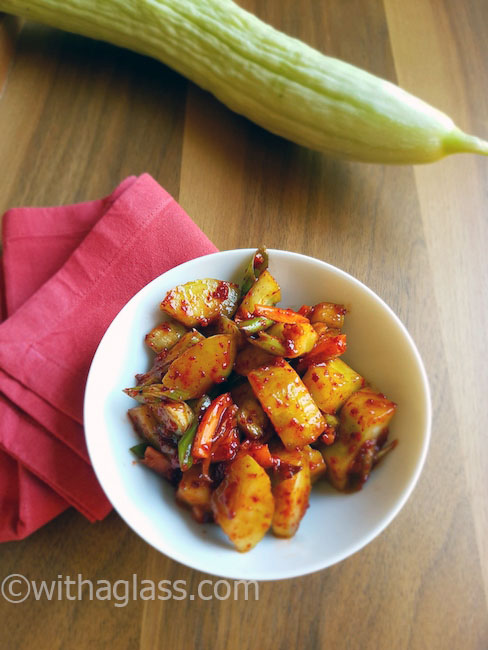
Have you ever fried cucumber? Even though it’s one of the vegetables I eat most often, such a way to serve it had never crossed my mind before I saw this recipe in the Revolutionary Chinese Cookbook by Fuchsia Dunlop. In constant search of new ways to cook shiso (see below), I prepared this dish out of pure curiosity, considering it a rather risky experiment. Luckily, quickly fried, still crunchy and juicy cucumber tasted surprisingly well. Paired with strong, slightly astringent shiso leaves, fresh chili and vinegar, it created a bold-tasting and original side-dish.

Shiso (紫蘇), or perilla, is an Asian aromatic dark red or green plant with an astringent taste and strong fragrance. I have discovered it thanks to the Japanese cuisine, where it’s frequently used raw, cooked and its red variety is gives a reddish hue to pickles. Similar varieties of this herb are also used in Korean (ggaennip, 깻잎) and Vietnamese (tía tô) cuisines. Thanks to Fuchsia Dunlop’s book I learnt that perilla is also appreciated in China.  Shiso is not to everyone’s taste, but I instantly fell in love with its herbaceous aroma and the more I cook with it, the more I appreciate it.

Revolutionary Chinese Cookbook, which presents the Hunan province, has not only revealed a new way to prepare cucumber. It has most of all made be realise I am very fond of the combination of hot, salty and sour flavours, typical of this place (and often distorted abroad by the addition of sugar). The few dishes I cooked from this book (I hope to share them with you soon) were excellent and proved once more that Fuchsia Dunlop approaches food writing with discipline and passion. I equally – and even more –  recommend her “Sichuan Cookery” which is one of the best  cookery books I have ever seen.

If you like cucumber and have access to shiso, try this simple but surprising (at least for me) recipe. I haven’t modified the original instructions and have only changed amounts of ingredients. If you don’t find shiso, the author advises Thai sweet basil and I totally agree. The taste will be completely different, but it’s also a strong, aromatic herb, which gives excellent results when cooked. For me, the taste of the dish is interesting enough to try making it without any herb.

If you look for shiso cooking ideas, you might like some of these:

Teriyaki Pork Rolls with Shiso and Gochujang

Teriyaki Pork Rolls with Shiso and Gochujang

Pork Rolls and Shiso in Tempura

Pork Rolls and Shiso in Tempura

Garlic and Shiso Infused Soy Sauce

Garlic and Shiso Infused Soy Sauce

Shiso and Bacon Fried Rice

Shiso and Bacon Fried Rice

Preparation: about 15 minutes

Ingredients (serves two):

1/2 long cucumber

1 red chili (fresh)

1 garlic clove

1 teaspoon light soy sauce

1 teaspoon  rice vinegar

4 tablespoons chopped perilla leaves (the recipe calls for purple perilla leaves, but I’m sure you can use the green variety too)

1 teaspoon sesame oil

1 tablespoon peanut or canola oil

Halve the cucumber lengthwise and then cut diagonally into 0.5 cm/about 1/4 in thick slices.

Chop the chili and the garlic. (Remove the chili seeds if you don’t want your dish to be too hot).

Heat one tablespoon oil in a pan or wok.

Spread the cucumber slices at the bottom and fry them at high heat until they are slightly golden on one side (about 2 minutes). Turn them and fry the other side in the same way.

Add the chili, the garlic and the soy sauce. Stir-fry for a couple of minutes.

Add the vinegar and the chopped perilla.

Stir well the dish for one minute and put the pan aside.

Add the sesame oil and stir well before serving.


Chicken, Carrot and Mizuna Spring Rolls

mizunarollsp

In spite of the coldest spring I remember, mizuna has been growing like crazy on my balcony. I have sown this delicious Japanese plant for the first time and am thrilled to see it adapts so easily to a different climate. Actually, it grows with such a speed, I have already harvested several handfuls in recent weeks. The only, very simple way I knew to enjoy mizuna was to make it into a green salad or mix with other leaves, but these spring rolls were well worth the small additional effort.

Mizuna (水菜) is one of the most popular Japanese leaf vegetables, used both raw and briefly cooked. Its long, thin fringed leaves are in a certain way similar to rocket (aka arugula) or dandelion, but they have a much more delicate taste, with a subtle peppery note (the younger the more delicate they are of course). Until now I have been using it only in salads, but given its growth easiness, I will certainly have many occasions to experiment.

These fresh spring rolls (also known as summer rolls) are very similar to those I posted here (with surimi, avocado and lettuce) and are a nice alternative to a salad starter, appetiser or a lighter replacement of a sandwich, for example at a picnic. I have always associated uncooked rice paper rolls with Vietnamese cuisine, but I have recently learnt they are also known in Japan as “harumaki” (春巻き), though I think mizuna is not their usual ingredient. In my opinion the extremely versatile rice paper can be filled with practically everything one likes, as long as it’s not leaking, and mizuna has been an interesting change.

You can serve these rolls with a mixture of soy sauce, chili oil and vinegar, but they were particularly good with this sesame paste dressing treated as a dip.

TIPS: If you add transparent (glass) noodles, these rolls will be more filling (in this case cut down the carrot and mizuna amounts).

Preparation: 15-20 minutes

Ingredients (8 rolls):

8 (22 cm or 8 3/4 in diameter) rice paper sheets

2 big handfuls of mizuna leaves 

2 big carrots

1 big baked, grilled, boiled or steamed chicken breast

mayonnaise

(chili paste or sauce)

(mint leaves)

Julienne the carrots.

Cut the mizuna leaves in two.

Cut the chicken breast in two horizontally and then into thin strips.

Fill a big wide bowl with warm (not hot) water.

Divide the mizuna, the chicken breast, the carrot (and the mint if you use it) into ten equal portions.

Dip rice paper sheets one by one in the water, immersing them delicately so that you don’t break them.

As soon as the sheet softens (after about ten – twenty seconds), put it onto a big chopping board.

Place first 2/3 of 1 portion of mizuna leaves in the middle, horizontally (at the edge which is closest to you) julienned carrot, a piece of chicken breast, mayonnaise, (chili paste and mint leaves if you choose to do so), cover with the remaining 1/3 of mizuna’s portion. You should aim at approximately 9cm/3,5 in long roll.

Roll tightly starting from the edge which is closest to you.

Proceed in the same way with the remaining rolls.

Serve them immediately as they are or cut in two horizontally with the sesame paste dressing/dip or with a mixture of soy sauce, chili oil and vinegar.

If you wish to serve them later, wrap them individually in cling film because they dry out very quickly.

Goat Yogurt, Cucumber, Radish and Dill Salad

goatyogurtsaladp

Have you ever bought a food product which tasted good but you had no idea what to do with it? It happens to me regularly, but usually involves exotic, foreign food. Strangely, I have recently had similar experience with goat yogurt. I like goat cheese a lot, so I did like goat yogurt too, but somehow couldn’t place it in any food category (and definitely not in the same as cow milk yogurt), not to mention a dish where I could use it.

The other day I felt like making a Cucumber and Radish Salad but unfortunately – or rather luckily – I ran out of standard yogurt and sour cream I usually add. Substituting it with goat yogurt, I actually discovered a much more interesting version of this refreshing salad. I have also added some chopped dill harvested from my balcony and couldn’t believe my taste buds! I have no words to describe how terrific proved the mixture of refreshing cucumber, subtle dill scent, slight radish spiciness and subtle goat yogurt flavour.

UPDATE: I have just discovered that goat yogurt is amazingly good served with Hungarian Chicken with Paprika (Paprikàs Csirke), instead of the usual sour cream.

Here are some other cucumber salad ideas you might like (I have just realised there is the same bowl in all the photos… I guess I liked it a lot last year!):

Cucumber and Seaweed Salad

Cucumber and Seaweed Salad

Cucumber and Chervil Salad

Cucumber and Chervil Salad

Radish Cucumber and Sour Cream/Yogurt Salad

Radish Cucumber and Sour Cream/Yogurt Salad

TIPS: This salad should be made just before serving, otherwise the vegetables will render liquid and the “sauce” will get watery.

Just like my older yogurt/sour cream version, this salad a perfect side-dish or starter in both Western and Asian meals. I can very well see it served with hot and spicy Indian food.

Dill is one of the herbs which freeze very well and taste much better preserved this way rather than dried. You just have to chop it finely before freezing and make sure it is thoroughly dried.

Preparation: 10 minutes

Ingredients (serves one):

6-7 big red radishes

1/3 long cucumber

3 heaped tablespoons goat yogurt

2 tablespoons chopped fresh dill

(salt)

Cut the cucumber in four pieces lengthwise, and then into thin slices.

Cut the radishes in two pieces lengthwise, then into thin slices.

Combine all the ingredients in a bowl (taste if you need salt; I didn’t need any) and serve.

Miso Vinaigrette

misovinp

I never get bored with dressed green salads. After years of having it regularly, both as a side-dish and a starter, I am always excited at the discovery of a new dressing, especially when warm spring days arrive and salad leaves are bought with higher frequency. This miso vinaigrette is simple, but original in its creamy consistency and quite complex taste it owes to miso. I have written below a short recipe, but to put it simply, it’s a traditional mustard vinaigrette with miso used instead of mustard. Accidentally this salad was a perfect company for the recently posted Chicken with Soy Sauce, Garlic and Molasses.

Miso has been frequently appearing on my table (see below) for several years now, but I have never thought of putting it into a vinaigrette. I have found this excellent and obvious idea in Japanese Farm Food by Nancy Singleton Hachisu, an American married to a Japanese farmer and living in rural area for several decades. The book contains both classic recipes and Nancy Singleton’s own inventions based on local ingredients. It is also full of stories about family, neighbours, local producers and, in general, describes life in the Japanese countryside. The book is a particularly compelling read, a beautiful object, a good source of recipes and I strongly advise it to all the Japanese cuisine fans, even novices because the majority of the recipes are easy and clearly explained.

For those who haven’t tasted miso (味噌), it’s a thick paste made by fermenting soybeans and/or barley or rice and one of the most important ingredients of the Japanese cuisine (Korean and Chinese cuisines use very similar pastes too). Miso is packed with protein, vitamins and minerals and some people claim it even helps to fight the radiation sickness. In Japan miso has three main colour types: white (shiromiso), red (akamiso), black (kuromiso), and there is also mixed miso (awasemiso). The only downside of miso is that is can be very high in sodium, so look for special “low sodium” misos (some high quality misos don’t even have this mention, but are less salty). Whatever the salt content, white miso has always a milder taste, so it’s a good idea to start one’s adventure with light-coloured miso. Apart from the three basic colours, there are myriads of different misos, depending on the brand or producer, the ingredients, the region…

If you have bought a tub of miso and wonder what to do with it, you might like:

aspchickmisop

Asparagus and Chicken Stir-Fried with Miso Sauce

-chmisogarlicpp

Garlic Miso Chicken Breast

misoshrimp3p

Miso Soup with Shrimp and Tofu

redmisomack1pp

Mackerel Simmered in Miso

chickenaubmisop

Chicken and Aubergine in Garlic Miso Sauce

And if you look for other salad dressing ideas, you might be interested in my recent delicious and very unusual discovery:

sesamesaladp

Sesame Paste (Tahini) Dressing

Apparently I am not the only one who eats more salads at the arrival of spring. This week Nami (Just One Cookbook) has posted a gorgeous seaweed salad and a miso (!) dressing, while Gourmantine (Gourmantine’s Blog) has presented no more no less but eight salad dressings. Visit their blogs for more inspiration!

TIPS: The below amounts should only be treated as approximate and adjusted to your taste, the miso kind or brand. (I have slightly modified the original amounts too). I have added some agave syrup to mellow the flavours (not present in the original recipe), but it’s not necessary.

I don’t like my salads drown in sauce, so double the below amounts if you prefer a very moist, rich salad.

Preparation: 10 minutes

Ingredients (serves two – three):

1/3 lettuce head, washed and torn into smaller pieces

(cucumber, tomatoes or any other raw vegetables cut into pieces)

Dressing:

3 heaped teaspoons miso of your choice (I wouldn’t advise the very dark, strong miso)

2 teaspoons oil

4 teaspoons rice vinegar

(1 teaspoon syrup or honey in case you need to adjust the taste; I have used agave syrup)

In a glass combine well the vinaigrette ingredients.

Place the salad leaves and other vegetables in a bowl and pour the miso vinaigrette over them just before serving.

Korean Mung Bean Sprouts Salad (Nokdu Namul)

koreansprouts_p

I’m starting to wonder how far will go my obsession with sesame seeds. A jar with roasted sesame seeds is placed just next to the salt container, at the stretch of my hand, so it proves how much I like it and how frequently I use it. Frankly speaking, every time I prepare an Asian (or even vaguely Asian) meal, my first reflex now is to sprinkle it with sesame seeds and I never regret my gesture (although I do manage sometimes to resist the temptation). As for the sesame oil, a small teaspoon stirred just before serving adds a deep, nutty flavour I find more and more addictive too.

This salad, found in Growing Up in a Korean Kitchen: a Cookbook by Hi Soo Shin Hepinstall owes everything to sesame oil and seeds. For me it was was also a interesting new way to consider mung bean sprouts I regularly add to stir-fried meats, rice or noodles. Even though the dressing is light, the tiny amount of powerful sesame oil transforms it into an interesting, fragrant side-dish. The addition of sesame seeds, as always, gives a pleasant crunchy note.

I have scaled down the original recipe to two serving and used European chives instead of spring onions I didn’t have. I have also change the name from “seasoned mung bean sprouts” to a “salad” because I have it cold and treat it as a salad.

TIP: If you have never used sesame oil, I advise buying it in a Japanese or Korean shop (or maybe simply Asian). The only time I bought a bottle of good quality, cold-pressed organic sesame oil made in Europe I discovered something I dislike so much I still wonder how to use it (and it wasn’t rancid). I think Asian sesame oil is made from roasted, not raw, sesame seeds.

This salad is apparently served both at room temperature and very cold. I prefer it cold, so I have quickly rinsed the blanched sprouts in very cold water. If you want to serve it at room temperature, skip this step.

Preparation: 15 minutes

Ingredients (serves two):

150 g/about 5 oz mung bean sprouts

1 teaspoon soy sauce (or more if you use low-sodium soy sauce)

1 teaspoon rice vinegar

1 teaspoon sesame oil

1 small clove garlic

(salt)

ground pepper

1 green onion (the lighter part only); I have used European chives instead

toasted sesame seeds

Blanch the mung bean sprouts in boiling water for a minute.

Quickly drain and, if you wish to serve the salad very cold, rinse it with very cold water.

Drain once more.

Crush the garlic and chop it finely.

Mix it with the soy sauce, the vinegar, the sesame oil, the ground pepper and the salt (if you need it).

Put the sprouts in a big bowl and combine with the dressing.

Chop the green onion or the chives.

Transfer the sprouts to a serving bowl.

Sprinkle with sesame seeds and green onion/chives.

This salad can be served very cold or at room temperature (I have preferred it cold).

Salad with Sesame Paste Dressing

sesamesaladpp

If, every time you open a jar of sesame paste, you have to close your eyes to fully enjoy the inebriating, nutty fragrance and never resist stealing a teaspoonful, then this recipe is for you. I know it looks like a bowl of ordinary lettuce, but it’s much more than that. The leaves are delicately seasoned with the creamiest, richest salad dressing I have ever made. If used in moderation (this is why it is barely visible on the photo), this dressing is so addictive, I found myself preparing it three days in a row. I discovered it accidentally, a couple of days ago, while leafing through Sichuan Cookery by Fuchsia Dunlop, one of the best written cookery books I know. As someone, who prepares either the classical French vinaigrette with mustard (sometimes garlic) or its vaguely Asian version, with soy sauce and sesame seeds, I was thrilled to discover this completely new way to dress the humble lettuce.

This salad has proved for me an ideal choice for the this time of the year, when a bright green, crisp, raw side-dish cheers me up and announces the imminent spring. Its creamy, intense dressing keeps it still in the rich, comforting food category. The addition of sesame oil might at first seem superfluous, but it has wonderfully increased the nutty fragrance, so I wouldn’t advise skipping it. The only big change I have allowed myself here was the addition of vinegar. The original recipe didn’t contain any acid ingredient and I desperately need some tanginess in my salads. In my defence I would like to emphasize I have used black Chinkiang vinegar, regularly appearing in Sichuanese recipes, such as Bang Bang Chicken, also found in the same book and also containing sesame paste.

TIP: If you don’t have dark Chinese sesame paste, try finding wholegrain sesame paste (I buy it in organic shops). Otherwise, any good light sesame paste will do. Black sesame paste might be too strong, but of course it depends on your preferences.

Soy sauce is not mentioned in the original recipe, only salt. I have used low-sodium soy sauce here because the dressing was too thick and I didn’t want to use more oil.

Preparation: 10 minutes

Ingredients (serves two):

crisp salad leaves (tear the bigger ones into several pieces)

1 heaped tablespoon sesame paste

1 flat tablespoon Chinkiang vinegar (I think that malt vinegar would be the closest substitute here but do try finding Chinkiang vinegar which is unique)

pinch of sugar or syrup

1/6 teaspoon salt (or/and light soy sauce)

1/2 teaspoon sesame oil

(toasted sesame seeds)

Place the dressing ingredients in a big bowl.

Mix them with a spoon until the sauce is homogenous.

Adjust the taste and add more oil/soy sauce/vinegar/sugar if the consistency is too thick.

Spread the dressing inside the bowl, place the salad leaves and delicately “wipe” the bowl’s interior with them.

Transfer the seasoned salad to a serving dish or bowl.

You can sprinkle it with toasted sesame seeds.


Harihari Zuke (はりはり漬け), Pickled Dried Daikon

harihari_pj

Drying fruits, vegetables and mushrooms is not only a way of preserving them. First of all, they have a different use in the kitchen and often become so good and unique, they could never be substituted by their fresh versions (it’s maybe a question of personal preferences, but I would never put fresh mushrooms in Ragù alla bolognese).  I have been drying fresh produce for many years (I have recently posted here several methods to dry apples), but doing this with the long Asian white radish called daikon has never crossed my mind. When I saw pickled dried daikon at Hiroyuki’s blog (Hiroyuki’s Blog on Japanese Cooking), I was very intrigued and curious but didn’t expect much more than a moderately flavoursome, interesting side-dish and certainly not the excellent taste and extraordinary texture it has changed into! I also like fresh daikon a lot, but once dried and pickled, it undergoes a magical transformation.

Daikon is one of the staple Japanese vegetable and its dried version is quite popular too. It is often used in simmered dishes and sold in two forms: wari boshi daikon (thicker strips) and shredded daikon called kiri boshi daikon (go to see the difference here at Hiroyuki’s blog). Harihari zuke (pickled dried daikon) calls for the thicker version (wari boshi daikon). Just like most Japanese pickles, these have a delicate, slightly sweetish taste, but this is where the similarity ends. The very special chewy, but at the same time crunchy texture is what makes them unique and, in my case, addictive. Thank you so much, Hiroyuki, for this extraordinary discovery!

If you don’t find thickly cut dried daikon, wari boshi daikon is ridiculously easy to prepare, whatever method you use (it’s also an excellent way to use up leftover wilted, dying daikon!). I haven’t even checked if I can get it in my city because I knew it would be cheaper when made at home and moreover I wanted to use organic vegetables. For this first experiment I used only one daikon, but after the surprisingly good outcome I have just started to dry a new, this time much bigger batch. This way I will have dried daikon ready any time I feel like preparing this wonderful snack again.

I have slightly changed Hiroyuki’s proportions in the pickling liquid and have omitted seaweed strips (see the original Hiroyuki’s recipe here).

If you don’t feel like drying daikon, you might like these tsukemono (Japanese pickles):

kyurinop

Cucumber Pickled in Vinegared Soy Sauce (Kyuuri no kyuuchan)

gingerpickledp

Pickled Ginger (Gari)

pickledradishp

Pickled Pink Radish

TIPS: In Japan daikon is usually dried in the sun. Of course, given the season, I couldn’t do this. In the winter I dry fruits and vegetables on radiators: it’s quick, it doesn’t require much attention and doesn’t consume any additional energy. If you don’t have radiators, you can dry them using either the oven set at lowest temperature or hang it over the stove and wait until it dries by the heat produces while you cook (the latter can last a bit more). Of course, if you have a dehydrator, you don’t need me to tell you how to do it. Click here to see detailed description of the drying methods I used for example with apples and which apply to most cut fruits or vegetables.

Fresh chili is not obligatory here, but a it is very pleasant addition if you like hot food.

Preparation (3 hours + drying process, if you don’t have dried daikon, which depends on the method used, see here): 

Ingredients: 

1 medium daikon (about 300 g – 350 g/about 11-13 oz) or a handful (filling loosely a 125 ml/ 1/2 cup container) of wariboshi (thick strips of dried daikon)

4 tablespoons low-sodium soy sauce or 3 tablespoons normal soy sauce+1 tablespoon water

4 tablespoons rice vinegar

1 flat tablespoon sugar (I have used agave syrup)

1 fresh medium-hot small chili, seeds removed

Frist dry the daikon (wariboshi, i.e. thicker version).

Peel the daikon, cut horizontally into 7 – 8 cm (about 3 in) chunks (I have cut my daikon in three parts).

Then cut each piece lengthwise in two, then cut each half lengthwise into 1 cm-thick strips.

They should be more or less similarly thick, but not necessarily identical.

Dry it following the instructions I gave here (using a radiator, an oven or hanging it above the stove).

When the daikon has dried completely (it has to be tough when you touch it: the drier it is, the longer it will keep; otherwise it can become mouldy), you can start the pickling process.

If dried daikon strips are too long to be considered “bite-sized”, cut them in two.

Put the daikon strips into a bowl of boiling water and leave there for about 30 minutes.

In the meantime dissolve the sugar in the mixture of vinegar and soy sauce.

Shred the chili pepper and put into the pickling mixture.

Squeeze the soaked daikon and dry it. Put it into the pickling mixture and leave in the fridge for 3 hours, shaking from time to time so that it pickles equally.

Eventually, the dried strips will absorb all the pickling liquid (the photo above was taken only after ten minutes’ pickling, hence the liquid at the bottom).

Such pickles can be left in the fridge for several days (or maybe weeks? I have no idea because I have managed to keep them only for two days).

Wonton Cups, or Edible Snack Containers

wontoncupspj

As you may have noticed I have taken a small break from blogging. After an intense shopping and cooking period, I have been spending recent days eating the remains of Christmas food, drinking wine, going through the tons of books I was offered for Christmas and, in general, enjoying a most lazy end of the year. I hope you are also relaxing and enjoying this festive period. The recipe I am going to present today perfectly illustrates my partly idle and festive mood. In fact, if I were to make a list of recipes with the highest attractiveness vs easiness ratio, these dumpling wrapper cups would win hands up. I will not exaggerate if I say that in my case they have revolutionised the world of snacks and particularly of finger food.

The ridiculously simple “recipe” keeps in one sentence really: brush the wonton wrappers with oil, line muffin moulds with it and bake for ten minutes. Once the edible, crisp cups are ready, you can fill them with practically whatever you wish, as long as it doesn’t leak. As you see, this time I chose my beloved guacamole, but the possibilities are really infinite. I can already imagine myriads of dips, salads and even grilled dishes, which served in these small cups would brighten up any party table.

This unusual way to use wonton skins is one of the most extraordinary cooking discoveries of this year and I owe it to Juliana (Simple Recipes) who, thanks to her beautiful post featuring wonton cups with smoked salmon filling, taught me the most magical snack trick in the world. Thank you so much, Juliana, for this amazing idea!

Before I pass to the recipe I would like to wish all my dear readers a very happy and prosperous New Year. May this upcoming year make all your dreams come true.

TIPS: If you want your cups neat and round, follow Juliana’s advice and cut off the corners before baking the skins. I found the uneven corners quite amusing (especially since it made the recipe even lazier…).

Before filling the cups with salads and other dishes with sauce, make sure they are well drained; the cups are not 100% waterproof!

Cut the filling’s ingredients into small chunks, so that the cups are easy to eat.

The cups can be made in advance (even two days in advance) and kept (empty) covered with paper towels.

Here are some other wonton filling suggestions:

mackerspreadp

Smoked Mackerel and Egg Spread

rspp

Rice Salad with Shrimp and Avocado

confitoignonp

Onion Confit with Fig and Port

mangochickenp

Mango, Chicken and Cucumber Salad

freshchradish2p

Fresh Cheese Spread

avocadowalnut2p

Avocado and Walnut Salad

babag1pp

Baba Ghanouj

calamarp

Korean Stir-Fried Squid

Preparation: 20 minutes

Ingredients:

wonton (Asian dumpling) wrappers (thawed)

oil

Preheat the oven to 180°C (350°F).

Brush wonton wrappers with oil, piling them up and slightly pressing so that you brush only one side of each sheet, but both sides end up oily.

Line muffin moulds (or other small moulds) with the wrappers and bake for about 10 minutes until they become golden brown.

(I use silicone moulds, so no need to grease them, but if you use metal tins you might need to brush them with oil).

As soon as the cups cool down, fill them with whatever comes to your mind and serve.

Empty cups keep crunchy for three days covered with paper towels.

Cabbage and Ramen Noodle Salad

ramensaladpj

This is, without any doubts, the star of this winter’s salads. I saw it several months ago on Azusa’s blog (Humble Bean) and wouldn’t stop thinking about it. How could I forget a recipe which had dried uncooked noodles among its ingredients? I simply waited for this time of the year when cabbage is one of the rare seasonal salad vegetables. Even though the salad looked beautiful, I must admit that the intriguing use of noodles was what tempted me most of all to prepare it. In fact I didn’t expect even half as good result and certainly not such a wonderful, complex side dish. The crunchy mixture of dry noodles, peanuts and sesame seeds is of course the focal point here. Once browned in butter, it proved an amazing topping and a perfect company for the sweet and sour salad dressing. I can very well see it sprinkled on many other dishes too. (Maybe I’m wrong, but I suppose the Japanese would call it “furikake”.) I made this salad for the first time yesterday, I have had it once more today and am already looking forward to serving it tomorrow. I think it will be my staple this winter just like Azusa’s Tomato and Shiso Salad was for the last two summers. Thank you so much, Azusa, for one more extraordinary discovery!

This recipe comes from a Hawaiian cookery book and accidentally it would go perfectly well with Shoyu Chicken, the only other Hawaiian dish I prepare (also found at Humble Bean). It would be an original alternative to coleslaw or any salad served with roast meat or birds during holidays. The guests’ amazement is guaranteed!

I have slightly modified the recipe mainly using peanuts instead of almonds, adding salt to the crunchy mixture (I still don’t know why I did it but it was a good decision) and scaling it down to a dish for two. Visit Humble Bean to see the original recipe.

TIP: The best way to crush both peanuts and noodles is to put them in a resistant bag (such as ziplock) and crush them with the bottom of a bowl for example.

I have made a bigger amount of the crunchy mixture (it has to be kept open, otherwise it will lose its crunchiness) and the following day the salad took me only 5 minutes to prepare. The mixture cannot be kept for a long period though (it might get rancid).

Preparation: 20 minutes

Ingredients (serves two):

150 g (about 2 cups) shredded white cabbage or a mixture or white and red cabbage

Crunchy mixture:

4 flat tablespoons crushed ramen noodles (Chinese-style “curly” wheat noodles)

2 flat tablespoons sesame seeds

3 flat tablespoons crushed peanuts (the original recipe calls for almonds)

1/2 teaspoon salt

1 tablespoon butter

Dressing:

2 tablespoons rice vinegar

1 tablespoon soy sauce

1 tablespoon sugar (I have used agave syrup)

3 tablespoons chopped green onion (I had chives, so I have used them instead)

Heat the butter in a pan and, at low heat, brown the mixture of noodles, peanuts and sesame seeds, constantly stirring. When the noodles become golden, put the pan aside and combine the mixture with the salt.

Combine the dressing ingredients. Combine it with the shredded cabbage.

Sprinkle the salad with crunchy mixture and green onion or chives.

Give the salad a stir just before serving it.


Korean Radish Salad (Musaengchae)

daikonsaladkpj

Winter – or late autumn – vegetables are scarce and can quickly become boring (especially for someone who doesn’t like pumpkin), but luckily there is daikon, the Asian long white radish. It can be served raw or cooked, but it is only the former which, thanks to its spiciness and crunchiness, reminds me of the spring pink radish. I have always liked the way for example Radish Kimchi stops me from feeling heavy and sleepy after hearty meals. This quick and refreshing salad is one of the rare Korean dishes not really requiring exotic food ingredients (apart from the sesame oil which can be easily skipped) and as such it can be served with many, not only Korean dishes. It should be prepared with “mu”, white Korean radish,  which is shorter and plumpier than daikon, but I have never seen it sold, so daikon was the only choice I had. I do not complain though because it’s excellent this way too.

I found this recipe in my Korean cookery book (The Food and Cooking of Korea by Young Jin Song) and have only slightly modified it, but its versions vary a lot on internet. I have seen it with ginger, garlic, green onions… so feel free to modify it, as long as the ingredients stay Korean (whatever it may mean!).

Yesterday I saw Hiroyuki (Hiroyuki’s Blog on Japanese Cooking) posted his wife’s Daikon and Tuna salad. I thought it was a funny coincidence to discover two new appetising daikon dishes in one week. Hiroyuki’s wife’s salad is completely different, but very tempting so click here to check it or wait until I post it on my blog ;-)  .

TIP: The salad does contain chili powder, but the amount and the hotness level depend on your personal choice of course (you can use sweet paprika too). The last batch (several big bags) of Korean chili powder I bought proved to be only slightly hot, so I can use more of it without obtaining fiery results.

Preparation: 10 minutes

Ingredients (serves 2 if it’s the only side-dish):

200 g/about 7 oz very cold white Korean radish or daikon

Dressing:

1 teaspoon delicate vinegar (I have used rice vinegar but it can be cider vinegar too)

1/2 teaspoon sugar (I have used agave syrup)

1/4 teaspoon salt

1/2 teaspoon Korean chili powder (or any other chili powder)

(1/2 teaspoon sesame oil)

1 teaspoon lemon juice

toasted sesame seeds

Cut up the radish into matchsticks or grate it on a mandolin or with a special shredder.

Combine the dressing ingredients and stir into the radish.

Serve immediately sprinkled with sesame seeds or put into the fridge and serve it later (it tastes better cold).


Celery Kimchi

celerykimchip

Charles would love it!” was one of my first thoughts when I tasted this new version of kimchi. First of all, I know that Charles (my blogging friend from 5 Euro Food) loves kimchi and Korean food. Moreover, we have recently had a most interesting conversation about celery (don’t laugh!), which Charles adores and I only start discovering. I am sure that someone has already tried making celery kimchi, but I swear it was my own idea (although maybe Hyosun’s kind suggestion of a Korean celery side dish has put me on the right tracks…). Whatever was the trigger, when I saw celery stalks in my fridge and two containers of kimchi above them (yes, I have become a notorious kimchi maker quite a long time ago), I thought “why don’t I “kimchi” the celery too?”.

The result is stunningly good. The celery has stayed crunchy, refreshing, but tougher than radish in kimchi. Its anise aroma, instead of disappearing, has curiously doubled, so even after a couple of days, the not fully mature kimchi is already particularly strong. (UPDATE: After 5 days the celery aroma started to weaken and sadly the kimchi started to lose its appeal…). I suppose this is only for the celery fans and I wouldn’t advise it to those who hate anise aroma either. For me, who only starts to discover the magic world of celery, this kimchi is a revelation and I am already making place for an additional, constant container in my fridge.

As a reminder, kimchi (김치), is a Korean method to ferment vegetables with garlic, chili and some other ingredients. Chinese (Napa) cabbage and daikon (white radish) kimchi are the most popular, but I think my all-time favourite is cucumber kimchi, I have discovered thanks to Charles’s suggestion. Kimchi has a very powerful smell, but once you taste it and love it, the smell will never be associated with anything unpleasant. It is spicy, hot, sour and, like most fermented vegetables, very healthy. High in fiber, low in calories and fat, it is packed with vitamin C (thanks to the fermentation) and carotene. It also contains several other vitamins, helps digestion, is said to prevent certain cancers… Its importance in the Korean cuisine cannot be compared to anything in any European food culture I know. Apart from being served as a side dish, kimchi is used in fried rice, stew and soups.

I fill my kimchi stock regularly, so that I have at least one kind in the fridge. It’s a perfect side dish and a quick way to add vegetables to any meal, especially when one doesn’t feel like cooking anything more or even making a salad. I also use it often (the cabbage version) in fried rice (see the recipe here) which thanks to kimchi’s strong flavours and its “sauce”, doesn’t require any additional seasoning. I haven’t tried it yet in soups, but am planning to do it soon.

The traditional, whole cabbage kimchi requires some dexterity (or maybe I am too clumsy?) and my three experiments were not fully successful. Its lazy version I prepare, the radish kimchi and the (also lazy) cucumber kimchi are ridiculously easy and can only get better in time, while we adapt the seasonings, the hotness level and the fermentation time to our palate. In short, if you like hot flavours and garlic, do try kimchi one day. Hyosun from Korean Bapsang is my main inspiration in Korean cookery and my radish and cucumber kimchi are based on her easy-to-follow recipes. The easy cabbage kimchi recipe comes from Shu Han’s Mummy I can cook!. I have based my celery version on radish kimchi. Thank you, Hyosun and Shu Han, for introducing me to the world of kimchi.

If celery is not your cup of tea, I propose more crowd-pleasing versions of kimchi (nowadays my chili powder is darker, hence the difference in hues):

daikonkimchip

Radish kimchi

makkimchip

Easy Chinese/Napa cabbage kimchi

cucumberkimchip

And my favourite: Cucumber kimchi

TIPS:

UPDATE: Contrary to the above kimchi, the celery version was excellent only for the first several days. After about 5 days it started to get too pungent and strong. I advise eating it quickly! This is an ephemeral kimchi :-)

Use younger celery stalks which do not require peeling (i.e. which don’t have “threads”). The process will be quicker. I find younger celery bunches in organic shops, but of course it depends on the country you live in.

Hyosun Ro’s and traditional Korean recipes call for raw shrimp or sometimes raw oyster as the fermentation enhancer, but since I can only get frozen shrimp, I thought it would be safer to replace it with additional fish sauce.

Wear gloves if you manipulate kimchi with your hands (apart from the smelly side there is lots of chili in it).

If you taste your kimchi and it seems very bitter, leave it to ferment for additional 24 hours. I did it with my radish kimchi and miraculously the bitterness disappeared!

Preparation: 1 hour + min. 2 days, but 2 weeks are optimal; the kimchi you see above was one week old and improved every day

Ingredients (I adapted the ingredients to my very small “test” batch):

500 g/about 1 lb rather young celery stalks (daikon) cut into 3 cm (a bit more than 1 inch) pieces

3 heaped tablespoons Korean dried chili (my kimchi wasn’t very hot, just hot, but it depends on the chili’s hotness)

1 flat teaspoon grated or crushed garlic

1/2 flat teaspoon grated fresh ginger

chopped green onions (or European chives)

salt (I used about 2 flat tablespoons)

1/2 teaspoon glutinous rice flour

4 tablespoons fish sauce or (as advised by Hyosun Ro):

2 tablespoons finely minced saeujeot (salted shrimp)

1 tablespoon fish sauce
1 raw shrimp (ground)

Prepare the rice paste combining the rice flour with about 20 ml water. Let the mixture simmer until it thickens.

Sprinkle the celery with salt and leave them for 30-40 minutes. (They will release some water but won’t soften like radish does).

Put the celery into a big container (with a lid) and combine well with the remaining ingredients.

Taste and if you think it’s not salty enough, add some fish sauce (Hyosun Ro says it should be just a bit too salty).

Cover with the lid, press with your hands (wear gloves!) to remove the air from between the celery pieces and leave for two days to ferment in room temperature. (Mine has fermented for three days because I prefer it stronger).

Put into the fridge after two days or more. In general it gets stronger every day.

You can refrigerate it only to make it cold and eat it straight away after the fermentation process or you can wait several days or weeks to see how the flavours change and at which stage you prefer it (Hyosun Ro says it requires two weeks to develop the best flavours and I totally agree).

You can keep kimchi in the fridge for several weeks.

Vietnamese Green Papaya Salad

greenpapayasaladp

This salad has become my obsession and addiction of recent weeks. Maybe it is due to the green papaya which I have tasted here for the first time or maybe it’s the unusual, perfectly balanced hot, sour and sweet dressing… The truth is that after five or six meals in recent two weeks, instead of getting bored, I crave it more and more.

I suspect that a big part of my enchantment is due to the green papaya. Did you know that green papaya is simply unripe papaya? I suppose all my Asian friends will laugh here at my ignorance, but I’m still in awe at how huge is the difference between unripe and ripe fruit stage. While I am not fond of the ripe papaya’s overwhelming aroma, I adore the green one’s subtle, delicate scent and crunchy texture. I intend to explore more recipes from South-Eastern Asian countries and India, where apparently green papaya is very popular. Apparently papaya is not only flavoursome, but also healthy, so I hope it’s better than being addicted to bacon.

This salad is also my first step into the discovery of real Vietnamese cuisine. Frankly, since my only memories of “Vietnamese” food were greasy, heavy dishes in thick, sticky floury sauces, this salad was a revelation. The recipe comes from “Vietnamese Street Food” by Tracey Lister and Andreas Pohl, a book I have recently bought when I realised I didn’t know much about this country’s cuisine and didn’t have a single Vietnamese cookery book. The book is not an introduction to the Vietnamese cuisine, but only to its street food which for me is a fascinating world, so absent in European culinary culture. It is beautifully designed, contains luscious photos and tempting recipes. While reading it I realised that many ingredients used in Thai cuisine are also used in Vietnam and, as I have already mentioned in a previous post, Vietnamese use my beloved shiso quite a lot (called tia to or ti to, but don’t ask me how to pronounce it).

I have slightly modified the recipe, skipping dried beef  and fried shallots I didn’t have. I don’t know how much I missed without these ingredients (every time I made it I skipped them), but the result was awesome and far beyond my expectations.

Preparation: 15 minutes

Ingredients (serves 2 as a side dish):

1/4 medium green papaya

a handful of soybean/mung bean sprouts

3 Asian spring onions (white and whiteish parts only) or 1 Asian shallot (advised in the original recipe)

1 heaped tablespoon toasted and roughly crushed peanuts

1 heaped tablespoon fried onion/shallot (I have skipped it)

leaves from 4 branches of coriander

Sauce:

1 small bird’s-eye-chili, finely chopped

1 garlic clove, thinly sliced

2 flat tablespoons sugar or Agave syrup

1 tablespoon fish sauce

juice from 1/2 lime

(shredded dried beef)

Peel the papaya and cut it into long matchstick threads (a mandolin is a good tool here).

Combine it with the sprouts, chopped spring onions and coriander leaves.

Mix the sauce ingredients and pour them over the vegetables.

Stir well, sprinkle with peanuts and serve.


Rice Salad with Shrimp and Avocado

shrimpricesaladp

Have you ever made a rice salad with mayonnaise? Until about a month ago I thought every single visitor of my blog would answer this question positively. For long years I was convinced such a leftover salad was popular everywhere around the world, especially among the nations for which rice is a staple. Then, astonished, I realised rice salad was a total novelty for my Japanese teacher, who took my recipe and prepared her very first rice salad. Her enthusiastic feedback emboldened me to post this casual dish. One’s staple is often another person’s discovery, so I hope that regular rice salad makers will forgive me such a basic recipe and will not consider this post pretentious.

I cook a lot of Asian dishes, so leftover rice is my everyday fare. To be honest, I always steam more rice than needed because we are particularly fond of fried rice and of course rice salads. Rice salads have always been for me a safe bet in the simple & quick meals category, especially in summertime when they become a chilling alternative to fried rice. I prepare many different versions, depending on what I have in the fridge, but the mixture of shrimp, avocado and cucumber is probably the most frequent. First of all I am very fond of this combination (see below other dishes including it) and keeping the three ingredients in stock is quite easy (I buy frozen raw shrimp). Almost all my rice salads include canned corn, a necessary sweet accent and a delicate softer but still crunchy note. In my opinion shrimp, avocado and rice literally scream for mayonnaise, so I have never tested this version with other sauces, although I serve other rice salads with mustard vinaigrette. I know this bowl might not look very appetising, but if you like the main ingredients and have never tried making a leftover rice salad, you should give it a go. I am almost certain you will not regret it.

Here are two other dishes with my beloved shrimp, avocado and cucumber combination (accidentally they also include rice and mayonnaise):


Maki Sushi with Shrimp, Avocado and Cucumber

Hot & Cold Rice Bowl with Shrimp, Avocado and Cucumber

TIPS: This is a laid back, casual meal. I change the ingredients’ proportions according to my mood and to what I find in the kitchen. Therefore the below amounts are approximate.

I find that leftover, one day old rice is the best option in rice salads. It should at least stay several hours in a closed container before the salad is served.

Preparation: 10 minutes

Ingredients (serves 2 hungry people as a main course):

15 medium shrimp (shelled, deveined and blanched)

1 avocado

1/2 long cucumber

1 1,2 – 2 cups (about 375 –  500 ml) cooked rice 

1 red onion or 1 big spring onion 

1 can corn (300 g/about 10 oz)

a couple of tablespoons mayonnaise

salt, pepper

(Tabasco, Worcestershire sauce)

Chop finely the onion or spring onion.

Cut up the remaining ingredients.

Drain the corn.

Heat the rice in a microwave until is tepid (it will help to break the grains and to avoid lumps).

In a big bowl combine all the ingredients, add the mayonnaise, salt, pepper, Tabasco and Worcestershire.

Serve cold.


Kyuuri no Kyuuchan (Pickled Cucumber with Soy Sauce and Ginger)

kyuurinop

Kyuri no kyu chan (きゅうりのキューちゃん) is brand name of extremely popular Japanese cucumber pickles. I’m always thrilled at the idea of reproducing a famous factory made product at home (I still keep on preparing my own Taberu Rayu, a Japanese thick chili oil), so when I saw the recipe on Hiroyuki’s blog on Japanese cooking, I knew I would try it soon. This first test was particularly exciting since I have never actually tasted the original pickles. I have no comparison, but Hiroyuki’s home version, slightly modified and prepared with big, long Western cucumbers turned out delicious.

Unlike Western strong pickles, Japanese style pickles (tsukemono) have a low acidity level, are more or less sweet (sometimes too sweet for my taste) and, unless store-bought, they belong to short-term preserves; as such they have to be kept in the fridge. The low acidity is sometimes a nice change from stronger European pickles which cannot be served at every meal. The sweetness level of many Japanese dishes is however often too high for me, so I have slightly reduced here the sugar amount. I have also used low-salt soy sauce (Hiroyuki said they were very salty). I was very happy with the result and found these pickles addictive. They were so delicate and versatile, I had them with every single meal (breakfast too). Moreover, I was astounded by the incredible taste of the pickled ginger strips. They were supposed to be only a part of cucumbers’ seasoning, but I enjoyed fishing them out and eating separately. My next batch will be bigger and I will certainly add more ginger. Thank you, Hiroyuki, for this excellent recipe!

If you find yourself with a big batch of cucumbers, I strongly recommend trying the incredibly easy and particularly flavoursome Cucumber Kimchi:

cucumberkimchip

or the Moomins’ Cucumber Salad I posted last year and have been putting into jars this weekend:


Preparation: 15 minutes + 12 hours

Ingredients:

2 Japanese cucumbers or 1 big long Western cucumber

1 tablespoon fresh ginger slivers

1 tablespoon sugar

100 ml (about 3,4 oz) low-salt soy sauce

50 ml (about 1,7 oz) rice vinegar

toasted sesame seeds

Cut the cucumbers into 1 cm (about 1/2 in) slices and if they are big, cut the slices in two.

Put the sugar, the soy sauce and the vinegar in a pan. Bring to the boil.

Add the cucumbers and the ginger strips. Let them simmer for 2 minutes.

Put aside and once cooled, refrigerate them overnight.

Serve sprinkled with toasted sesame seeds.


Egg, Pepper and Anchovy Salad

egganchovysaladp

I promised myself to use my kitchen library more often. I did it when I started to mark with red stickers all the spines of the books I have never cooked from. I was appalled by the result and decided to act immediately, especially since another two recently ordered items were on their way… I love reading cookery books, leafing through them (even those which don’t have illustrations), dreaming with them (those without photos are excellent here), but somehow rarely open them in my kitchen.

The other day, desperate to use up a couple of dying, wilted red peppers I forced myself to keep away from the computer and turn to my book shelves instead. I remembered vaguely something interesting in a Spanish cookery book I haven’t opened for ages and I was right. A cute little book called simply Cocina Española (a Spanish edition of “Spanish” by Parragon books, no author), brought by my friend as a gift from Spain, proved to contain a salad I was able to prepare without even going out shopping. I couldn’t ask more for lunch on a hot sunny day: the salad was quick, easy, comforting and incredibly Mediterranean. In short the epitome of a casual Spanish dish.

This salad (not the first recipe from this concise but surprisingly practical book) not only convinced me that I should cook Spanish more often, but most of all, proved once more that my cooking library if full of treasures I should profit from. It has also reminded me how much I adore anchovies and how delightful they are paired with eggs. Accidentally, it’s the first Spanish recipe I have posted on my blog and I was very glad to add a new “country” category.

I have slightly adapted the original recipe to make it a dish for one. I have also changed the proportions and replaced black olives with vinegared capers to add a fresh, acid accent. (I’m sorry for the messy presentation, but I was really hungry!).

Preparation: 30 minutes

Ingredients (serves one as the main course or two as a starter):

2 hard boiled eggs

2 big sweet red peppers (long or bell peppers)

6 -8 canned anchovy fillets (drained)

3 tablespoons drained capers (I used vinegared capers) or 6- 8 black olives

Sauce:

1 tablespoon jerez (sherry) vinegar

1 teaspoon extra-virgin olive oil

salt, pepper

Combine the olive oil, the vinegar, season with salt and pepper.

Cut the peppers in two and place, skin side up, under the oven grill or keep them over the flame until the skin becomes black.

Put them into a plastic bag, close it and wait until they cool down.

Peel them with your fingers, remove the seeds and white parts.

Wash the peppers and slice them.

Cut the eggs into quarters.

Put all the salad ingredients in a bowl.

Pour the sauce over them and serve with bread.


Bang Bang Chicken, Strange-Flavour Chicken, or Cold Chicken with Sauce

bangbangp

It’s hard to make one’s choice when more than half of a cookery book has been marked to be tested…. (If you have been following my latest culinary discoveries, you will not be surprised  if I say I talk about “Sichuan Cookery” by Fuchsia Dunlop). I always hesitate between the famous recipes I want to test, the easy and quick no-fuss dishes and of course the intriguing ones. Bang Bang Chicken (Bang bang ji si) falls into the latter category and not only by its amusing name (which makes me hum a certain film soundtrack for two last days…) but, as I later learnt, also by its unusual flavours.

I suppose that to many of you Bang Bang Chicken is as familiar as Gong Bao/Kung Pao Chicken. To me, however, it has only recalled a vaguely Asian dish, but nothing else. For those, who, like me, have never seen this famous dish, it’s composed of boiled cold chicken, torn into pieces and dressed with a very particular sauce. If one takes into consideration the onion or/and the cucumber the chicken is served with, the dish might be called a chicken salad.

The words “bang bang” come from the wooden cudgel (“bang” in Mandarin) used to “beat” the cooked chicken so that its fibers  loosen and it becomes easier to be torn into pieces. A very similar dish is  called “Strange-Flavour Chicken (Guai wei ji si) due to the unusual combination of the sauce flavours (salty, sweet, sour, nutty, hot, numbing). The difference between these two Sichuan dishes is minimal.  According to the chefs cited by Fuchsia Dunlop, Bang Bang Chicken should be more “hot and numbing” than its close cousin. Otherwise, the basic ingredients and the method remain identical.

I took out the chicken breasts and thought I would prepare a quick lunch. Alas, the preparation is not as quick as it seems or looks. First the chicken needs to be boiled and slowly cooled. The Sichuan pepper, sesame seeds or peanuts need to be toasted (although the former two ingredients are very handy in other Sichuanese dishes and can be prepared in bigger amounts). Onions need to be soaked in water and cucumbers salted for at least 20 minutes… The time and effort were certainly worth it because the dish is a pure delight and the strange-flavour sauce makes the first bite an unforgettable experience.

Even though I kept the sauce as genuine as I could, I must confess a slight modification concerning the chicken preparation. First of all, instead of cooking the whole bird, I used two skinless breasts found in the freezer (thus the meat didn’t need any beating). I have also slightly modified the boiling liquid, using a cube of chicken stock with fresh ginger. If you want to see the original recipe, I strongly advise buying Fuchsia Dunlop’s book. It’s a rare jewel.

I have also prepared several other recipes from the Sichuan Cookery; all turned out excellent. Until now I have posted:

Steamed Aubergine with Chili Sauce

Gong Bao (Kung Pao) Chicken

TIPS:

The author says Bang Bang Chicken is served either on a layer of spring onions or on cucumbers. I have dressed mine on spring onions, putting cucumbers on a separate plate. At the table I combined everything in a bowl creating a very refreshing light summer salad.

Apparently dark sesame paste is the best choice for this dish. The author suggests however tahini or any other standard sesame paste as a substitute. I was glad to use light, organic sesame paste that has been sitting in my fridge for ages.

The chicken can be cooked one day before and dressed just before the meal.

If you have some leftover chicken, boiled in stock, steamed or prepared in any other, rather neutrally tasting way, this dish is  an original way to use it.

Preparation: 2 hours (or 30 minutes if you have already boiled and cooled the chicken)

Ingredients (serves two as a main dish, with rice or bread and some vegetables; serves 3-4 as a starter):

2 chicken breasts (or half of a small chicken weighing about 400 g/0,9 lb) + 1 litre (about 4 cups) chicken stock + 2,5 cm (1 in) ginger

Sauce:

1  flat tablespoon sugar

1 tablespoon light soy sauce

(salt)

1 tablespoon Chinkiang vinegar (black Chinese vinegar)

3 tablespoons sesame paste (the best one is dark Chinese sesame paste, but tahini or any other sesame paste is a good substitute)

1 tablespoon sesame oil

2 tablespoons chili oil with chili flakes (I used my home-made Taberu Rayu)

1 teaspoon toasted and ground Sichuan pepper (see below)

a couple of teaspoons toasted sesame seeds or unsalted toasted peanuts, roughly crushed (I have chosen the peanuts) (also see below)

6 spring onions (only white parts) or/and 1 long cucumber

First prepare the chicken. Bring the stock to the boil.

Cut the ginger into thick slices and crush them with the handle of your knife.

Add the ginger and the chicken (or chicken breasts) to the boiling stock.

Cook for 15 minutes (breasts) or 30 minutes (half-chicken). Cover with a lid and let it stand for another 15 minutes.

Let the chicken cool down, skin it and then shred the meat into slivers with your fingers. Make sure there are no bones in your shredded slivers.

Toast the sesame seeds or peanuts in a dry frying pan, on medium heat, until they are golden.

Put the sesame seeds aside. Crush the peanuts roughly with the bottom of a bowl or the handle of a big knife.

Toast the Sichuan peppercorns in a dry frying pan, on medium heat, until they start giving off a very strong smell but don’t let them burn. Put them into a coffee grinder or a small food processor (the one for baby food is perfect) and grind them.

Put aside.

If using the cucumber, cut it into thin strips (similar in size and form to chicken slivers), sprinkle it with salt and put aside for about 20 minutes.

Wash off the salt and drain the cucumber.

Cut the spring onion into thin strips lengthwise (similar in form and size to the chicken slivers) and put them into a bowl of cold water for at least 15 minutes. Drain them.

Prepare the sauce combining all the ingredients.

Pile either the onions or the cucumber in the middle of a plate.

Place the chicken slivers on top of the onions or cucumber.

Pour the sauce over the chicken.

Sprinkle with sesame seeds or peanuts.

Serve.


Mango, Chicken and Cucumber Salad

mangosaladp

I have always considered the addition of fruits into savoury dishes a delicate matter and approached the new combinations very cautiously. The results can be extraordinary, but I have already had awful experience with certain fruits, such as the pineapple (pineapple on a pizza or in a mayonnaise salad is simply not my thing). As much as I love mango in hot sauces (I preserve dozens of jars of hot mango sauce every year), I had serious reservations to include them raw into savoury dishes. Finally, the numerous tempting mango salads I kept on seeing on my favourite blogs convinced me  (thank you my dear friends!) and last Saturday I prepared my very first savoury salad with mango. I shouldn’t boast, but this salad was sensational and, needless to say, has totally convinced me to keep on experimenting mango’s savoury potential.

I haven’t followed any recipe but simply my cravings. I wanted a refreshing, light salad with chicken (which frankly I crave quite often). I ended up with the ubiquitous cucumber of course, added some mango, stir-fried chicken breast, red onion to counterbalance the mango’s sweetness, some chili to give the salad a hot kick and coriander… because somehow it seemed right. I was surprised that the sweetness of mango wasn’t as overwhelming as I feared and its relative softness added an interesting combination of texture with the crunchy cucumber. I loved this salad so much, I prepared it twice in two days and I already feel it will be my summer staple. If you have never included mango in savoury salads, the summer heat is the best moment to experiment.

TIPS: I suppose this salad would be extraordinary if prepared with green tangy mango, but since I had only yellow sweet mangoes, I used these.

I stir-fried the chicken breasts, but leftover roast chicken would be perfect here too.

Preparation: 20 minutes

Ingredients (serves two):

2 small chicken breasts 

2/3 of a long cucumber

1 clove garlic, finely chopped

1 big firm mango (it shouldn’t be too ripe or soft)

1 medium red onion

juice from 1 lime

2 tablespoons olive oil

salt, chili in powder or fresh (I used medium hot Korean chili powder)

fresh coriander

Cut up the chicken breasts into small, bite-sized pieces.

Season them with salt and stir fry with garlic on medium heat.

Pour the lime juice and the olive oil into a big bowl.

Add the chili and the salt.

Cut up the mango and the cucumber and put into the bowl.

Add the chicken, the chopped coriander.

Mix everything, check the taste and rectify the seasoning if needed.

Serve with crunchy bread and butter.


Cucumber and Chervil Salad

This year I have started to grow chervil for the first time in my life. It proved one of the easiest and quickest herbs to grow on my balcony and I haven’t even noticed when it started to look like a small bush. Even though chervil is widely used in French cuisine (it’s a part of “fines herbes” mixture) and easily available here, I have never bought it or cooked with it, so this huge harvest looked quite challenging.

If you have never tasted and/or seen chervil (Anthriscus cerefolium), it’s similar to carrot greens, but its leaves are more fragile and smaller. Even though chervil is related to parsley, its subtle aniseed taste is completely different. The first leaves I pinched out of my balcony plant made me realise it was the most elegant herb I am growing and therefore it required a special treatment, at least for the first time. Alas, all the recipes I found used chervil together with other herbs, so I realised I had to make up something on my own. Finally, I decided to combine it with cucumber in a light, refreshing salad. Instead of vinegar I used lemon juice in my vinaigrette to make a more delicate seasoning, which wouldn’t mask the chervil taste. The simple salad I have prepared reminded me a of some Japanese simple but surprising dishes: the few ingredients created distinct, but subtle and elegant flavours. After such a rewarding first experiment I am looking forward to harvest more off my beautiful balcony bush.

Preparation: 10 minutes

Ingredients (serves two): 

1 chilled small or half a big cucumber (I used 12 cm/ about 5 inches)

a small handful of chopped chervil

Vinaigrette:

1 tablespoon olive oil

1 teaspoon lemon juice

salt, pepper 

Cut the cucumber in two lengthwise and then slice it thinly.

Combine the sauce ingredients in a bowl.

Add the cucumber and the chervil.

Mix everything and serve immediately.


Spring Salad with a Fried Egg, or Salade Composée Printanière

I meant to post a completely different recipe today, but when I prepared this salad for yesterday’s lunch, I liked so much its spring look, colours and character, I decided to write about it instead. “Salade composée”, or mixed salad, is a dish I discovered in cheap small French restaurants, where it’s usually served for lunch. It is served in big bowls filled with green salad leaves, other raw vegetables and some proteins (usually a fried egg and for example a slice of ham). As soon as the weather starts warming, this kind of salad is one of my favourite quick lunch ideas. Last September I wrote about the salad I prepare most often (with tomatoes and smoked pork loin, click here to see the recipe), but the ingredients change quite depending on the season and on what I have in the fridge. Only the “bed” of green leaves and the fried egg are the obligatory items. (When you break the yolk and taste a salad leaf coated in the stupendous mixture of vinaigrette and egg yolk, you will understand why I never skip the egg).

Even though I made it with what I found in the fridge, this salad was mainly composed of seasonal produce: cucumber, radishes, avocado, a fabulous, spring, crisp, reddish lettuce called “rougette” and, last but not least, several rocket leaves straight from my balcony. Moreover, the egg, as well as the cooked ham come from happy, free-range animals (well, the pig was happy only until a certain point…). In short, it might look like an ordinary salad, but for me it represents the perfect high-quality, healthy spring meal. Served with several slices of good baguette, it’s a light, but complete and definitely nourishing dish. If only I could control my food cravings and have such a wise dish daily…

Preparation: 15 minutes

Ingredients (serves one):

green salad leaves (5 big or ten smaller)

5 cm (2 inch) cucumber piece 

7 big radishes

1/2 avocado

1 slice of cooked ham

1 egg (or two if you feel very hungry!)

Vinaigrette with mustard:

1 tablespoon olive oil

1 heaped teaspoon mustard

3 tablespoons vinegar of your choice 

salt and pepper

Take a big bowl (for example with 20 cm (8 inch) diameter).

Tear the bigger salad leaves, cut the cucumber into matchstick or other small pieces, slice the radishes.

Cut the avocado into pieces.

Cut the ham or tear it (this is what I prefer to do if the slices are thin).

Arrange the salad, the cucumber, the avocado and the ham in the bowl.

Prepare the salad dressing and pour it over the salad.

Heat a pan and fry an egg.

Put the egg on the top of the salad, sprinkle some salt and pepper over it and serve.


Radish, Cucumber and Yogurt /Sour Cream Salad

I woke up yesterday and, just after my obligatory coffee fix, all I could think of were pink radishes. As if hypnotised, I went to the market, bought two huge bunches of beautiful radishes, came back home, opened the fridge, took a cucumber, sliced it, then sliced some radishes, added soured milk (I had been craving this one too, see the explanation below), salted everything and literally threw myself on it (luckily, after a while, I controlled myself enough to save some of it for the photo).

I think I should listen more often to my cravings because the salad was exactly what I wanted for a sunny spring day. It was crunchy, refreshing, tangy and slightly peppery thanks to the radishes. It was inspired by a cucumber salad (vaguely Polish) I sometimes prepare, but the radishes made all the difference. The second batch I made also yesterday for dinner was a perfect side dish with fiery fried rice. Given the sour milk/cream cooling properties, I’m sure it will go well with any hot dish.

TIPS: I usually prepare this salad with sour milk which is almost as thick as sour cream (at least the one I buy), but is low-fat. You can use sour cream or natural yogurt or, even better, Greek yogurt instead (I would add a dash of lemon juice to the yogurt to obtain the slightly sour result).

This salad should be made just before you serve it, otherwise the vegetables will render liquid and the “sauce” will get watery.

Preparation: 10 minutes

Ingredients (serves one):

6-7 big red radishes

1/3 long cucumber

3 heaped tablespoons sour milk/cream or yogurt

salt

Cut the cucumber in four lengthwise and then into thin slices.

Cut the radishes into thin slices.

Combine all the ingredients in a bowl and serve.


Cucumber and Wakame Sunomono (Cucumber and Seaweed Salad)


Nami’s blog (Just One Cookbook) is one of my biggest Japanese cuisine inspiration sources. If I hadn’t written about any of her recipes recently, it’s only because several of those I had tested and posted have become my staples (Korokke or Potato Teriyaki Pork Rolls are the best examples). This refreshing salad has been bookmarked for a long time and after testing it I already feel that it will regularly appear on my table too.

If you go to a Japanese grocery shop (or to an organic food shop), you will find several types of seaweed, most of them sold in dried form. They have different colours, textures, they are cut in different shapes, they are used in slightly different ways and of course their taste is different. This salad calls for wakame seaweed which is usually sold pre-cut, in small bags. When soaked, wakame’s size increases in a very impressive way. Since it happens very quickly, I am still amazed every time I watch it “grow” in a bowl of water. Since the only dish I have been making with it was miso soup, I was glad to find a second and completely different way to use this seaweed.

This salad is a part of Japanese “sunomono” or vinegared dishes category. Even though I have already had this type of salad in Japanese restaurants, it was my first home-made and I must say I loved everything about it. The colours, the lightness and tanginess of the dressing, the slightly crunchy wakame texture, the dynamic “kick” julienned ginger provided and, most of all, the aroma. In fact, once mixed with the dressing and chilled, the salad’s smell reminded me of freshly caught, fried small fish… This unusual impression is probably due to the combination of wakame, dashi (Japanese stock) and sesame oil. Thank you, Nami, for one more amazing recipe.

TIP: My only modification was reducing the sugar content because I prefer acid dressings. If you want it milder, double the sugar amount (1 tablespoon instead of 1 teaspoon).

Dashi, the Japanese stock, can be bought instant or prepared at home. I make it once a week and refrigerate it (it is used in many Japanese dishes I prepare). Click here to see the recipe.

Toasted sesame seeds were not included in Nami’s recipe, but I just couldn’t stop myself from adding them…

Preparation: 15 minutes + chilling time

Ingredients (serves 2):

1/2 long cucumber or 1 shorter (about 15 cm)

1 teaspoon salt

Dressing:

3 tablespoons rice vinegar

2 tablespoons dashi (Japanese stock; click here to see how to make it at home)

1 tablespoon soy sauce

1 flat teaspoon sugar

1 teaspoon sesame oil

2 thin slices of julienned fresh ginger

Soak the wakame in a bowl of cold water and drain it after 10 minutes.

Peel the cucumber, leaving the skin with every second stroke of the peeler, so that you obtain a nice pattern.

Cut the cucumber in half lengthwise and then into thin slices.

In a bowl combine the cucumber with salt, mixing well with your hands, and leave for 3 minutes.

Squeeze the cucumber to eliminate the water it has produced and put it into the fridge.

In the meantime combine the dressing ingredients (vinegar, dashi, soy sauce, oil, sugar) and bring them to boil, stirring to dissolve the sugar.

Put aside.

When the dressing has cooled down, combine it with wakame and cucumbers.

Chill the salad.

Sprinkle with ginger. Serve.


Smoked Mackerel and Egg Spread

When about two weeks ago Charles (Five Euro Food) posted the famous Kedgeree recipe, using smoked mackerel, I was very glad to discover a new way to prepare this delicious fish. In fact, even though I love smoked mackerel, I have been preparing it for many years in only one way.  I promised Charles I would write about it, so here it is!

The addictive mackerel and egg spread you see above comes from Poland, where smoked Atlantic mackerel is very popular and often ends up prepared this way. The spread is very quick to prepare and makes a wonderful everyday sandwich filler (it keeps for several days in the fridge), but I also find it perfect as a canapé topping. Maybe it is due to the big egg content, but somehow I thought it could be a nice idea of an Easter snack.

This spread goes well with all types of bread (even the “diet” crunchy one), but the canapés you see above were a real hit. I made them with a recent find: tiny round slices of my beloved German pumpernickel bread. If you can find this bread, I strongly recommend it not only with this spread, but with any pickled or smoked fish.

TIP: If you cannot find smoked Atlantic mackerel, you can substitute it with another smoked fish, but choose the one which has very delicate, flaky flesh (smoked salmon is not a good substitute here).

Preparation: 10 minutes

Ingredients (makes about 300 ml): 

150 g smoked Atlantic mackerel without skin or bones (I also discard the darkest flesh parts, because they tend to taste bitter)

2 hard-boiled eggs

1 big pickled cucumber (fermented in salted brine or pickled in vinegar, both are ok)

1/2 medium white or yellow onion (the red one I used looked better but was somewhat not strong enough here)

salt, pepper

2 – 3 heaped tablespoons mayonnaise

(chives to decorate)

Shred the fish with your fingers, discarding all the small bones and put it in a big bowl.

Chop the cucumber as finely as you can.

Chop finely the onion and the hard boiled eggs.

Combine all the ingredients with the shredded mackerel, add the mayonnaise, season with salt and pepper.

Mix everything with a fork. Taste, add some more salt and pepper if necessary (you may also want to add more onion or cucumbers depending on your preferences).

Serve cold.

Carrot and Canned Tuna Salad

This salad is another very simple, but surprisingly good dish I have found on the Humble Bean blog. Azusa adapted it from a Japanese cook’s recipe (Harumi Kurihara’s) and even though at first sight the salad seems European, its simplicity, its perfect choice of ingredients and the method have a typical Japanese touch. The recipe was published in January, but during this particularly cold Winter light salads were the last thing I craved. Somehow it stayed engraved in my memory and proved excellent at this warm beginning of the Spring.

Even though I have prepared it only twice, I already feel this salad will become a staple in my house. Carrots are available all year round, they have quite a long storage life, not to mention the canned tuna I always have, so this will be convenient in any season. It is light, but surprisingly filling and if served with crunchy, buttered baguette (in my opinion the best choice), it works not only as a healthy snack, but even as a light main course. I think what I love the most about this salad is the difference of textures. The partly cooked crisp carrot, combined with soft tuna and mustard – or sesame – seeds, create an exceptional effect. Even though I have slightly modified it  (click here to see Azusa’s original recipe), the result was stunning. Thank you, Azusa, for one more extraordinary and simple recipe!

Preparation: 15 minutes + 1 hour in the fridge

Ingredients (serves two for main course or four as a starter):

1 can tuna, drained (white tuna works better here)

4 medium carrots, julienned

1 onion or shallot thinly sliced

2 garlic cloves, finely chopped

1 tablespoon oil

Sauce:

5 tablespoons low-sodium soy sauce

1 heaped tablespoon whole grain mustard (or smooth mustard + 1 tablespoon toasted sesame seeds)

2 tablespoons white wine vinegar (I used rice vinegar)

ground pepper

In a big bowl combine the sauce ingredients with the crumbled tuna.

Heat oil in a pan and fry the onion until it softens.

Add the garlic and the carrots.

Stir-fry until the carrots are a bit softened (about 5 minutes).

Let the carrots cool down.

Put the carrots into the bowl and stir well.

Refrigerate for one hour.

Serve with crunchy bread and butter.


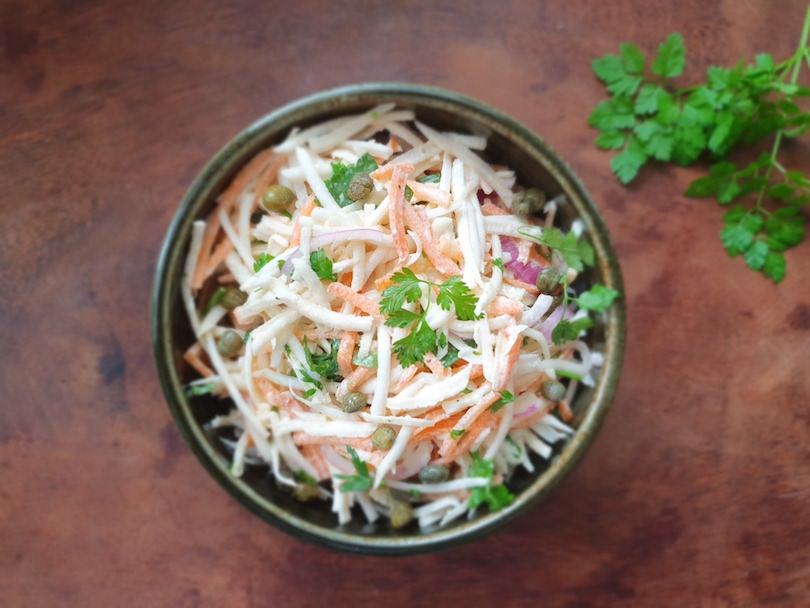
Daikon Remoulade


I have bought some daikon (white radish) with a plan to make a Japanese daikon salad or pickles. Once julienned, the daikon reminded me of celeriac… Since the only way I have celeriac is celeriac remoulade, I have decided to give a Japanese twist to this famous French classic. I have substituted the French mustard with wasabi paste and skipped pickled cucumbers which would make it too harsh. Otherwise I think the sauce still can pretend to the name “remoulade”. (See here the traditional Celeriac Remoulade recipe)

This version of remoulade is light, refreshing, with a hot wasabi kick and a slight crunch. Made with a Winter vegetable, but in a springtime spirit. Ideal for a sunny March day.

TIP: This salad can be made in advance (even the day before). Actually it tastes even better the following day.

Preparation: 25 minutes

Ingredients (serves 2):

200 – 250 g daikon (white radish), peeled and finely julienned or grated

2 tablespoons mayonnaise

2 tablespoons capers (drained and washed if they were preserved in salt)

1 tablespoon green onion, chopped (or (an)other fresh herb(s) of your choice)

1 teaspoon wasabi paste (or fresh grated wasabi if you are one of those lucky people who can get it)

salt

Put the daikon in a bowl.

Sprinkle with 1 tablespoon salt toss well and let it stand for about 15 minutes.

Wash the daikon with very cold water and drain it well.

Put in a big bowl.

Combine all the remaining ingredients and then stir them into the grated daikon.

Adjust the seasoning and serve.

Korean Stir-Fried Squid with Cabbage and Carrot

koreansquidpThe successful experiment in simmering daikon with squid (click here to see the recipe) reminded me how much I love squid and made me look for new squid dishes. If I hadn’t seen this recipe in The Food and Cooking of Korea by Young Jin Song, I would have never even dreamt of stir-frying white cabbage and even less combining it with squid. Therefore, I treated it as a high-risk experiment, but the result was stunningly good. Actually it was so good that I prepared this dish three times last week!  The cabbage was refreshing, slightly crunchy, while the squid was soft and soaked with my beloved and typically Korean sweet and hot flavours. Since the cabbage, a Winter vegetable par excellence, is treated here in a definitely springtime or summertime way, I found this dish a perfect choice for a between-the-seasons meal.

I have slightly modified the recipe skipping the chilies because the gochujang (Korean chili paste) and chili powder make it already quite hot. If you prefer very hot dishes, add 2 fresh chopped chilies to the first frying step.

TIP: You can prepare this dish in advance and serve it… cold. It is delicious served as a cold salad.

Preparation: 20 minutes

Ingredients (serves two):

2 fresh or thawed, cleaned medium squids (mine were about 15 cm long, excluding the tentacles) 

1 medium white onion, chopped or sliced

2 cabbage leaves, cubed (without the central thick vein)

1 big carrot, julienned 

2 flat tablespoons Korean chili powder

1 garlic clove, crushed or grated

2 tablespoons sake

1 tablespoon gochujang (Korean chili paste)

1 tablespoon maple or agave syrup

1 teaspoon sesame oil

(soy sauce or salt to taste)

1 teaspoon (or more) sesame seeds

2 tablespoons oil

Cut off the squid fins and put them aside.

Cut the squid tube lengthwise in order to obtain one flat sheet.

Score it diagonally into a criss-cross pattern (the interior side) and then cut it into 2 cm strips.

Do the same with the fins.

Cut the tentacles into bite-sized pieces.

Heat the oil in a pan and stir-fry the cabbage, the carrot and the onion for about 2 minutes.

Add the squid and the chili powder and fry them, stirring for another 2 minutes.

Finally add the gochujang, the garlic, the sake, the syrup and the sesame oil. Season with soy sauce or salt to taste. Stir-fry until the squid is cooked (about 3-5 minutes). Each strip should be white (whiter than the raw squid) and curled.

Sprinkle with sesame seeds and serve.

Warm Lentil Salad (Salade Tiède aux Lentilles)

Last week, while preparing the Friday Far Breton post, my old recipe book reminded me I used to cook French much more often at the time I discovered this pudding. Leafing through the stained pages I stumbled upon the Warm Lentil Salad, my beloved lentil dish I haven’t had for ages. I still remember the first time I tasted this salad, in a traditional French restaurant and was very surprised by the enthusiasm of the friend I lunched with. When her salad finally arrived and I tasted it, I instantly regretted having taken a different starter. It was a simple, typically bistrot style preparation of warm lentils and vinaigrette, but the taste was astonishing.

The Warm Lentil Salad  is usually served as a starter (at home I prefer it as a side dish), sometimes alone, sometimes sprinkled with fried bacon and sometimes with foie gras terrine. You might be surprised by the latter version, but actually the humble lentil is an ideal company for foie gras and if you ever go to France, this pairing is quite frequent in Lyon restaurants. Even served alone the salad is certainly hearty and filling, but probably thanks to the vinaigratte it feels much lighter than any lentil dish I know.

TIPS: This salad can be made with freshly cooked lentils,  but it’s also a very good way to use leftovers, warm them in the microwave and then combine with the vinaigrette sauce. The lentils can also be cooked the day before and warmed just before being served with the vinaigrette.

Preparation: 40- 50 minutes depending on the lentils

Ingredients (serves two – three):

250 g firm, dark green or brown lentils (the best here are the French lentilles de Puy) or 500 g cooked lentils (in this case skip the stock, bay leaf and thyme)

1 liter chicken or vegetable stock

1 bay leaf

1 heaped teaspoon thyme

Vinaigrette:

2 tablespoons olive oil

4 tablespoons vinegar (or more)

1 tablespoon French mustard

salt, pepper

Cook the lentils in the stock with bay leaf and thyme. When they are soft, but not mushy, drain them.

Put the warm lentils in a big bowl and combine with the vinaigrette. Taste and adjust the taste.

Serve immediately as a starter or a side dish.


Mak Kimchi, or Easy Kimchi

makkimchip

Some of you probably remember Cubed Radish Kimchi (Kkakdugi 깍두기) I have written about a couple of weeks ago. This famous dish was easy, absolutely delicious and made me seriously hooked on the magic world of Korean fermentation. The Mak Kimchi you see above is another flavoursome experiment and certainly not the last one in my kimchi adventures.

For those who have never heard of kimchi, a quick reminder of what I have written in December. Kimchi (김치) is a preparation of fermented vegetables with dried chili peppers and other seasonings and has a very long history. According to Wikipedia the oldest references to kimchi go back as far as 3000 years ago. Koreans didn’t know chili peppers until the XVIth century, so the beautiful red colour and fiery taste are quite recent. (In fact, there exists also a “white” kimchi version, without chili, originating from the Northern Korea. ) Apart from the chili, garlic, ginger and scallions are the most frequent ingredients of the most popular, fiery kimchi. It also always contains a fermentation “enhancer” such as fish sauce, raw shrimp, raw oysters or fermented fish.

Kimchi has a very powerful smell, but once you taste it and love it, the smell will never be associated with anything unpleasant. It is spicy, hot, sour and, like most fermented vegetables, very healthy. High in fiber, low in calories and fat, it is packed with vitamin C (thanks to the fermentation) and carotene. It also contains several other vitamins, helps digestion, is said to prevent certain cancers… In short: it’s a wonder food. Its importance in the Korean cuisine cannot be compared to anything in any European food culture I know. Apart from being served as a side dish, kimchi is used in fried rice, stew and soups. The only Korean cookery book I have contains a whole chapter dedicated to kimchi and many Korean families have special kimchi refrigerators.

Chinese (Napa) Cabbage is the most popular kimchi vegetable and the most versatile, since it is  often added to hot dishes (fried rice, soups, noodles). I have once tried making it, but it was very disappointing and the procedure was more complicated than in the case of Radish Kimchi. I thought I would never make cabbage kimchi again, but thanks to Shu Han (from Mummy, I can cook!) I have discovered the existence of  “mak kimchi”, meaning “easy kimchi” in Korean. While the classical cabbage kimchi (poggi kimchi) consists in seasoning and fermenting halved cabbages, mak kimchi is cut into small pieces before the fermentation process. This small step makes the seasonings’ distribution easier and accelerates the preparation process.

I have slightly modified Shu Han’s recipe, mainly changing the ingredients’ amounts and omitting the carrot I simply didn’t have.  Nevertheless my three days old mak kimchi is already incredibly good, but since I prefer it more “mature” and stronger, it will be more to my taste in a a week’s time or so. Thank you, Shu Han for giving me this wonderful idea and for the easy, foolproof recipe! (Click here to see Shu Han’s original recipe with making-of photos.)

TIP: Wear gloves if you manipulate kimchi with your hands (apart from the smelly side there is lots of chili in it)

Preparation: 1 hour + minimum 2 days

Ingredients:

1 small Chinese (Napa) cabbage (500 g)

about 4 tablespoons coarse salt

2 heaped tablespoons Korean chili powder

1 tablespoon sugar (or 1/3 grated pear)

1/2 teaspoon grated fresh ginger

2 scallions stalks, cut into 2 cm pieces

1 garlic clove, grated

2  tablespoons fish sauce

2 flat tablespoons sweet (glutinous) rice flour

50 ml water

(1 small carrot, grated or julienned)

Prepare the rice paste combining the rice flour with about 50 ml water. Let the mixture simmer until it thickens.

Put aside.

Cut up the cabbage into 3 cm more or less square pieces.

Sprinkle it with salt and leave for at least two hours. The cabbage will soften and let release some water.

Drain the cabbage and wash it.

Put it into a big container (with a lid) and combine well with the remaining ingredients and the rice paste.

Taste and if you think it’s not salty enough, add some fish sauce. (It should be only a bit too salty).

Cover with the lid, press with your hands (wear gloves!) to remove the air from the cabbage and leave for 2 days to ferment in room temperature.

Put into the fridge after two days. In general it gets stronger and more acid every day.

You can refrigerate it only to make it cold and eat it straight away or you can wait several days or weeks to see how the flavours change and at which stage you prefer it.

You can keep mak kimchi in the fridge for several weeks. It is excellent added to rice dishes and soups (I hope posting some recipes very soon).


Avocado and Walnut Salad

Happy New Year to everyone! I hope you have spent lovely holidays and a wonderful New Year’s Eve. I also hope you haven’t exaggerated with rich festive food and drinks, but if you did, switching to healthy and simple recipes might help you recover from the recent indulgences or at least make you feel better.

The avocado and walnut combination is a recent discovery, inspired by Shizuoka Gourmet’s blog, and to be precise, by his creative wife’s bentos. Her avocado, mayonnaise and walnuts salad looked appetising, simple and proved a very interesting combination of flavours and textures. Apart from the obvious crunchy texture, walnuts provide a slight bitterness, which counterbalances the mellow avocado taste. The cucumber I have decided to add lightened the dish without modifying the flavours. Apart from the wonderful flavour, this salad is packed with blood pressure-lowering potassium, anti-oxidants, has a high fiber content, vitamins and even though it does contain a dash of mayonnaise, it is a very pleasant change from the heavy dishes I have recently exaggerated with. In short, this simple salad is a delicious and healthy side-dish, ideal for this time of the year. Robert-Gilles, please thank your wife for one more culinary inspiration.

Before I pass to the recipe I would love to say how proud and happy I was to learn Ping from Ping’s Pickings has tested my simple Last Minute Crackers recipe, making gorgeous star- and tree – shaped crackers. Click here to see how wonderfully she used up her puff pastry cuttings. Thank you, Ping, for this New Year’s gift!

Preparation: 10 minutes

Ingredients (serves two as a side-dish):

1 avocado

10 cm fresh cucumber

5 walnut kernels (+more 2-3 for decoration)

1 tablespoon mayonnaise

Tabasco

Worcestershire sauce

salt, pepper

Cut up the avocado and the cucumber into bite-sized pieces.

Chop up the walnuts.

Mix the mayonnaise, Tabasco, Worcestershire sauce, salt and pepper

Combine the sauce with the walnuts, cucumber and avocado.

Serve chilled.


Kkakdugi (깍두기), or Cubed Radish Kimchi

daikonkimchip

Seeing radish kimchi at Hyosun Ro’s Eating and Living and then at Hiroyuki’s Blog on Japanese Cooking I felt it was high time I embarked on a fermenting adventure. Kimchi (김치) is the real monument of the Korean cuisine. It is a preparation of fermented vegetables – most often Napa/Chinese cabbage or white radish – with dried chili peppers and other seasonings. Kimchi is certainly one of the oldest dishes in the world, since (according to Wikipedia) the oldest references to it go back as far as 3000 years ago. Koreans didn’t know chili peppers until the XVIth century, so the beautiful red colour and fiery taste are quite recent. (In fact, there exists also a “white” kimchi version, without chili, originary from the Northern Korea. ) Apart from the chili, garlic, ginger and scallions are the most frequent ingredients of the most popular, fiery kimchi. It also always contains a fermentation “enhancer” such as fish sauce, raw shrimp, raw oysters or fermented fish.

To those who haven’t tasted it, kimchi might not sound particularly appealing, especially given its powerful smell. For me well-made kimchi is a pure delight. It is spicy, hot, sour and, like most fermented vegetables, very healthy. High in fiber, low in calories and fat, it is packed with vitamin C (thanks to the fermentation) and carotene. It also contains several other vitamins, helps digestion, is said to prevent certain cancers… In short: it’s a wonder food. Its importance in the Korean cuisine cannot be compared to anything in any European food culture I know. Apart from being served as a side dish, kimchi is used in fried rice, stew and soups. The only Korean cookery book I have contains a whole chapter dedicated to kimchi and many Korean families have special kimchi refrigerators.

I first tasted kimchi a couple of years ago in a Korean restaurant, then at my Korean neighbours’ house (the latter was of course beyond compare) and then tried making my own. The preparation was easy, but I was disappointed with the result. This experience has put me off making kimchi for two years. Last week, however, I decided I had to make at least one more attempt. I happened to have almost all the required ingredients from Hyosun Ro’s recipe, so I have followed closely her instructions and I can proudly say my kimchi is quite palatable. I panicked a little when after two days’ fermentation my kimchi was very bitter, but, strangely, leaving it to ferment for one more day resolved the problem! Thank you, Hyosun Ro, for this easy and efficient recipe! I feel now ready to carry on further kimchi experiments.

TIPS: Hyosun Ro’s recipe calls for raw shrimp as the fermentation enhancer, but since I can only get frozen shrimp, I thought it would be safer to replace it with additional fish sauce. The below recipe is adapted to my small batch (I was worried to make a bigger one for the first time), so if you want to see the original go to Eating and Living blog.

Wear gloves if you manipulate kimchi with your hands (apart from the smelly side there is lots of chili in it)

If you taste your kimchi and it seems very bitter, leave it to ferment for additional 24 hours. I did it and miraculously the bitterness disappeared!

Preparation: 1 hour + min. 2 days, but 2 weeks are optimal; the kimchi you see above was one week old and improved every day

Ingredients (I adapted the ingredients to my very small “test” batch):

500 g white radish (daikon) cut into cubes

3 heaped tablespoons Korean dried chili (my kimchi wasn’t very hot, just hot)

1 flat teaspoon grated or crushed garlic

1/2 flat teaspoon grated fresh ginger

chopped scallions (I used European chives instead)

salt (I used about 3 tablespoons)

1/2 teaspoon glutinous rice flour

4 tablespoons fish sauce or (as advised by Hyosun Ro):

2 tablespoons finely minced saeujeot (salted shrimp)

1 tablespoon fish sauce
1 raw shrimp (ground)

Prepare the rice paste combining the rice flour with about 20 ml water. Let the mixture simmer until it thickens.

Sprinkle the radish cubes with salt and leave them for 30-40 minutes. They will soften and let release some water.

Drain them, but do not wash.

Put the radishes into a big container (with a lid) and combine well with the remaining ingredients.

Taste and if you think it’s not salty enough, add some fish sauce (Hyosun Ro says it should be just a bit too salty).

Cover with the lid, press with your hands (wear gloves!) to remove the air from between the radish cubes and leave for 2 days to ferment in room temperature.

Put into the fridge after two days or more. Mine tasted better (and lost its bitterness) after the third day of fermentation at room temperature. In general it gets stronger and more acid every day.

You can refrigerate it only to make it cold and eat it straight away or you can wait several days or weeks to see how the flavours change and at which stage you prefer it (Hyosun Ro says it requires two weeks to develop the best flavours).

You can keep kimchi in the fridge for several weeks.


Southern German Potato Salad

Most people have probably heard about the famous German potato salad, but few know what really makes it different from other salads. I have heard about it already a long time ago, but, as in the case of many vaguely known dishes, I didn’t feel like doing it until I saw it at a friendly food blog. When Kiki (from Fraeulein Trudes Kochversuche) posted her Southern German style potato salad, I quickly understood why it was so special. First of all, contrary to most potato salads, this one doesn’t contain an ounce of mayonnaise or any thick, fat similar sauce. It almost “swims” in a light, well seasoned stock. Moreover, it’s served warm and, as I learnt later, its cold version isn’t even half as good. Last, but not least, the taste is terrific!

The amounts of certain ingredients and adding raw onion were the only things I modified in Kiki’s recipe (see the original here). I have also added Maggi sauce, but I don’t consider it as a change since this is the way apparently Kiki’s father does. Maggi brings back my childhood memories and usually goes well with marjoram, so I am very happy to use it from time to time. I think it fitted very well this salad, but it’s absolutely not an obligatory ingredient. With or without without Maggi, this dish has an original, complex flavour and is surprisingly light  (in spite of the bacon). Thank you, Kiki, for this unusual and delightful recipe!

TIP: Do not use instant stock. It is too important in the overall taste of the salad.

When the salad gets cold, you can microwave it (it’s not as good as freshly made though).

Preparation: 40 minutes

Ingredients (serves 3):

about 1 kg potatoes (firm after being cooked)

3 tablespoons finely chopped smoked bacon

Sauce:

1/3 cup thick, rich home-made stock (Kiki advises beef stock, but I have used chicken stock since I had a big batch in the fridge)
2 tablespoons white wine vinegar 
2 tablespoons canola oil or another neutral tasting oil 

1 teaspoon mustard
1/2 teaspoon sugar
1 small onion (finely chopped)

1 teaspoon dried marjoram

salt (depends how salty your stock is; mine was almost without salt, so I used 1/2 teaspoon salt)

1/3 teaspoon ground black pepper

(1 tablespoon Maggi sauce)

Wash the potatoes and cook them whole until they are slightly soft (they cannot be too soft, otherwise they will fall into pieces in the salad).

When the potatoes are still hot, but you can manipulate them, peel them and cut into big chunks (I have cut them into slices and the halved them).

Put the potatoes in a bowl.

Combine the sauce ingredients and heat them until it is hot (do not boil).

Pour half of the sauce over the potatoes, give the salad a delicate stir.

In the meantime fry the bacon.

Pour the remaining sauce over the potatoes and sprinkle them with bacon.

Serve warm.


Layered Herring Salad

I have been meaning to post this recipe a long time ago, but no matter what I did this dish always looked unappetising. Finally I started to think it was a part of its charm, visible only to an adventurous gourmet’s or a herring fan’s eyes. My cousin had discovered it at a party where this salad was the only item no one wanted to touch. As a daring gourmet, she took a generous portion, urged by the hostess, who told her that as soon as one of the skeptical guests tasted it, it would disappear in no time at all. She was right and I’m happy my cousin asked for the recipe. Otherwise, I wouldn’t have discovered the most irresistible herring salad which has been my favourite for almost ten years. If you like herring, you will find yourself unable to stop eating it. If you are a beetroot hater, you must absolutely taste it anyway (I know people who hate beetroot but love this salad). If you are Mr. Three-Cookies (from the Three-Cookies blog), I bet you will adore it! (For those who don’t know the Three-Cookies blog, its author is a big herring – and of course cookies – connoisseur and if I eat more of this fish this year, it’s certainly thanks to his inventive and frequent herring dishes.)

This complete-meal salad calls for soused herring (thank you Charles), labeled “matjes”/”maatjes”/”matjas” and sometimes simply “herring in oil”. Since apparently matjes can in some countries mean herring without oil (thank you, Mr. Three-Cookies), I thought the best advice would be to say the herring used here shouldn’t be very sour. All the ingredients are perfect paired with herrings and the layering isn’t only for decoration. The order of layers is not accidental either. Onions must absolutely touch the herring, since their flavours merge when you put the salad in the fridge (several hours are obligatory!). Potatoes have a neutral taste, so they don’t disrupt the onion and herring combination. Eggs come just under the mayonnaise (how could I possible separate eggs from mayonnaise?) and the beetroot brings a nice, sweetish, refreshing touch in the middle.

I will be honest: the more mayonnaise you put on top, the better the salad will be. On the other hand, if you want to make this lighter, you can mix the mayonnaise with some yogurt or sour cream, but the taste will be slightly “thinner”. The ingredients’ amounts are totally up to you, as long as no layer is skipped. The original recipe calls for grated eggs, but I have discovered chopping them finely creates the same taste result, so I stopped the arduous process of egg grating.

I would have almost forgotten to mention this salad is an excellent hangover soother.

If you have difficulties with finding pickled herring, look for Russian or Polish grocers. They will certainly carry both vinegared and “matjes” herrings.

If you look for an easier, but delicious herring salad, try my Herring and Potato Salad.

Preparation: 1 hour + at least 5 hours in the fridge (but it’s best left overnight)

Ingredients (serves 4 or 6 as a main dish):

250 g drained “matjes” (soused) herring

2 medium onions

4 big potatoes

2 big beetroots

4 – 5 eggs

10 heaped tablespoons mayonnaise (or more), or a mixture of mayonnaise + sour cream/yogurt (don’t use low-fat yogurt)

salt

pepper

Cook the potatoes, the beetroots and the eggs.

Let them cool down.

Cut the herring into bite-sized pieces and place at the bottom of a big salad dish.

Chop the onion and sprinkle over the herring.

Peel the potatoes and grate them over the onions.

Season generously with salt and pepper.

Peel the beetroots and grate them over the potatoes.

Chop the eggs finely and sprinkle over the beetroot layer.

Season with salt and pepper and cover with mayonnaise.

Cover the bowl with cling film and put into the fridge for at least 5 hours, but the best results are after a night in the fridge.

Green, Unripe Tomato Salad

October seems to be the best moment to look for (or ask for) green tomatoes, at least on my market. I don’t talk about the always-green variety which is very sweet and often striped (I think it’s called sometimes “zebra”). What I mean are completely unripe tomatoes. They are acid, already have a pleasant aroma, but their flavour is still very shy. I started to preserve green tomatoes a couple of years ago when I realised how cheap they were (farmers prefer probably to get rid of the unripe tomatoes very quickly and sell them for almost nothing) and when I decided to recreate the green tomato salad I used to like as a child. Since I didn’t know anyone who did it at home, I looked for recipes on internet and modifying them throughout the years, adding carrots and peppers, I have adapted them to my own taste.

Green tomato salad is very easy to make and its flavour is surprisingly delicate, compared to other vinegared preserves. It never fails to impress those who taste it for the first time, since most people expect it very sour and harsh. The onions make the vinegar brine mellower, the carrots give a crunchy side and together with the peppers, they make the jars look merrier. If you remember the Moomins’ Cucumber Salad, the process of making this one is very similar. As you see on the photo above, green tomatoes quickly become yellowish, but both carrots and red peppers keep their bright colours.

This salad is a great side dish and an excellent alternative to cucumbers, tomatoes and lettuce in sandwiches. It is best when served chilled.

Preparation: about 1 hour + hot water bath or another processing method

Ingredients:

1 1/2 kg green tomatoes

2 big carrots

2 big red bell peppers

300 g onions

1 liter vinegar 4,5%

600 ml water

200 g sugar

4 tablespoons salt

2 tablespoons mustard grains

2 tablespoons pepper corns

2-3 bay leaves

Slice the tomatoes and the onions.

Cut the red peppers in thin strips.

Slice the carrots finely (the best would be to use a mandolin).

Put the vinegar, the water, the sugar and the salt in a pan. Bring to boil and let it on medium heat for 10 minutes.

Pack the vegetables tightly in jars, distributing evenly the pepper corns, the mustard grains and the bits of bay leaves.

Fill the jars until about 80% of the jars’ height.

Pour the hot (not boiling) vinegar mixture over the vegetables, leaving about 2,5 cm space below the lid.

Cover with lids and let the jars cool. (You can leave them overnight).

/At this point you can (after the jars have cooled down)  either keep them in the fridge for a couple of weeks or process as described below and store in your pantry for at least a year!/

Leave the jars to cool.

Place the cool jars into a big pan, bottom lined with an old kitchen towel folded in two (this will prevent the jars from breaking), cover up with hot – but not boiling- water to the level just below the lid. Bring to boil and keep on a very low heat, in simmering water, for around 20 minutes.

Stick on self-adhesive labels, write the name of the salad and don’t forget to mark the date.

NOTE: For the readers who live in the USA, the USDA-approved canning method is different. You can find it described here: http://www.uga.edu/nchfp/publications/uga/using_bw_canners.html.

Green Tomato Pickled Salad on Punk Domestics

Mixed Salad with a Fried Egg, or Salade composée

This is one of the dishes I have been preparing for ages and would have never thought of posting about if it hadn’t been for the fact that not a single one of my friends or family members makes it. A couple of days ago the Tandoori-Style Salad on Baking Devils’s blog has reminded me I have been planning this post for some time and that warm September days are probably still a good period to write about a nourishing, but light salad.

“Salade composée”  (mixed salad) is not something you will find in standard French cookery books. You also have slim chances of being served it in a French house and in most French restaurants. I first tasted it when a friend took me for lunch in Paris announcing we would go to a very cheap restaurant serving most extraordinary salads. The restaurant was cheap indeed, it served only salads (all based on lettuce), each of them looked very exotic to me for one reason: they all had a fried egg or/and other warm ingredients served on top and were really huge. Since then I have noticed only some cheap, quick, small restaurants serve this kind of salads and you don’t find them in every French city. The only exception is Lyon. “Salade lyonnaise” is very similar (it contains bacon, green leaves, croûtons and poached eggs), but I have already seen it served there with boiled eggs or without eggs.

One day I decided to prepare my own “salade composée” and since then I have prepared hundreds of them, every time different, but every time with two permanent items: lettuce (or other green leaves) and a fried egg. It is healthy, quick, easy and could be called “put-whatever-you-want” salad (but, please, don’t skip the fried egg!). Technically this salad is great fun to eat. First, you serve it in a big bowl, which usually contains the green salad for the whole family. Secondly, everyone has his or her own method and order of eating it. Some start by combining everything with the dressing, others leave the fried egg for the end and have it soaked in the dressing. When served for the first time, people always wonder where to start, which is quite amusing to observe. I always eat a bit of the salad and then break the liquid egg yolk, so that it blends with the salad ingredients and the vinaigrette sauce…

This salad is great for a weekend brunch, lunch and dinner. Apart from the fried egg I also like putting some other warm ingredients, like grilled bacon/sirloin/chorizo or cheese cubes. If you are vegetarian, skip the ham/bacon and put some cheese or tofu for extra proteins (check the Tandoori marinated tofu on Baking Devils, it really sounds amazing). It can be served simply with good bread, but goat cheese toasts are perfect too.

Preparation: 15 minutes

Ingredients (serves one):

5 – 7 iceberg or other salad leaves

1 big tomato (I used 5 mini San Marzano tomatoes)

several cucumber slices

1 big slice of ham/grilled sirloin or bacon or any other cold meat (I used smoked and grilled sirloin)

1 egg (or two if you feel very hungry!)

Vinaigrette with mustard:

1 tablespoon olive oil

1 heaped teaspoon mustard

3 tablespoons vinegar of your choice (balsamico tastes great here, but I often use rice vinegar)

(chopped chives or other herbs)

salt and pepper

Take a big bowl (for example with 20 cm diameter).

Tear the salad leaves, cut the tomato into pieces, slice the cucumber.

Cut the ham or sirloin into bite-sized pieces.

Arrange the salad, the tomato, the cucumber and the ham in the bowl.

Prepare the salad dressing and pour it over the salad.

Heat a pan and fry an egg.

Put the egg on the top of the salad, sprinkle some salt and pepper over it and, if you have, chopped herbs.

Serve with bread or toast.

Moomins’ Cucumber Salad

Moomins, aka Moomin trolls, are chubby characters invented by the Finnish-Swedish writer Tove Janssen who depicted their adventures in a series of sparingly illustrated books I used to devour in my early teens. The books were originally written in Swedish and then became famous all around the world, in as different countries as Germany and Japan, where they were extremely popular. I remember I immensely enjoyed finding myself plunged in the peaceful, simple Moomin world, where everyone was kind and even the scariest characters end up being nice… I got really addicted to Moomins when, in the 90s, the tv started to broadcast a full-coloured Japanese Moomin cartoon. Here is the English theme song, just to give you an idea of what Moomins’ world looks like:

Afterwards I learnt that several different cartoons had been produced not only in Japan, and some as early as in the 60s! I have to confess even as an adult I feel nostalgic about Moomins. Once, I have even given CG from Cooking Gallery an idea to put them into one of her extraordinary charaben (character bento boxes). Imagine my joy when I saw she actually made perfect, beautiful, edible Moomin family! Click here to see what I of course consider as the most beautiful of CG’s bento boxes.

Moomins’ adventures haven’t been developped for years, so imagine my emotion when I learnt the existence of the Moomins Cookbook! Luckily, it has already been translated into English, otherwise I would certainly order it in Swedish (or Finnish) and would insist on reading it with a dictionary in one hand! As its title suggests (Moomins Coookbook. An Introduction to Finnish Cuisine), this illustrated book contains Finnish recipes. However, I must admit I haven’t ordered it with intention of its practical use, but merely to purchase a new Moomin item.

Imagine how excited I was to discover there not only an ideal way to pickle the cucumbers I was offered at the farmers’ market, but to realise that the result went far beyond what I had hoped for. The salad is extremely flavoursome, it can be served as a side dish or drained and put into sandwiches and I recommend it to everyone, not only Moomins’ fans. However, I admit that labeling the jars as “Moomins’ Salad” is a particularly thrilling experience for someone who feels nostalgic for these chubby characters.

The recipe calls for sliced gherkins, but long cucumbers were a perfect substitute. I have only slightly modified it, mainly reducing the sugar content, so if you prefer sweeter pickles, add 320 g sugar. I didn’t have fresh black currant leaves, have put dried ones instead, but I think they don’t change the taste at all, so I shall skip them next time. The salad tastes lovely without them too!

(This salad can of course be made as a short-term pickle and kept in the fridge. It is ready after a couple of days.)

Preparation: 1 hour + hot water bath processing (or another method)

Ingredients (I have obtained 5 x 400 ml jars):

1 kg gherkins or cucumbers

1 big carrot

1 tablespoon allspice berries

1 tablespoon peppercorns

1 tablespoon mustard seeds

(1 tablespoon cloves which I have skipped, since I am not a big fan of cloves in pickles)

4 garlic cloves (peeled and cut in two)

(1 tablespoon grated horseradish, which is optional in the recipe and which I didn’t have)

dill flowers, stems (dried or fresh) or seeds

(blackcurrant leaves (I used dried, but they don’t really change the taste so either use fresh ones or skip them))

1 liter wine or cider vinegar (4,5%)

200 g sugar

3 tablespoons salt

Wash and scrub the gherkins. If using big long cucumbers you can peel them if the skin is very tough or only one row in two (as I did) or not at all (the pickles will be crunchier). Slice the cucumbers or gherkins finely with a knife or with a mandolin.

Peel the carrot and slice it finely too.

Pack the sliced vegetables tightly into the jars, distributing the spices and garlic evenly between the layers (one garlic clove for one jar). Finish the layering at the 3/4 of the jars’ height.

Combine the vinegar, the salt and the sugar. Bring to boil, stirring.

Pour the hot vinegar into the jars (leave 1,5 cm under the rim) and close them.

/At this point you can (after the jars have cooled down)  either keep them in the fridge for a couple of weeks or process as described below and store in your pantry for at least a year!/

Leave the jars to cool.

Place the cool jars into a big pan, bottom lined with an old kitchen towel folded in two (this will prevent the jars from breaking), cover up with hot – but not boiling- water to the level just below the lid. Bring to boil and keep on a very low heat, in simmering water, for around 20 minutes.

Stick on self-adhesive labels, write the name of the salad and don’t forget to mark the date.

NOTE: For the readers who live in the USA, the USDA-approved canning method is different. You can find it described here: http://www.uga.edu/nchfp/publications/uga/using_bw_canners.html.

Moomins' Cucumber Salad on Punk Domestics

Pickled Herring and Potato Salad

herringsaladp

Together with vinegared herring, lightly cured herring plays a big role in Northern European, German and Slavic countries and is also often associated with the Jewish cuisine. People who didn’t grow up in these cultures may be put off at first by the cured herring’s strong smell and taste, but they usually end up in succumbing to its addictive, complex flavour and mellow, meaty texture. While the vinegared herring is usually served on its own, in different sauces, the lightly cured herring is also often found in salads and this is the way I prefer it.

Herring has been preserved in brine since the Middle Ages, but the salt concentration was so high, the fish had to be desalted bo soaking before it was consumed. In the XIIIth century the Dutch have improved this process creating a light brining technique, which doesn’t require desalting. “Maatjesharing”, often called “maatjes” is an example of this curing technique and is now readily available in many European countries, usually sold covered in oil.

I love cured herring, but usually crave it on cold days. However, watching the infinite variety of herring dishes on Three-Cookies blog, I simply couldn’t resist the temptation to make a herring salad in spite of the hot weather. Thus, I have discovered that a herring and potato salad is a very refreshing dish, well adapted to sunny Summer weather. This salad is probably the oldest and the simplest one I have ever made. I have been preparing it since I was a teenager and whenever I want a simple herring dish, it is the first thing I think of. The reason is simple: potatoes, onions and mayonnaise are simply the winning company for cured herring. I usually have this salad as a main dish with bread (black bread is particularly advised here!), but it can be also a starter, in which case it serves 6. I often combine it with brine-pickled (fermented) cucumbers (see the TIP below).

If you want to see myriads of herring cold and hot dishes ideas, visit either Three-Cookies (a great day-by-day read) or Easily Good Eats (a collection of recipes), both blogs by the same author, a real herring connoisseur, who I hope, will decide one day to write a herring cookery book. (I am already queueing up for a signed copy!).

Just before the recipe details I would like to share with you this funny and scary fragment of a Japanese cartoon, featuring not the herring but a very courageous potato:

TIP: As you might have noticed on the photo, I have added some brine pickled cucumbers (also known as “fermented cucumbers”). They are not obligatory but their sour taste goes perfectly well with this salad. You can find them in Central and Eastern European grocery shops. In order to make sure you don’t buy vinegar-pickled cucumbers, make sure the water in the jar is slightly “muddy” and there is a whiteish sediment on the bottom. Sometimes they are also sold in plastic bags, in the refrigerated section. Then you know they are brine-pickled, not vinegared.

Preparation: 30 minutes + 2 – 3 hours chilling in the fridge

Ingredients (serves 3 as a main dish):

400 g  cured herrings in oil

1 medium onion

1 kg potatoes

(3 medium brine pickled cucumbers)

a couple of tablespoon mayonnaise

pepper, salt

Cook the potatoes, peel them and cut into bite-sized pieces.

Drain the herring, cut it into bite-sized pieces too.

Chop the onion.

Combine the herring, the warm potatoes, the mayonnaise, add salt, pepper, the onion and put into the fridge for at least 2 hours.

Tomato and Shiso Salad

Forget the basil, forget the chives, the mint or the parsley; shiso is undeniably the tomato’s best friend. Shiso (紫蘇) or perilla, a staple in the Japanese cuisine, has a herbaceous, slightly bitter flavour and a strong aroma. It is used as well in raw as in cooked dishes (see the Ume-Shiso Chicken Skewers). I took to shiso instantly and the more I use it the more I like it. Looking for some shiso use ideas I stumbled upon a wonderful inspiring blog called Humble Bean, where I found the Tomato and Shiso Salad and felt at once I would not be disappointed.

I was right. The salad was a revelation. It is falsely simple, yet proves sophisticated and complex, which for me is a perfect definition of the Japanese cuisine. The sweetness of the tomato, the bitterness of the shiso and the lively crunch of the onion are already an  ideal combination, but the delicate sauce makes it extraordinary. The salad is so addictive I served it two days in a row and I feel I could have it not only every day, but with every meal or even in between, as a light snack. The only modification was substituting the onion with a shallot (I ran out of onions). In theory the below amount serves two, but for me it makes only one portion for one shiso addict. Thank you, Azusa, for this marvellous discovery.

(A shiso leaf photo for those who are not familiar yet with this aromatic herb).

Preparation: 10 minutes

Ingredients (serves one):

1 chilled tomato

3 big shiso leaves

1/2 small onion (I used 1/2 shallot)

Sauce:

1/2 tablespoon soy sauce

1/2 teaspoon rice vinegar

1 teaspoon sesame oil

several turns of the freshly ground pepper

Remove the tomato stem and slice it.

Chop finely the onion and soak it for 5 minutes in cold water.

Do the same with shiso (in a separate bowl).

Combine the sauce ingredients.

Drain the onion and the shiso and pat dry.

Arrange the tomato slices in a bowl.

Sprinkle with the onion, then with shiso and drizzle the sauce over it.

Dry Tarator, or Bulgarian Dill Salad

I think I have already mentioned I am growing herbs on my balcony. Some grow easier, some less and some refuse to sprout. This year’s dill grains were very shy at the beginning, but now they grow like crazy reaching almost 50 cm height!. Finding a new, rich in dill recipe became vital! Something reminded me of a delicious dill salad I was served any years ago by a Bulgarian friend of mine and after a quick internet research I found the Angellove’s Cooking Bulgarian blog and there the dry tarator recipe.

Tarator is a famous Bulgarian cold soup made with yogurt, cucumbers and dill, while dry tarator, also called Snow White salad (Салата Снежанка), or yogurt salad (Млечна салата), is a thicker version of the soup, served as a salad. I have repared two versions of dry tarator: one with chopped cucumber and the other with grated cucumber. The latter was rather semi-dry, perfect as a dip or as a thick sauce (the above photo is my second, dip/sauce version). Both versions were excellent for the hot days we are having now in Switzerland. I think I’ll grow dill all year round only to be able to prepare it whenever I want.

Mina from Angellove’s Cooking advised me to add some water, if I wanted to obtain the tarator soup. I will certainly remember this advice on very hot Summer days. As usually I have modified a bit the original recipe (e.g. adding more dill since I really adore it and grating the cucumber since I wanted this to be a dip). This is the first Bulgarian recipe I have realised, but certainly not the last!

Preparation: 10 minutes

Ingredients:

400 ml drained yogurt (or not drained if using very thick yogurt)

3 tablespoons olive oil

5 tablespoons chopped dill (the recipe called for 2 tablespoons, but if I couldn’t stop myself from adding more)

1 tablespoon lemon juice

2 cloves garlic

a couple of tablespoons chopped/ground walnuts

1 long cucumber

2 teaspoons salt (or more)

(crunchy Chinese cabbage leaves or or other crunchy salad leaves)

Mix or grate the garlic (I mixed them with the dill in a food processor).

Either peel the cucumber and chop it finely or don’t peel it and grate it if you prefer this to be a dip/sauce.

Combine all the ingredients.

Taste the salad and add more salt if necessary.

Fill the crunchy salad leaves with dill salad or serve it in bowls.

Decorate with dill sprigs.

Celeriac Remoulade, or Céléri rémoulade

Raw, cooked or fried, the celeriac was high on my “hated vegetables” list since I was a child. When I started to cook, the only time it appeared in my kitchen was in a  home-made stock composition. Once the stock cooked, celeriac would end up in the bin. Observing some of my French  friends enjoying their ubiquitous céléri rémoulade I didn’t know at the time I began to be intrigued. It took me however a long long time to dare tasting this despised root, albeit disguised. Celeriac Remoulade was a real revelation and I am convinced it has a power to convert more than one celeriac hater. In fact, hardly a couple of days after I tasted it, I bought the first celeriac in my life with another intention than making stock.

I was of course lucky to have my first céléri rémoulade in a good restaurant and not in a school cafeteria or bought in a supermarket. In fact, most of what is labelled as “céléri rémoulade” is terrible (from what I’ve heard not only in France) or simply hasn’t got much in common with the original preparation. Remoulade Sauce means basically seasoned mayonnaise with herbs, gherkins and capers, and a good Celeriac Remoulade is so simple and undemanding, it is hard to believe how efficiently and frequently it is spoiled.

My slightly modified recipe comes from the French classic “Petit Larousse  de la cuisine“, but many different traditional versions exist. Some advice blanching celeriac after it’s grated, but I think this way it loses the wonderful fresh crunchy side. Some literally soak the celeriac in the sauce, but I prefer to keep it light, with hardly any sauce. Of course you can adjust the mayonnaise’s amount to your own taste. Celeriac Remoulade keeps very well in the fridge, up to a week (unless the mayonnaise is home-made). Definitely a very healthy and good change from a green salad, it is excellent with a pork roastcold cutsEgg and Bacon Pie, toasts, sandwiches…

Preparation: 10 minutes if using a food processor or more, if you grate the celeriac on a traditional grater

Ingredients (serves four as a side dish):

1 big celeriac (approx. 500 – 600g)

Remoulade sauce:

100 ml mayonnaise

10 flat tablespoons chopped fresh herbs (I usually put parsley and chives, but my recipe mentions also tarragon and chervil; other recipes enumerate borage among the remoulade herbs)

5 small finely chopped French gherkins (cornichons) or two big pickled cucumbers

5 tablespoons drained capers

salt, pepper

(French mustard)

(anchovy essence or 2 mixed anchovies)

Peel the celeriac and grate it very quickly on a vegetable grater (the bigger holes).

Combine it with the mayonnaise, the herbs, the gherkins, the capers and the anchovies if using. Season with salt and pepper.

Stir well and taste. If it seems a bit bland, add some mustard.

Serve preferably chilled (if all the ingredients are very cold, it can be served straight away).